Showing posts with label special needs program. Show all posts

Wednesday, July 11, 2012

TalkTools Straw #7

Straw #7 is the second to the last one in the TalkTools straw hierarchy kit. Matthew used this straw for 3 months, from April through June.


It must have been harder to drink with this straw as he didn't transition to this straw as easily as he did with the previous one. It seemed longer than coily straw #6. But as with the others in the straw hierarchy kit, he used the straw daily for most of his drinks, even at school. I sent one straw and cup to his preschool daily for him to use at snack time. He eventually warmed up to this straw and could drink a whole cup of orange juice, lemonade, or chocolate almond milk without any issues.

In the beginning of July, we started with straw #8. On straw #8, I noticed he regressed back to a pattern of suckling (straw resting on tongue when the tongue is too far forward then moves forward more, rather than back, when sucking on the straw) instead of sipping (using lips only). We went back to straw #7 for a day to see if we had moved on too quickly. He did just fine for the most part and easily corrected with verbal cues from me (as seen in the video). The speech therapist whom we work with in NACD suggested that we move on to straw #8 with more manual support and a tactile cue such as a lip block or medical tape 1/4-inch from the drinking tip.

Saturday, July 7, 2012

TalkTools Straw #6

It's hard to tell if straw #6 is shorter than straw #5. Because of its coils, straw #6 doesn't stick out of the cup as far as straw #5. Matthew had an easier time drinking from this straw mainly because he didn't need to hold the cup out as far.


I also ordered two extra #6 straws as back-ups to replace the ones with internal residue build-up. Matthew easily transitioned from the previous straw to this one as they were the same diameter. Like the previous straws, he used this straw for most of his drinks including chocolate almond milk, orange juice, apple juice, and water everyday. The straw was sent to his preschool as well for him to use at snack time.

I'm not sure if I had mentioned it in any of my previous TalkTools straw posts but Matthew is on straw therapy as recommended in his NACD program. So we also used the straw as part of a set of oral motor stimulating activities specified in his daily program.

Matthew started on straw #6 during the Christmas break. He could've moved on to straw #7 after a month but I kept him on this straw for almost 3 months because there was so much going on that I just kept forgetting to move him on to the next straw in the hierarchy. It didn't hurt to keep him on the straw longer anyway. The instructions only discouraged from moving on to the next straw within a few days, which would be too fast of a transition. As of April this year, he was on straw #7.

Monday, July 2, 2012

TalkTools Straw #5

Straw #5 was the same diameter as straw #4. However, straw #5 was a little longer than the previous straw and used without a lip block.


There was noticeably less reminding on my part to use lips only, no tongue protrusion, when drinking. I had ordered two extra #5 straws, anticipating Matthew to be on straw #5 for at least a couple months. Since he uses the straw for most, if not all, his drinks including water, orange juice, apple juice, and chocolate almond milk everyday, residue build-up in the straw was expected no matter how well it was rinsed through after every use. I also sent a straw to his preschool for him to drink with at snack time.

He was on straw #5 for almost 3 months. He "graduated" to straw #6 during the Christmas break.

Wednesday, December 7, 2011

TalkTools Straw #4

"Use your lips, not your tongue." That was what I'd say when we started with Straw #4 in the beginning of June. I doubt many parents have to give their children specific (and odd) instruction on how to drink with a straw.

Straw #4 is relatively a shorter straw and has a smaller diameter than straw #3. The smaller diameter makes straw #4 a challenge. In the beginning, I used a lip block (as shown in the photo) to control how much straw tip goes into Matthew's mouth.


The lip block, which was positioned 1/4-inch from the tip of the drinking tip, was essential as a tactile prompt to seal his lips around the straw. Without the lip block, he sometimes shifted to suckling or wrapping his tongue under the straw as his natural urge is to let a longer straw tip into his mouth. A longer length of straw in his mouth (more than 1/4-inch) makes it easier to suckle.

Without the lip block, verbal prompts or reminders "use your lips, not your tongue" and my fingers positioned 1/4-inch from the drinking tip were necessary to get a similar effect as having the lip block in place. Then I re-read the instructions and learned that I was supposed to cut the straw close enough to the first loop so that the loop served as a lip block. So I cut the straw and did away with the yellow rubber lip block.

After 4 months of using straw #4, I have noticed better and stronger lip closure. Along with this physical progress, I have noticed clearer articulation of single speech sounds. Stringing sounds together is still a work in progress though.

I don't doubt that the straws have been helping Matthew develop a stronger oral foundation for speech but his progress in speech is really a combination of the right amounts of speech therapy, reading sight words, oral stimulation techniques (including use of the TalkTools straw kit), and articulation practice. Other oral stimulation techniques include using a z-vibe and offering food that require a lot of chewing or brings more awareness to the mouth such as pickles, grilled chicken, grilled steak, fresh cut apples, lemon sorbet, and so on.

Since the end of September, he easily and successfully (no leaking) drank 4 ounces of milk or juice with straw #4 in one uninterrupted sitting and with less prompting. He has moved on to straw #5!

Thursday, June 16, 2011

TalkTools Straw #3

Ever since starting straw therapy with Matthew, I've been trying to offer drinks using his therapy straw only so he gets as much practice with it as possible.

Longer than straw #1 and straw #2, I was worried that Matthew would have a hard time drinking with it.

straw #3

I was wrong. Not the first time he has proven me wrong. He can get the juice or water from the cup all the way up the long straw into his mouth, which may not seem like a big deal for any typical person, but in my eyes, that's good "sucking" power! The lip block is set at 1/4-inch from the tip of the straw and it is a tactile prompt for Matthew to use his lips to suck from the straw instead of wrapping his tongue underneath it (suckling like a baby would with a bottle nipple).

When drinking, I always hold his cup anyway to keep the straw in place so the length wasn't an issue for him. And we still used the take 'n toss plastic cups even if the straw was more than double the height of the cup.

He was on straw #3 from mid-April to the end of May. Moving forward with straw #4!

Saturday, April 16, 2011

TalkTools Straw #2

We used straw #2 of the TalkTools Straw Hierarchy kit from the beginning of March to mid-April this year. Straw #2 is a curvy purple straw. I've seen this straw at Target in the party supply section and at a local party supply shop. So if we lost this straw or it broke, then it would be easy enough to replace.

The lip block on the straw is very effective at keeping just 1/4-inch of straw for Matthew to practice a proper lip seal around the straw instead of wrapping his tongue around it and suckling. Two lip blocks came with the TalkTools straw kit but I think they can also be bought individually from TalkTools or possibly from other online stores that sell therapy supplies for oral-motor activities.

Between this straw made of a harder plastic than straw #1 and the lip block, (and better supervision from me) Matthew had no opportunity to chew on this straw like he did with straw #1.

Either the take 'n toss cup with a straw lid or the sip tip cup generally seems to work. There is little risk of a little spill through the hole in the lid if the cup is tipped at an extreme angle since the straw is loose-fitting through the lid. It's usually not an issue though since I hold the cup and straw for Matthew.

The drink of choice: Motts for Tots apple juice. He prefers not to drink water or milk with this straw.

Here's a short video of Matthew using straw #2.


Related posts:
TalkTools Straw Hierarchy Kit
TalkTools Straw #1

Monday, April 11, 2011

TalkTools Straw #1

Straw #1
It's a blue straw with a duck that serves as a built-in lip block - to prevent too much of the straw to be in the mouth. Before starting, I trimmed the duck end of the straw to 3/4-inch, which was how much straw he usually had in his mouth when drinking from any straw.

He started with straw #1 after Christmas as part of his individualized NACD (National Association for Child Development) program. He was on it for 2 months. He would've been on it for much less time if I had been more consistent with it and if I didn't run into a problem.

The Dilemma
TalkTools straw#1
He bit the straw tip and flattened it. He did the same to the spare #1 straw in the kit. I tried to save the straws by re-rounding them. I was successful the first few times then the tips of the straws started cracking, making them unusable.

I cut off the duck and improvised with a makeshift lip block. But then I realized that cutting the length was probably not ideal. It made it easier for Matthew to drink with the shortened straw but it probably wasn't ideal for the objectives of straw therapy.
TalkTools

Moving On
After consulting with the speech therapist via our NACD coach, I got the green light to move on to the next straw. At that point, he was drinking with only 1/4-inch straw tip in his mouth, which meets one of the criteria for moving on to straw #2.

Straw #2 started at the beginning of March.

Related post:
TalkTools Straw Hierarchy Kit

Wednesday, April 6, 2011

TalkTools Straw Hierarchy Kit

Tongue protrusion and low muscle tone (also known as hypotonia) are common among individuals with Down syndrome. Is it because of an enlarged tongue? Is it because of hypotonia (low muscle tone)? Contrary to the belief that it is because of an enlarged tongue, I have come across some literature that low muscle tone leads to tongue protrusion. I mentioned this in my previous post "On Tongue Protrusion". The article "Tongue Protrusion" by Karen Henderson SLP, explains it and provides suggestions to promote tongue retraction. (The article is available as a .pdf file online. Google Tongue Protrusion Karen Henderson).

Hypotonia affects all the muscles in the body. The tongue is a muscle. We have mouth muscles that allow us to move our mouths, chew, and keep our mouths closed to keep our tongue in. Without hypotonia, our mouths are naturally closed when we're not talking or eating. With hypotonia, it seems that natural tendency is for the jaw to remain open and tongue thrust to occur.

The TalkTools Straw Kit is one of the tools to inhibit tongue thrust. The idea is to improve mouth and tongue tone through a hierarchy of drinking straws that encourage utilization of various targeted mouth/ tongue muscles.

There are 8 straws. Each straw is different in length, diameter, and form and intended to address certain areas of the tongue. The straws also promote lip closure.


I had considered finding similar straws at dollar stores instead of buying this kit. But it would be too troublesome and time-consuming for me. I also wouldn't have the instructions that come along with the kit.

I recently learned that when drinking out of any straw, even one not in the TalkTools straw kit, only about 1/4-inch of the straw should be in the mouth for proper lip closure and straw drinking. With a lot more than that in the mouth, Matthew starts to suckle the straw instead therefore not encouraging the right muscles to improve tone and promote lip closure.

Matthew started with the straw kit right after Christmas. We are about to move on to straw #3.

Keep in mind that there are many other ways to improve muscle tone and awareness. Chewing (chewy food) is one way to make the mouth muscles work and get that tongue moving around. I listed other tips in "On Tongue Protrusion".

Do you use the TalkTools straw kit? What has your experience been with it?

Related post:
On Tongue Protrusion

Wednesday, October 27, 2010

TalkTools Horn Kit

TalkTools Horn KitThe TalkTools horns kit is used by some speech therapists to help improve oral-motor tone and target skills such as lip rounding, lip closure and tongue retraction. The kit we have includes a set of 12 horns rated according to difficulty level. Each horn works on specific speech sounds and even drooling control.

We are on horn #3 and I started this program with Matthew when he was 30 months old. But it hasn't been easy keeping up with this. Sometimes Matthew just isn't in the mood for the horn so we skip it. He's more interested in blowing bubbles so I go with what motivates him more. For now, we're stuck on horn #3 (the orange horn in the above picture). At this point, it's hard to say if this has really helped with lip closure and tongue retraction or if the other activities we do help more.

Do you have the Talktools horn kit? What do you think? Has it helped or not?


Related post:
On Tongue Protrusion

Saturday, March 20, 2010

Transition Meeting

Transitioning from the Early Intervention (EI) program to the Early Childhood Special Education (ECSE) can be an overwhelming experience for a first-timer like myself. But I found ways to make the process less daunting. We had the 6-month IFSP review last week and the transition meeting yesterday. In our state and our school district, the transition meeting was scheduled separately from the final 6-month IFSP review. Overall, both meetings went very well.

Preparing for the Transition Meeting
1. Attend workshops - I attended workshops such as "Your First IEP" at the 2010 Down Syndrome Conference and "Next Steps" at the local Disability Fair. These workshops gave me a chance to listen and talk to other parents about their experiences with the transition process. I picked up great information and tips at these workshops. It was at one of these workshops that I learned about a good resource called "Transition from Early Intervention". There are also helpful workshops such as "IDEA Part C to B" and "Understanding the IEP Process", both of which I was not able to attend.

2. Prepare a Developmental Achievement Chart - This document lists Matthew's can-do's and things he needed to work on in all areas of development (communication skills, fine motor skills, gross motor skills, self-care/ independent skills, social skills & self-concept, cognitive skills, senses & perception). I typed it up on Microsoft Word, patterned after the downloadable .pdf file is available on the MPACT (Missouri Parents Act) website's resource page. I highly recommend preparing this (or similar document) for the school representative(s) at the transition meeting. I met with three school reps, gave them a copy of this document and they were impressed and grateful to have such specific detail about Matthew's current development. While this document highlights Matthew's many strengths, it also emphasizes the fact that he has developmental delays and still needs help. Hence, he would still need certain therapy services.

3. Prepare a list of questions - I listed all my questions on a sheet of paper. At the transition meeting, I checked off questions as they were answered. My questions were:
- How and when will it be determined what services Matthew is eligible for?
- What does the evaluation process entail?
- Where will the evaluation take place?
- When will the evaluation be? Can we schedule separate evaluations?
- What type of testing may be done? What assessment tool will be used?
- Can a family member be present during the evaluation?
- After the evaluation, when will the results be available? Will I get my own copy?
- Is the Reading of the Evaluation Results scheduled separately from the evaluation day and IEP meeting?
- Are there "typically developing" kids placed in the class at any time during the week?
- Will Matthew be pulled out of the classroom for all types of therapies? Are some therapies pushed in the classroom?
- Are therapies group or individual?
- How can parents communicate with the teacher and therapists? How often?
- What supplies will Matthew need?
- Will the school need hearing and vision information from Matthew's doctors? How current must they be?
- What other information will the school need about Matthew?
- How will teachers and therapists communicate with Matthew, assuming he's still not saying understandable words when he's in the program? Will assistive technology devices be used?
- How will Matthew's classroom placement be determined?
- How many students are there in a class?
- Are there field trips parents can participate in?
- Who can I call if I have more questions?

4. Start a binder - To file everything from communication logs between the school and myself, copies of IEP's (Individualized Education Plan), evaluations, rights and procedural safeguards, and other information pertaining to Matthew's education.

Other helpful tips I picked up from the workshops but didn't apply in our situation were:
1. Visit the early childhood centers or preschools to get a good idea of which one you want your child to attend. - We don't have a spread of choices for special education in our area but the few parents that I had spoken to about our local ECSE program had only good things to say about it. So I didn't feel the need to visit the school or look around prior to the meetings.

2. Explore the necessity of Senate bill 112 - This is for children who turn 3 mid-school year. Matthew turns 3 close to the beginning of the school year so it is not necessary in our case.

The Meeting
Our EI service coordinator, three school representatives, and Matthew's speech therapist, who also works at the school, were present at the meeting. Matthew's other therapists offered to be at the transition meeting but I didn't think it was necessary. I would, however, want them present at our First IEP meeting, which will be scheduled close to Matthew's birthday.

During the meeting, we went over the evaluation process and how services can be center-based or provided at the preschool, daycare, and/or at home. That decision will be made at the IEP meeting. Our preference would be to have Matthew receive services in the preschool setting so that he also gets the benefits of socializing with other kids in his class. Each class usually has a maximum of 12 children, sometimes a few more toward the end of the schoolyear. Each class has "typically developing" kids to serve as role models. I forgot to ask how many there were per class and if they were there during the whole school week, which is every morning for 4 days in the week.

Some therapy services are pushed in the classroom, which means the therapist will work with Matthew in the classroom as they are participating in the class activities. Some therapy services are done in a group and some are individual, depending on factors such as Matthew's needs, effectiveness, and if we choose to specify one way or another in his IEP.

I can expect to receive quarterly progress notes from the teacher and therapists. At the same time, I can contact them anytime if I have questions or concerns. Some parents communicate with the school via a notebook on a regular (maybe weekly) basis if needed. I personally think that a notebook or email would be a good way to communicate with the school so I can have everything in writing.

Since Matthew's current speech therapist in the EI program also works at the school, she will be assigned to Matthew when he is in school. This should make for a seamless transition in speech therapy for Matthew and one less adjustment to make.

The classrooms are packed with toys and activities to stimulate any child's imagination and make learning a lot of fun. As soon as we walked into one of the classrooms, Matthew immediately started investigating the different toys and activity areas. There is a separate area for speech therapy if a child needs to be pulled out of the classroom for it. And there is a separate room for physical therapy (PT) and occupational therapy (OT). The PT and OT room had a trampoline, a swing, climbing equipment and other fun stuff.

From what I gathered at the meeting, everyone seems to be excited about having Matthew there. It was pretty funny and cute to hear about how everyone wanted to work with Matthew and they were going to have to fight over him or draw straws. Some of the teachers/ therapists hadn't met him yet or had only briefly met him. Maybe it was his charming, sweet smile that drew them in. Maybe it's because of all the good things his speech therapist has said about him. Whatever it is, it makes me smile.

What's Next?
The school will contact us in August or September to schedule an individual evaluation. This may be done in several sessions, depending on how many areas of development they will need to assess and depending on how well Matthew puts up with the process. If the diagnosticians/ evaluators get enough information about Matthew's development from updated EI progress notes in August and other information I provide them with, they may not have to evaluate him in some areas of development.

I will write about our experience with the evaluation process once we have gone through it. Stay tuned!


Related posts:
Preparing for the Final 6-month IFSP Review

Saturday, March 13, 2010

Preparing for the Final 6-month IFSP Review

Being enrolled in the Early Intervention (EI) program involves creating an Individualized Family Service Plan (IFSP) that outlines our goals for Matthew and how we would achieve them. He's been in the EI program since he was a month old. Goals are set with the coming year in mind and based on where he is with different areas of development. I also meet with his therapists and service coordinator every 6 months to review the IFSP and see if anything needs to be added or changed.

We recently met for the final 6-month review. Matthew will be transitioning to the Early Childhoold Special Education (ECSE) program in October this year at one of the local schools. He'll be 3 years old. On one hand, I can't believe he'll be going to school soon. On the other hand, I think he is so ready to be in school.

Preparing for the IFSP Meeting

1. Review previous IFSP before the meeting.
To me, going over the previous IFSP is my least favorite thing to do. The document is confusing and I dare say that the lay-out is not "family friendly", especially when certain outcomes have been "continued with changes". But moving on, I make myself go over the IFSP before the meeting to note accomplished outcomes and necessary changes.

2. Look at developmental milestone lists.
One of Matthew's therapists provided me with lists of developmental milestones arranged by age range and area of development. The lists allow me to generally evaluate Matthew's developmental age based on his abilities. More importantly, the lists help me see what we can or should be working on next.

Other assessment tools such as HELP (Hawaii Early Learning Profile) are available to families. I have no experience using HELP so I wouldn't be able to share any other information about this other than that it exists.

Looking at assessment lists hasn't always been easy. I used to focus on the age specified for a skill and only saw it as confirmation that Matthew was behind. Over time and a conscious effort to look at progress and the road ahead, I can now look at such lists without getting hung up on the age. Matthew is doing what he can and has certainly shown a lot of progress in all areas of development even if he may be behind in certain areas such as speech and language, gross motor, fine motor, and self-help. We just have to keep working, move forward, and celebrate progress.

3. Prepare a summary of abilities and corresponding skills that need to be worked on.
This is actually the first time I typed up a summary of Matthew's strengths and weaknesses. I did it as preparation for Matthew's transition meeting, which is next week, and wished I had done this for past IFSP meetings. It showed everyone that I was on top of things and knew exactly what I wanted for him. I used the Developmental Achievement Chart form, which is available on the resources page of the MPACT (Missouri Parents Act) website. The downloadable form is in .pdf format so I created my own version using Microsoft Word.

I will give a copy of this summary to the school representative at the transition meeting next week and an updated copy of it at Matthew's evaluation, which will be close to when he goes to school. This is also a good document to give to his teacher in October.

Wednesday, February 10, 2010

Therapy Services from Age 2 to 3

How would we know what to ask for if we don't know what we are missing?

I recently received emails from a mom in Richmond, VA who had a few questions about the therapy services we currently receive and the skills we are currently working on. With her permission, I am sharing our email exchange as it could be helpful to others. Here are excerpts from her emails (in green text):
I'm writing because I struggle in my county with therapy services. We only receive infant education 2-3 times per month. The IE is a PT, ST and OT all rolled into one person.

Obviously in that one hour, we can't cover all the skills so we talk about them and I am given "homework" to do in between our sessions. We probably have one therapy session for one hour each week. As you can imagine, this puts a lot of pressure on us to make sure we (parents) are working on all these skills with him and doing them correctly. However, on the positive side, we don't have a lot of therapies to occupy our days and can spend plenty of time playing and enjoying other activities. This parent-centered approach leaves me struggling on whether we are getting good advice and whether our therapy sessions are similar to others. I realize all kids learn differently and at different speeds but it does help to have some insight into what others are getting.

I really respect your perspective and would be curious as to the following: what type of services and frequency are you receiving at age 2-3 yrs old? What did you feel were the most important skills that you are working on (now that walking is mastered)? Did you have home therapy, office therapies or group therapies?
I think many parents who have kids that are the same age as or younger than Matthew (he is now 28 months old) have these same questions. Many would be interested in insights and ideas that others have to offer. I invite everyone to share their experiences by answering any or all of the above questions.

Ways to share (if you are willing):
1) Leave a comment below....OR...
2) Write your own post in your blog (if you have your own blog) and share the link in a comment below...OR...
3) If you have already written on this topic, please share the link in a comment below.

My Reply
(reformatted for easier reading with additional links to previous posts)

It's interesting to see how early intervention services can vary so much. I suppose every state/ county does what it can do given the demand and available resources. What matters the most is if you feel like you're getting all the services you are should be getting. I understand the need to ask other families about their experiences with EI in order to compare and see if you might be missing something. Of course, keep in mind that every child's needs are different so what one child may be receiving and benefiting from may not necessarily work for another.

What type of services and frequency are you receiving at age 2-3 yrs old?
In our case, at age 2-3, Matthew sees 4 different people who come to our home. We are receiving physical therapy (PT) every 2 weeks, developmental therapy (DT) every 2 weeks, occupational therapy (OT) twice a month, and speech therapy (ST) once a week via the early intervention provider in Missouri called First Steps. The frequency "every 2 weeks" is different from "twice a month" to accomodate a 3rd session during long months (based on how the dates fall).

We used to only get ST twice a month but since Matthew's annual evaluation in October, I requested for an increase to once a week. I'm glad we did it because we've seen more progress in the area of speech in the past couple of months. Granted, Matthew's not saying whole words yet with clarity (he started approximating words last week) but we definitely hear him babble and experiment with sounds and inflections more and more, along with the words that he knows how to sign.

Did you have home therapy, office therapies or group therapies?
I have no experience with group or center-based therapies. But I supplement by taking him to preschool gym at the YMCA, the Parents as Teachers playgroups, and tot time at the library. I used to take him to swim classes (in 2008 and 2009) for kids with special needs at the Y too but it got harder for me to do being pregnant. I view these as opportunities for Matthew to socialize and just be around other kids since he does not have any siblings yet. That will change soon though with his sister due towards the end of April. :-)

Other families also get music therapy. We don't as it is not available in our area. If it were available, I would probably request for it too. So instead, I enrolled Matthew in a Kindermusik class last summer and last semester because he enjoys music so much. It's probably not the same as a one-on-one music therapy session with more specific and individualized goals but it was still an opportunity to expose Matthew to music and kid interaction.

What did you feel were the most important skills that you are working on (now that walking is mastered)?
Now that walking is mastered, we are working on walking up and down the stairs. He can climb/crawl up and down the stairs but he doesn't have the strength and balance necessary to be able to walk up or down. We also worked on walking while holding one of my hands - very important when we are in a place where I don't want him to wander off alone such as a parking lot. Last year, we also started on the concept of jumping, which he now gets, except he still doesn't have lift-off. It's funny to see him count to 3 (he says "oo, oo, oo") and then bend his knees and straighten up to jump. Learning to kick a ball independently was also important for developing balance and coordination. Other gross motor skills we worked on after his 2nd birthday (and he has already achieved) included backing into a kid's chair (one low enough to the ground) to sit, climbing on the sofa to sit (requires more upper strength and coordination to pull himself up without assistance and sit safely on the sofa, facing the right direction), and carrying a big, heavy (for him) object while walking (trains him to adjust to the change in center of balance).

In fine motor development, we are currently working on rolling play doh into balls and with a rolling pin, squeezing playdoh, coloring with crayons, stringing beads, using a spoon and fork, and other similar activities that help develop finger dexterity. We had to work on pointing for a while too because he wouldn't point with his index finger with his other fingers and thumb tucked in (proper finger isolation). He used to, and sometimes still does, point with his thumb but he has started isolating his index/ pointer finger in December when I had my Hallmark Christmas decor with buttons out for him. He enjoyed listening and dancing to the music everytime he pressed the button and it would only work when he used his index finger. Now our next goal is for him to point on request, for example when asked to point at a specific picture in a book. Our OT also helps us with feeding issues.

Sessions with his developmental therapist are focused on cognitive skills such as problem solving and learning to focus and attend to a task for longer periods of time. The activities usually require using fine motor skills and a lot of thinking on Matthew's part especially when working on activities such as matching pictures, sorting shapes or learning colors.

Our speech therapist gives me suggestions for jaw strengthening and feeding, which I implement whenever possible with Matthew. So during the speech therapy session, activities currently are centered on articulating the b, d, m, and p sounds merely based on imitation and prompting. I recently learned of a method called PROMPT wherein a PROMPT-certified speech pathologist is trained to physically manipulate the child's mouth muscles in order to make a specific sound. Moms and fellow bloggers, MaggieMae, who blogs at Take a Walk on the Happy Side, and Jennie, who blogs at A Little Something Extra For Us, have highly recommended the PROMPT method to me based on their sons' progress when their speech therapists used it. I've asked our speech therapist about PROMPT and she said she had been looking into it and was interested in getting certified. I was encouraging her to do so based on other kids' success with it but it will ultimately be her decision whether to pursue it or not. I'm keeping my fingers crossed. Another method I was made aware of is the Hanen Program for Parents - It Takes Two to Talk. I haven't had a chance to research this yet but I know another blogger who took the course. You can find her at Cathal's Big Adventure.

Additional Thoughts
What I like about the services we get is that all four therapists exchange information amongst themselves about Matthew. They joke that kids will sometimes speak for the physical therapist, demonstrate fine motor skills for the speech therapist, and show off gross motor skills for the occupational therapist and developmental therapist. Keeping communication lines open between them helps them come up with a more unified and targeted approach for each of their therapy sessions, overlapping where they should and reinforcing learned skills. This is evident during our annual and semi-annual evaluations.

Matthew will start school when he turns 3 in October 2010. This is when we transition out of our early intervention program and into the Early Childhood Special Education program, which is where Matthew will receive the therapy services that he may still need. I know another mom who sent her daughter to school before she turned 3 to receive services and I believe she was very pleased with how that worked out. If you want her experience on that, you can find her at Just RK.

I have simple detailed lists of developmental milestones that are organized by area of development and age range. (Contact me if you would like a copy). I got these lists from one of Matthew's therapists. While they are not modified for kids with Down syndrome, I have been using these lists to help me keep my eye on the horizon and see what we can work on next. I ignore the age ranges because if I focus on that then I'd look at the lists as a gauge for Matthew's delays instead of the progress he's making.

Thursday, October 8, 2009

IFSP Annual Review

I met with Matthew's therapists and Early Intervention (EI) Service Coordinator today to review our IFSP (Individualized Family Service Plan). The IFSP was created as soon as we were in the EI program and met with the therapists and service coordinator. It is basically a written document listing and detailing the goals we set for Matthew, as well as the outcomes. Progress is documented at semi-annual and annual reviews until Matthew transitions out of the EI program and into a school at age 3.

It's hard to wrap my mind around the fact that he'll be starting school a year from today. Focusing on the goals we would like to achieve within the next 12 months seems easy and hard at the same time. Easy because focusing on a few specific things helps make life less overwhelming. Hard because there's a multitude of developmental milestones for a 2-year old.

On the one hand, I view the IFSP as a necessary tool. I find that with any long-term goal, it's best to have it on paper. It serves as a visual reminder of what we're working toward. It helps keeps our eye on the prize as it is easy to forget or get off track. The IFSP also details specific strategies to implement in order to achieve our goals. On the other hand, however, it's hard to think of everything we want him to achieve in the next 12 months. It's almost like trying to predict how many leaves a young tree will have in a year.

That said, I have to remember that the IFSP is not about predicting Matthew's progress. It's about taking steps towards what we believe he can achieve. And we believe he has endless possibilities.

Tuesday, May 12, 2009

No Tears Solution

Matthew and I were running late for his Music and Movement class yesterday. On the way there, I was debating in my mind whether we should go or turn back while William Tell Overture (Lone Ranger theme song) played in the background on Matthew's i-pod.


We arrived 10 minutes late. There were only two other kids in the class this time. As soon as I entered the room, Matthew was instantly superglued to me and he stuck out his lower lip (a warning sign that he was not liking his current situation). The idea that toddlers forget is now a myth in my mind. Matthew obviously remembered the unhappiness he felt in this room from the previous weeks. So I went around the little obstacle course with him in my arms, reassuring him that I wasn't going to leave him this time. Then we sat in a corner and played with foam blocks. That got him smiling and clapping his hands. The rest of the class went well. No tears! Yay!

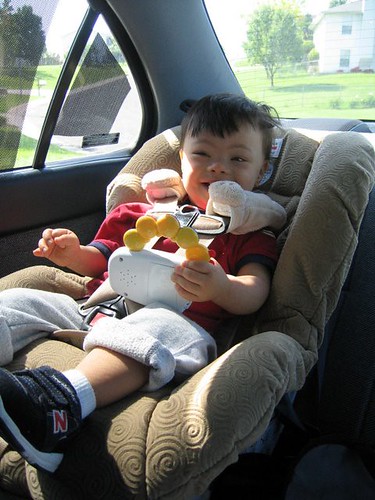
In the car with his i-podSo, until he gets used to being away from me, I'll have to be in the class with him so he gets a better experience out of it.

To have an idea of how we did in the previous classes, see related posts:

Monday, May 11, 2009

The Water Baby

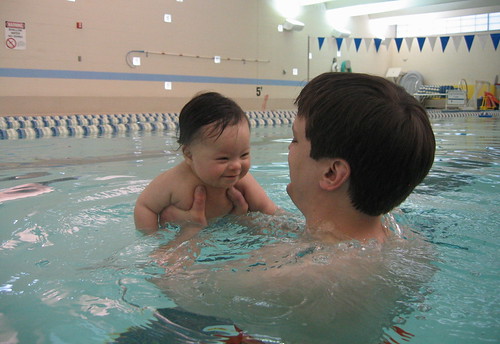
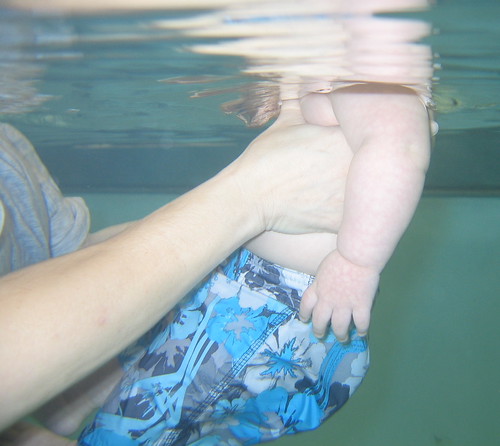
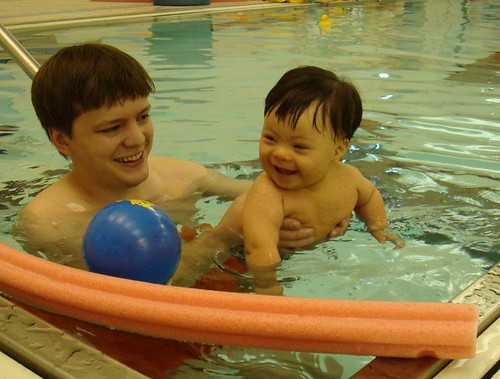
6-month old water babyThe first time I took Matthew in the pool, I immediately knew he had the water gene, just as Bill and I do. It was at a swim class called 'Creative Movement Swim' at the YMCA. Matthew was 6 months old. The other kids screaming or laughing in and around the (indoor) pool did not bother him at all. The sensation of the water around his body didn't bother him either, but I wasn't surprised by that because he loved bath time. He was quite at home in the pool.

We took a break from the class in the winter and the beginning of spring but now we're back in it. Before you get visions of Matthew swimming laps with the butterfly stroke or learning to swim underwater, let me tell you it's not THAT kind of swim class. The class focuses on fun activities for babies and kids (6 weeks to 6 years old) who have developmental disabilities. Not only is it aqua therapy or hydrotherapy, but it's a fun playgroup in the pool.

The Activities
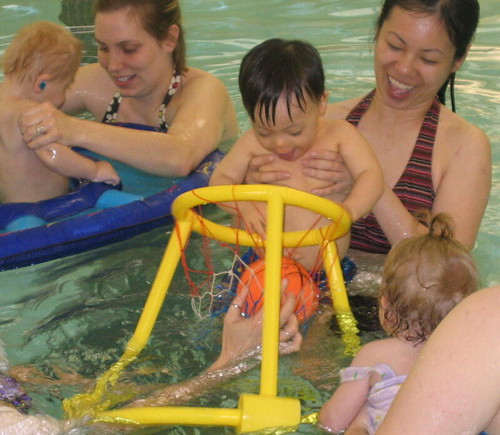
water basketballWith the goal of building coordination, balance, flexibility, strength, muscle control, spatial awareness and focus, we sing songs, play ball, and simply move around in the water. Sometimes the class instructor has everyone in the class move in a circle, with parents helping their kids use their arms to doggy-paddle. Matthew is learning to scissor kick while holding on to the kick board. Noodle floats also provide lots of entertainment when the kids ride them as if they were seahorses. Then of course, there's water basketball where we take turns dunking the ball. These are just a few of the activities that we do in this 45-minute class.

It's one of the best things we've done for Matthew's development.
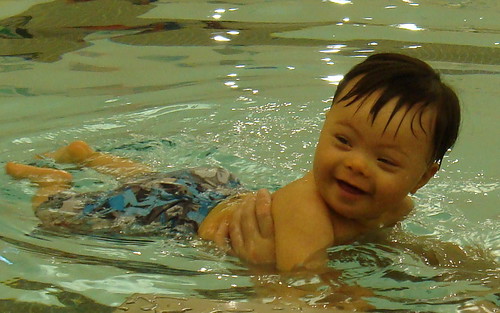
kicking and swimmingWhen he was 6 months old, he could hold his head up but was far from being mobile. Being in the water allowed him to move his arms and legs with less effort. He was so excited that he kicked and kicked, like little frog on caffeine. He would belly swim on land too but he couldn't get himself to move forward. But in the water, his kicking was rewarded with moving forward as I held him under his arms and trolled him through the water every time he kicked. Now, 19 months old, we're focusing on more controlled kicking and using the arms more in the water.

underwater shotFor our purposes, the class provides early intervention to counteract his low muscle tone, also known as hypotonia, which is common in people with Down syndrome. In a blog post at Down Syndrome New Mama titled "Got Tone?" , Ds. Mama wrote: "Think of it as waking up sleeping muscles and then helping to pave the communication highway between the brain and the muscles." With practically every muscle in the body working when swimming, it's a great way to increase stimulation to the brain and nervous system. The water allows more freedom of movement and provides gentle, even resistance for Matthew to develop better muscle control, strength, coordination, and sense of balance.

How much has this helped Matthew?
To be honest, I have no way of telling exactly how much this swim class has helped his overall development. I do know that by giving him more learning opportunities through a wide variety of activities, I am contributing to his development in some way. More importantly, Matthew enjoys the water. That's what really matters.

Bill and Matthew

Wednesday, May 6, 2009

Baby Boot Camp

Baby Boot Camp (also known as "our home") was lovingly and humorously coined by my mother-in-law and myself during Matthew's 1st year in life. Here's how it came to be.

Shortly after Matthew was born, he was diagnosed with Down syndrome. The pulmonary hypertension he had cleared about 5 days after he was born and thankfully he did not have any major heart defects. Right before we left the hospital, we signed up for the First Steps program, which provides early intervention services in Missouri.

A month after bringing him home from the hospital, we already had a Physical Therapist (PT) and Developmental Therapist (DT) see him. He was still battling jaundice and his thyroid level was still in question, but being new parents, we wanted to maximize every wakeful moment with him. When he was almost 4 months old, we added an Occupational Therapist (OT) to the team and a Speech Therapist (ST) when he was 9 months old. They are all wonderful people and make such a great team, always on the ball with Matthew's developmental stages and loaded with helpful information and suggestions on how I could teach Matthew at home in between therapy visits. When something really interests me, I try to learn everything I can about it. So being the nerd that I am, I wanted to learn everything about Down syndrome and how I could teach Matthew. I made sure I had books and more books and DVDs including:


In my opinion, these were all great reference materials, especially in between therapy visits. I remember referring to the Gross Motor Skills book a lot when Matthew was younger, since gross motor skills are really the first to develop and work on. I'd have the book out on the living room floor and Matthew next to me as I tried to help him learn the skills he was ready for or almost ready for. And so while my husband went to work in an office, most my days were spent at Baby Boot Camp.

We don't refer to our home as Baby Boot Camp these days anymore. Toddler Camp maybe? We haven't come up with a new name yet. In any case, here's a video of Matthew's first belly crawl - one of the outstanding achievements at Baby Boot Camp. He was just over a year old.


Tuesday, May 5, 2009

Music and Movement and Mad Tears III

I hope this is the last post I have to write about 'mad tears' (Related posts include Music and Movement and Mad Tears and Music and Movement and Mad Tears II). It makes me sad thinking about how unhappy Matthew was in the music and movement class yesterday. He had taken a long nap before the class but was especially clingy to me when he woke up. In hindsight, maybe going to the class yesterday was a mistake.

He put on his I'm-about-to-cry face as soon as the class instructor held him. On the one hand, he stayed in the class for the whole 30 minutes instead of just 20 minutes like he had the past few classes. On the other hand, it was 30 minutes of unhappiness. It was so nice that his Occupational therapist (OT) met us at the class and stayed in the class as Matthew's buddy while I watched from the tv screen in the other room. He recognized her and would've given her a big smile but he was just past the point of being consoled and persuaded to participate, despite his OT's efforts and calming techniques. He was constantly signing "all done" and just didn't want to be in the class.

Maybe Matthew was just having an off day. Maybe he's not ready to be separated from me for that long, which is totally understandable and expected given his age and attachment to me. Maybe he has associated the class with his previous negative experiences. Maybe all the activity is just too much for him right now. Maybe he has underlying sensory issues, but I would honestly be surprised by that since we go to other similar recreational/educational programs in town with no problems.

Despite the thumbs-down-big-pout vote from Matthew, I still think that this is a good special needs program, especially since it includes typically developing kiddos in the class. We'll try it one more time next week and I'll be in the class with him. If that still doesn't work, then I'll know he's just not ready for this particular class. If so, we'll pull out of the class and just get back into it when he's older. Either way, I just hope we can end the class on a positive note (and not feel like a bad mommy).

Tuesday, April 28, 2009

Music and Movement and Mad Tears II

We went to the music and movement class at 4:30pm yesterday.

Last week, he got upset after doing well 20 minutes into the class. The instructor said he got upset when being guided to go through the obstacle course for a second time.

Yesterday, he got upset after doing well 20 minutes into the class. Although this time, the instructor thinks he was upset about being handed to another buddy mid-class. Unfortunately, that was a double whammy. Firstly, Matthew doesn't cope well with change. Secondly, it was someone Matthew was not familiar with.

We had attended a trial class 2 weeks ago and if I remember correctly, he did fine for the first 15-20 minutes before coming apart. That time, it was the last group activity and song with maracas that did him in.

Three classes. Each class lasts 30 minutes. He has lasted 20 minutes on average. There has been a different trigger for his meltdown each time. Several people have told me that 20 minutes of participation (without me by his side) is great for an 18-month old. I believe them. Now the question is - is it worth it trying to stretch him out to being in the class for the full 30 minutes at this age? I wish I knew the answer.

The class instructor suggested inviting Matthew's OT (Occupational Therapist) to sit in with him at one of the classes. Maybe she has some calming techniques to circumvent a meltdown? Maybe they can calm him if they offer a personal object of comfort such as his lion blankie? If I can be in the class with him, he would probably happily make it through 30 minutes but that would defeat the purpose of enrolling him in this class, wouldn't it?

I wish I knew what to do.

Monday, April 20, 2009

Music and Movement and Mad Tears

Matthew (18 months old) does not speak any words yet. But he knows how to sign a few words like "more", "book", "shoes", "help", "all done" and "eat". While his expressive verbal language is slow to develop, his receptive language (understanding of words) is outstanding (my biased opinion). He understands "give to Mommy", "blow kisses", "close the dishwasher door", "blink eyes", among many other simple instructions. I know Matthew is getting it bit by bit but an extra nudge in that direction certainly helps.

Matthew is now enrolled in a music & movement class at a local studio in town. The class meets every Monday at 4:30 to 5pm, with an average of 5 toddlers. In this class, Matthew is the youngest but I agree with the speech therapist who runs the class that this is a good fit for him. He's very curious about other toddlers close to his age and they'd set a good example for him with their verbal skills. Right now, Matthew is the only one in the class with Down syndrome and the other kids seem to be typically developing who may be in the class just to help their language skills along. So the whole point of putting Matthew in this class is to help him develop his verbal skills through:
1. observation of and/or socialization with peers in a group activity-type setting
2. structured activities that combine music and movement, i.e. songs that require hand or arm gestures
3. physical activity as the toddlers go through a fun mini obstacle course while music plays in the background.

The idea is that when I give Matthew more opportunities to learn, explore and think about new things, all this stimuli promotes brain development hence, helping him progress. The more input he receives, the better his receptive language skills will get. The more he is processing, the better the chances of getting something to capture his interest which will hopefully lead to him wanting to express his interest - verbally.

The tricky part is I'm not with him for those 30 minutes. I'm in another room watching everything they do on a tv screen. He is assigned a "buddy", who is the speech therapist's assistant. It's tricky because Matthew is practically glued to me. Yes, he's a mama's boy (and I love it!) but it does raise his anxiety level up a notch to be taking in everything that goes on in the class without me by his side. I'm not suggesting it's bad in this case. It just is.

So he was fine for the first 2o minutes then refused to do anything else and got mad and upset and started sobbing. (How's that for non-verbal expressive language?!) So they took him out of the class when their attempts to comfort him were in vain and brought him to me. Half of me was saying "My poor baby! Let's not come back here" but the stronger half of me was saying "This exposure is good for him in the long run. He's not hurt, maybe just a little overwhelmed. We'll be back next week!"

The class coordinator reassured me that this is a typical reaction for toddlers his age. They have seen it many times before. It takes a few classes before they start to get into the groove of how the class is run. So we'll see how he does next week. Wish us luck!