Showing posts with label signing. Show all posts

Wednesday, June 29, 2011

Why and How I Teach Sight Words

The brain hears by seeing - something I learned this year. An excerpt from the article Brain Hears Just By Seeing, "The brain's auditory cortex reacts to and categorizes stimuli even when you only see the sound being produced and can't hear it." This probably explains how Bill, when he was a child, could watch a TV show on mute and still understand it. He could lip read.

So if the brain hears by seeing, then the brain can hear speech sounds when presented with a written word. Of course, this would probably be more possible after having the appropriate and correct input once or a few times before it is able to "hear" the word correctly. For example, if the only language I knew was English, then I wouldn't know that the "j" in Spanish was pronounced silently, like an "h". But given the input or knowledge of the Spanish alphabet and/ or language, my brain would be able to recognize "Juan" and enable me to pronounce it correctly with an "h" beginning sound instead of a "j" sound like in "jump". My brain wouldn't hear anything either when presented with Chinese characters because I don't know the first thing about them.

The interesting research on how the brain hears what it sees encourages me to continue teaching Matthew sight words. With a second set of ear tubes and regular ear checks with an otoscope, Matthew's ears have been fluid-free and his hearing has been good as far as I can tell. But hearing levels can fluctuate. Background noise can be distracting. Since Matthew can read, his preschool teacher can show him the words "stand up" if he is unresponsive to verbal instruction. As soon as he sees the words "stand up", he stands up.

Signing vs. Speaking
Signing would've worked too to get him to stand up. Matthew and I communicated via signing when he was 15 months to about 2-1/2 years old. It served as a useful and helpful bridge to fill in the communication gap when Matthew wasn't saying as many words yet. In our experience, sign language seemed to help ease communication frustration (most of the time, not all the time) and increase receptive language skills.

He still signs a few words these days like "more" but he always pairs it with a verbal "more". Generally, we've dropped sign language. As soon as he started articulating more sounds and saying a few words, I decided it was time to encourage spoken language more than sign language.

Increase Speech, Articulation, Vocabulary
Aside from the research on the brain hearing what it sees, there are other benefits to teaching reading at an early age. Articles like "Teaching reading skills to children with Down syndrome" talks about teaching reading to help with speech, vocabulary, and working memory.

The book "Teaching Reading to Children with Down Syndrome - A Guide For Parents and Teachers" by Patricia Logan Oelwin catapulted me into introducing a few words of high interest to Matthew like Daddy, milk, cat, apple, Matthew, Mommy, and ball, pairing the words with pictures to provide a visual cue. What worked best for us included using words that were of high interest to Matthew and words he heard often in daily conversation and routines. He was 2-1/2 years old.

As he learned to read more words, his speech (verbalization/vocalization) and vocabulary picked up by leaps and bounds. Our suspicions of verbal apraxia were dispelled.

Speech therapy at school and using the SmallTalk Phonemes app on my iPhone has corrected many speech errors and improved his articulation of individual letters in the alphabet and a few blends. He says "Mommy" very clearly now instead of just "b" or "bahbee". He was substituting the 'm' sound with a 'b'.


Today, he can read over 110 words by sight without any pictures. He can read many of the words on the dolch list.

Our Favorite Tools and Resources
- Mentioned earlier, the book "Teaching Reading to Children with Down Syndrome - A Guide For Parents and Teachers" by Patricia Logan Oelwin was helpful to me.

- For articulation, iPhone app SmallTalk Phonemes.

- Homemade flashcards. I started with laminated cards with the word on one side and the corresponding picture on the other. It was easy to do with nouns. When we started to move into words on the dolch list I just wrote words on plain 3x5 index cards. I flash 5 to 7 new words a week and review several old ones. We keep the flashcard activity fast and brief.

word bank

- Homemade alphabet, number, and word videos, a couple of which I shared on my blog. (Click on "videos-learning". The link is also found in "View Posts by Category" on the sidebar.)

- Preschool Prep Meet the Letters and Meet the Sight Words DVDs, books, and iPhone apps. Matthew loves Preschool Prep.


Factors That Help Sight Reading
We only have one set of eyes and good, clear vision helps tremendously in allowing us to take in information, process it, and learn.

Matthew was around 7 months old when we took him for his first eye exam with a pediatric opthamologist. A little far-sighted than one would expect, the doctor said, but nothing that would require eyeglasses. His clogged tear duct that had been making his one eye gunky and crusty every morning finally cleared up when he was 10 to 11 months old. So surgery was not required to probe the clogged duct. After another eye exam at 16 months and 28 months and no major concerns, the doctor said he didn't require another eye exam until he was 4 years old unless he developed a problem before then.

It is Matthew's good vision that is partially responsible for allowing him to learn sight words. Other factors are his strong visual style of learning, good visual memory, fluid-free ears and good hearing, improving articulation and speech, and of course, high interest in learning to read.

Comprehension
I think comprehension will develop with exposure, practice, and maturity. He understands the meanings of individual words but learning to understand a story or an idea is harder to grasp - for anyone who is trying to learn a language.

Comprehension may also develop by pairing written high interest phrases or sentences with the corresponding situation. Moving forward to 3 or more-word phrases from 2-word phrases, I currently use plain 3x5 index cards to visually prompt him with highly used sentences. "I want more please", "Let's go home", and "Time to eat" are a few examples. Today, he came to me with something on his mind and slowly but clearly said, "I want help please." Unprompted.

In the bathroom, a list is posted as a visual prompt for his toileting routine. He can read it. I use it to prompt his next step in case he gets sidetracked with singing or self-talk.
toileting routine

One of Many Paths to Literacy
Learning sight words is just a beginning step in learning to read. To quote the Preschool Prep DVD:

"Learning to read is a combination of many skills including letter recognition, decoding skills, phonics, phonemic awareness, and memorizing sight words. Knowing sight words alone does not mean that a child can read but it is an important step on the path to literacy."

Friday, January 29, 2010

2-Year Old Communication Frustration

I dare say that most if not all parents have some level of communication frustration with their 2-year old. The level of frustration is elevated when the toddler is speech-delayed. Matthew is 2 years old and is speech-delayed. It's common among kids with Down syndrome. I recently learned that the "typical" toddler takes off with speech and language between the ages 2 and 4 while speech for a child with Down syndrome takes off between ages 4 and 6.

Sign language has definitely been a good tool for us. It is our bridge to talking and allows Matthew to communicate with us since his speech has not developed yet. However, there are a few words that Matthew has no signs for. What do we do? I can teach him more signs. It's easy enough to look up signs on sites such as Signing Savvy. In the meantime however, we usually get into a guessing game. I try to guess what Matthew is trying to communicate. When I guess correctly, he'll giggle and smile. When I'm wrong, he'll shake his head "no" and/ or grunt.

Matthew knows at least 30 sign words but his vocabulary is growing and I have not taught him the sign for every word he knows. His babbling is emerging and he can make some consonant sounds like da, pa, t, sss, and ba. He said ba-ba a few times before for "bubbles" but it hasn't been consistent so we keep working at it. His latest speech-related progress is that he's vocalizing the consonant sound in some words that he is familiar with. For example, he'll say t for "cat" and "eat". And he'll say sss for "baby signing time" or "stairs".

Understanding More Than He Can Verbally Express
We ran into a problem recently and I'm sure this won't be the last time this will happen. He came to me and said "sss" with his hands positioned as if signing "baby". So naturally, I guessed, "Do you want to watch your Baby Signing Time video?" To my surprise, he shook his head "no". I tried a few other words like "stairs", "puzzle", "slide", "kiss", "eat", "music", "ball", "crackers", "cereal", (note that he can clearly sign eat, music, ball, crackers, and cereal but I guessed those words anyway) and a few other possible activities he likes.

He shook his head "no" and grunted to everything and was visibly getting frustrated and upset that I wasn't understanding him. I felt helpless not being able to understand him. Then out of desperation, I said, "Bubbles. Do you want to play with bubbles?" He finally giggled and smiled - meaning "yes!" How he meant "bubbles" out of "sss" is beyond me but I was glad we got over that hurdle.

This brings to mind something I've heard and read: "Children with Down syndrome usually understand more than they can express through talking." How very true in our case!

Verbal Apraxia
He knew what he was trying to say. He was trying very hard to tell me what he wanted. The problem was that his thought didn't translate into the speech that we readily know and understand. So maybe in his mind he was saying "ba-ba" but instead he was verbalizing "sss". I'm guessing this is an indication of verbal apraxia.

Childhood verbal apraxia affects the motor planning or programming of speech sounds which basically means (and correct me if I'm wrong) an inability for the brain to signal the right mouth muscles to move in order to make the correct sound for the word in mind. It doesn't mean he will never learn to talk. It just means he will need to learn to make the sounds individually before combining sounds.

His speech therapist thinks that Matthew may have verbal apraxia but he was probably too young to be diagnosed. Whether he has verbal apraxia or not, we've agreed to just approach his speech therapy sessions with that in mind. So far, we've been emphasizing certain strong consonant sounds during play and showing Matthew how the sounds are made. For example, "mmmm" is said with the lips together and I let Matthew put his hand on my lips so he can also "feel" the mmmm sound.

Picture Cards to Communicate
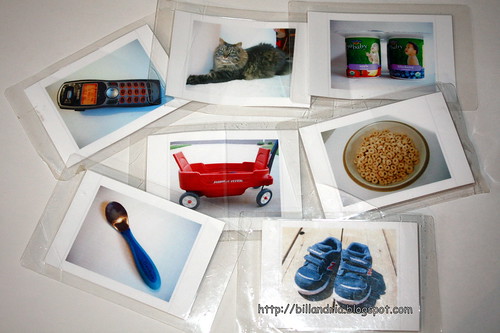
If Matthew could point to what he wanted, I think it would make things a little easier. But he doesn't point. We're still working on pointing. I encourage him to point at pictures in his books and to objects around him but it seems that pointing doesn't come naturally for him. His speech therapist has incorporated using picture cards for the different activities and toys she prepares for him. So before presenting the actual activity or toy, she shows him two picture choices and encourages him to point at what he would like to do.
picture cards
The picture cards that I made for him are great for helping label objects, activities, and people he is familiar with. Matthew is a visual learner and he also learns by doing. I made these cards with the idea that they would provide a visual for vocabulary-building and eventually learning sight words. The photos are on the front of the card and the word is on the back. He loves to babble while looking at his picture cards. Lately, his favorite card is a photo of his Grandpa. He says "pa" and signs "Grandpa" while looking at it.

However, all his picture cards are all mixed together in one bag. I think my next project is to group them by activity, family, food, and so on. I also need to add more pictures (note to self: add one for bubbles.)

Monday, August 3, 2009

Signing with Matthew

We began teaching Matthew American Sign Language (ASL) when he was 7 or 8 months old. We started with "milk" and "more", signing and saying the word at the same time. At the time, we didn't know if he would be interested in signing at all but it didn't hurt to try to teach him. It would be one way for us to communicate pre-speech if he took off with it.

I took a sign language class last year and came home with hand-outs. Inevitably, I forgot some of the signs that I learned from the class. Instead of looking up a sign on paper, I prefer to look at online video sign language dictionaries. A few good ones I have found are:

ASL Pro
Baby Sign Language on Babystrology - Not a complete dictionary of signs but this site has a cute 3D animated baby signing everyday words.
Signing Savvy

Matthew can sign 24 words as of today. They aren't perfectly executed but we're not looking for perfection. We just want to equip him with a tool to communicate with us. His signs are fairly consistent and a close approximation of the proper sign. Also, his signs are always paired with verbal attempts (even if it's a simple "aaaa"), which is what we are encouraging when we sign and say the word simultaneously.

He has his own variation of sign for some of the words making it seem like a game of Charades sometimes. He giggles when we finally guess the word he is signing. He can spontaneously sign as well as sign the words he recognizes when he hears us say them.

More
Put your finger tips together to sign more. Matthew's first version of the sign was putting his thumbs together. It was his first sign early this year. He was signing 6 words by April.

Fish
Matthew is usually up by 6:30 or 7 in the morning. He plays with his Fisher Price Ocean Wonders Aquarium. I point to the fish, "Look at the fish!" His right hand sways wildly from side to side like a fish swimming through the water (for fish).

Eat, Milk, Cereal, All Done
Breakfast time. I ask him if he's hungry. He smiles and brings his fingers to his mouth (for eat). "We will have milk too." He squeezes both hands as if milking a cow (for milk). "Want some cheerios?" He giggles and scoots his right index finger across his chin (for cereal). When he's done with breakfast, he starts to turn his head away or fuss that he doesn't want anymore food. I ask, "Are you all done?" He stops fussing and repeatedly waves his hands, palms down, in front of him like he's wiping his tray clean (for all done).

Play, Ball, Hurt, Cat, Music
All done with breakfast. "It's time to play." He rotates both hands at the wrist (for play). The proper way to sign 'play' is rotate your hands at the wrist with your hands formed like a 'Y' with the thumb and pinky extended. Matthew cannot isolate his fingers yet but his version works just the same.

He walks to his ball pool then puts his hands close together like he's holding a ball (for ball). He dives into his ball pool and tosses the balls out. After emptying the ball pool, he finds a push toy and happily pushes it from the kitchen to the bedrooms and back. The push toy has gotten away from him once or twice while he was pushing it. His lower lip stuck out as he put the tips of his index fingers together (for hurt). I wrote about the first time he signed hurt in Baby Signing Time - "Hurt".

Yuri, our cat, loves to hang out with us most of the day. Sometimes Matthew taps his cheek with either his left or right hand like he's touching imaginary whiskers (for cat) when he sees Yuri. Usually though, he's too busy trying to grab Yuri's fur. To redirect his attention, I ask him if wants to listen to music. He enthusiastically sweeps both arms up to one side as if he threw something over his shoulder using both hands (for music). The proper way to sign 'music' is to have your left arm up in front of you, palm facing you, then sweep over your left arm with your right hand. We listen to the CD from the Kindermusik class or his songs on our iPod.

Shoes, Car
When I have errands to run (and even when I don't), he'll look at me and act like he's holding a steering wheel and driving a car (for car). He loves to ride in the car. "We need shoes," I say. He taps his fists together on the thumb side (for shoes) and finds them by the front door.

Baby
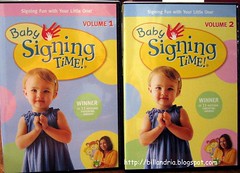
Baby Signing Time DVDsBaby Signing Time Vol. 1 & 2 are the only DVD's he'll watch. When we are in the living room, he sees the TV, looks at me and places his arms in front of his chest, swaying from side to side as if rocking a baby (for baby). It's his way of telling me that he wants to watch Baby Signing Time. He giggles and smiles when I agree to play the DVD.

Wash Hands, Cracker
signing crackerClosing in on snack time in the afternoon, I say, "Time to wash hands." He puts his hands together like he's washing his hands (for wash hands). I tell him that we're having yogurt and crackers for a snack. He touches his right hand on his left forearm close to his elbow (for cracker). The proper way to sign 'cracker' is to knock your right hand on your left elbow.

Daddy, Walk, Dog
In the evening, Bill gets home from work and as he walks through the kitchen door, I say, "Daddy's home". Matthew touches his index finger to the side of his head (for Daddy). The proper way to sign 'Daddy' is to touch your thumb to your forehead.

After dinner, Matthew usually sways his open hands, palms down, in front of him (for walk). The proper way to sign 'walk' is to imitate walking with your hands, moving each hand forward alternately. Walking around our hilly neighborhood really means he gets to ride in his red wagon while we do the walking.

Along the way, we hear and see dogs barking from our neighbors' houses. Matthew can't snap his fingers as if calling a dog to come so instead, he taps his hand on his thigh as if calling a dog to come (for dog).

Bath, Shirt, Thank You
After our walk, it's time for a bath. Matthew scrubs his hands on his chest as if washing himself (for bath). He grabs my shirt while I'm carrying him to the bathroom. I ask him where his shirt is and he grabs his shirt at his chest (for shirt).

While in the tub, he plays with cups, a rubber duck, and a few other toys. He finds it very interesting to toss the toys out of the tub one by one. I've learned to intercept and have him give the toys to me instead. Every time he gives me a toy, I put my hand on my chin and extend it downward in an arc (for thank you). He imitates me each time.

Brush Teeth, Book
Matthew brings his fingers to his mouth and acts like he's brushing his teeth (for brush teeth). Right before bedtime, I say, "It's time to read a..." Matthew completes my sentence by holding his palms together as if they were a book (for book). We read a few books then I tuck him into bed with his little lion blanky.

We love the fact that Matthew can communicate with us using sign language. It's our stepping stone for building his vocabulary before he is able to express himself with words.

It seems like many parents are signing with their kids these days. If you are signing, we'd love to hear your signing stories.

Related posts:
Baby Signing Time - "Hurt"
Biting and Signing

Monday, July 6, 2009

Biting and Signing

If the compulsion to bite is hereditary, then we don't stand a chance. Bill was a biter. I'm told I was a biter. The small, perfect teeth impressions sometimes found on my arms or shoulders aren't tattoos. Matthew bites when he gets overly excited and when you least expect it. Pulling him off when he has already latched on with his teeth is NOT an option. Matthew has all his teeth except for the second molars.

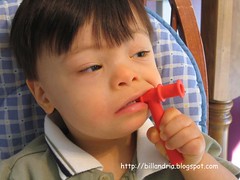
the chewy tubeI wince. I cry a little from the pain. If his chewy tube is within reach, I offer it to him. (The Chewy Tube is an oral motor tool designed to develop biting and chewing skills).'Tis better to bite the chewy tube than Mommy or Daddy. I firmly say, "No bite" and "Ow. That hurt Mommy." He knows how to sign hurt.

He bit Bill on the shoulder one evening. Bill, startled and in pain, and firmly said, "No bite." Matthew looked Bill in the eye and signed 'hurt'.

To make sure Matthew understood that correctly, he bit Bill again. "No bite." Matthew looked at him again and signed 'hurt' again. "Yes, (grrr) that hurt Daddy".

One more time! "Ow, that hurt Daddy." Matthew signed 'hurt' then moved on to play with a toy. Meanwhile, Daddy disappeared into the bathroom to look at his new bruises.

Little stinker! Hmmm...next on the list of sign words to learn: "Sorry".

Tuesday, April 21, 2009

Baby Signing Time - "Hurt"

Except for steering, Matthew pull himself up on his Fisher Price activity walker and walk behind it with good enough balance and control without my help. It's a good walker, plastic and light but sturdy enough for an 18-month old who can't walk without any support yet.

Unfortunately we had a little accident today. It slipped out from underneath him, he fell and hurt his cheek (and the fall most likely scared him too). And more unfortunately, I wasn't close enough or fast enough to break his fall. Crocodile tears streamed down his face as I picked him up and held him close. I quickly looked him over. He wasn't bleeding and didn't have a bruise. Poor baby! I guessed that it frightened him more than anything. I looked him in the eye and said, "You'll be fine. I'm sorry you fell. Where does it hurt?" Then it seemed like time stood still when he looked back at me and touched the tips of his pointer fingers together (the sign for "hurt"!!!) before he proceeded to cry more. I was surprised... happy... conflicted. Why should I be happy? He's hurt. But should I praise him for signing "hurt" for the first time? So I just calmly said, "Ouchie? Your cheek hurts? I'm sorry it hurts. You'll be fine" and held him close. He was back playing with his toys within a few minutes.

I'd been told that some kids really take to signing, others don't at all. We had started signing to him since he was around 7 or 8 months old. Doing signs with him and watching Baby Signing Time Vol. 1 (his all-time favorite DVD) seems to be really clicking with him now. To date, he signs - "more", "all done" "help", "book", "milk". And now, my baby can sign "hurt"!!!