Showing posts with label milestones/developmental progress. Show all posts
Monday, September 19, 2011
What My Soon-To-Be 4 Year Old With Down Syndrome Is Doing And Learning
At Matthew's first IEP (Individualized Education Plan) meeting last year, I prepared a Developmental Achievement Chart (DAC) and shared it with all involved in the meeting. I try to update it quarterly. It lists what Matthew can do and what he is learning to do. It's very encouraging and exciting to see his progress when I update it.
His 2nd IEP meeting is on September 23 and I think I am ready.
So, how is Matthew doing these days? I'll share a few highlights.
Communication Skills
Matthew can:
- sight read 224 words with comprehension.
- understand more words than he can read.
- understand and independently use size concepts, descriptive concepts, and spatial concepts during structured language activities and sometimes in unstructured settings. Last week, he and Bill were racing a seadoo on the floor. Matthew spontaneously said, "The seadoo is fast!" Sometimes Matthew will give me a hug and say, "Big hug!" We saw a truck drive past when we were out on a wagon ride one day and he said, "A black truck!"
- articulate age-expected sounds in the initial and final positions of many words.
- answer "yes" or "no" questions appropriately instead of just repeating the last word he hears. Today, I asked him if he wanted ice in his cup of water and he said "yes please".
Matthew is learning to:
- sight read 8 or 9 new words per week. It helps him expand his vocabulary and practice his reading skill.
- speak more clearly so that unfamiliar people can understand him.
- verbally express himself with sentences I write for him to read at certain moments. I've never taken a mind-reading course but this is as close as I get.
- use language more conversationally and spontaneously.
- apply more concept words spontaneously each day.
Fine Motor Skills
Matthew can:
- use both hands to manipulate small objects. He shows preference for his left hand most of the time but he still switches back and forth.
- scribble with crayons and markers on an inclined, horizontal, and vertical surface. He can also imitate vertical lines, horizontal lines, and circles.
- twist lids off containers, turn doorknobs, lock deadbolts.
- snip paper with a modified preschool scissors. He can also cut play-doh with play-doh scissors but still has a hard time holding on to the scissors and coordinating the movement.
- turn single pages in paper books.
Matthew is learning to:
- use both hands in a more refined and coordinated manner. We need to improve his dexterity, hand strength, and visual-motor skills.
- draw a cross and simple shapes. We need to work on preprinting concepts.
Gross Motor Skills
Matthew can:
- confidently put his face in the pool, confidently jump in a pool with a swim vest or back float, and doggie paddle the whole length of a pool with a just back float strapped to him.
- jump in place with lift-off.
- jump 6" forward on level, even ground.
- walk up and down a flight of 6" high steps, holding the rail, one step at a time.
- walk up and down a single 6" high step hands-free.
- get on and off his tricycle with minimal assistance.
- hang with arms from a 7/8" diameter bar for 3 to 5 seconds.
- run.
Matthew is learning to:
- float on his back in the pool and improve his swim skills.
- jump off a 4" high step without hand support.
- walk up a flight of 6" high steps holding the rail, alternating feet.
- hang with arms from a bar for longer durations and lift legs while hanging.
- run with proper symmetry.
Self-help/ Independent Skills
Matthew can:
- use a spoon or fork to eat independently.
- wipe his mouth and clean up small messes at the table with prompting.
- take his plate to the kitchen sink after a meal, sometimes without any prompting.
- independently get on and off the toilet with a step stool, flush, and wash hands with verbal prompting.
- blow his nose into a tissue with adult assistance.
- pick between 2 shirts to wear each day.
- fasten the top velcro on his shoes, with prompting.
- step into his shoes to put them on.
- zip up a jacket (after it is started) and unzip with some assistance.
- independently remove socks.
- indpendently put on underwear/ naptime & nighttime pull-ups/ elasticized shorts/ elasticized pants, with verbal prompting and minimal assistance when he gets stuck. He sometimes needs help pulling up the backside of his underwear or pants/ shorts. I also have to hand him the underwear/ shorts/ pants so that he holds the waist and can readily put them on.
- put on a loose shirt over his head and put his arms through but the shirt has to be handed to him ready for him to slip on over his head.
Matthew is learning to:
- use a spoon and fork with more precision, less spilling.
- initiate and verbally communicate that he needs to go potty.
- zip up jacket (after it is started) while he holds the bottom part with one hand as he zips up.
- put on socks with assistance starting. He still has a hard time pulling it from the bottom over his heel up to his ankle.
- remove a loose shirt independently.
- put on underwear, elasticized pants/ shorts, without any assistance with pulling up the backside.
- identify the front of clothing from the back.
Social Skills
Matthew can:
- say "Excuse me" when he passes gas. And he grins from ear to ear.
- say "Bless you" without prompting when he hears someone sneeze.
- say "Thank you" and "You're welcome" most of the time without prompting and at appropriate situations.
- appropriately approach adults, especially when familiar to him. He's very sociable.
- get along with other kids and participate in group activities.
Matthew is learning to:
- appropriately approach, interact, initiate play or join a game with other kids. He's generally shy around his peers.
- ask for a turn with a toy, not just grab toys from Elizabeth.
Cognitive Skills
Matthew can:
- play Memory Game with up to 5 pairs.
- navigate my iPhone, his VTech VReader, and VTech Mobigo independently. He only needs help to slide the screen off the keypad on his Mobigo.
- understand number concepts up to 4, maybe even 5. I asked him to give Elizabeth 4 saltine crackers yesterday and he did it flawlessly.
Matthew is learning to:
- play other developmentally-appropriate board games.
- count with 1-to-1 correspondence more accurately.
- play more elaborately and appropriately with non-electronic toys with better attention span. He usually plays for 2-5 minutes and then he moves on to a different toy.
Senses and Perception
Matthew can:
- attend to tasks well when very alert. He is a visual learner and a kinesthetic learner. He also learns better by experiencing concepts rather than just hearing or reading about them. He tends to be under-responsive at times and benefits from various vestibular and proprioceptive activities for sensory input.
- demonstrate understanding of verbally-given familiar, simple 2-step directions (related & unrelated) in the same sequence it was requested with minimal distractions.
- repeat a verbal sequence of 3 to 4 objects or colors in the same order it was given.
Matthew is learning to:
- stay on task with activities.
- demonstrate understanding of verbally-given familiar, simple 3-step directions (related & unrelated) in the same sequence it was requested.
So this is where he's at developmentally. He will be 4 years old on October 5.
His 2nd IEP meeting is on September 23 and I think I am ready.
So, how is Matthew doing these days? I'll share a few highlights.
Communication Skills
Matthew can:
- sight read 224 words with comprehension.
- understand more words than he can read.
- understand and independently use size concepts, descriptive concepts, and spatial concepts during structured language activities and sometimes in unstructured settings. Last week, he and Bill were racing a seadoo on the floor. Matthew spontaneously said, "The seadoo is fast!" Sometimes Matthew will give me a hug and say, "Big hug!" We saw a truck drive past when we were out on a wagon ride one day and he said, "A black truck!"
- articulate age-expected sounds in the initial and final positions of many words.
- answer "yes" or "no" questions appropriately instead of just repeating the last word he hears. Today, I asked him if he wanted ice in his cup of water and he said "yes please".
Matthew is learning to:
- sight read 8 or 9 new words per week. It helps him expand his vocabulary and practice his reading skill.
- speak more clearly so that unfamiliar people can understand him.
- verbally express himself with sentences I write for him to read at certain moments. I've never taken a mind-reading course but this is as close as I get.
- use language more conversationally and spontaneously.
- apply more concept words spontaneously each day.
Fine Motor Skills
Matthew can:
- use both hands to manipulate small objects. He shows preference for his left hand most of the time but he still switches back and forth.
- scribble with crayons and markers on an inclined, horizontal, and vertical surface. He can also imitate vertical lines, horizontal lines, and circles.
- twist lids off containers, turn doorknobs, lock deadbolts.
- snip paper with a modified preschool scissors. He can also cut play-doh with play-doh scissors but still has a hard time holding on to the scissors and coordinating the movement.
- turn single pages in paper books.
Matthew is learning to:
- use both hands in a more refined and coordinated manner. We need to improve his dexterity, hand strength, and visual-motor skills.
- draw a cross and simple shapes. We need to work on preprinting concepts.
Gross Motor Skills
Matthew can:
- confidently put his face in the pool, confidently jump in a pool with a swim vest or back float, and doggie paddle the whole length of a pool with a just back float strapped to him.
- jump in place with lift-off.
- jump 6" forward on level, even ground.
- walk up and down a flight of 6" high steps, holding the rail, one step at a time.
- walk up and down a single 6" high step hands-free.
- get on and off his tricycle with minimal assistance.
- hang with arms from a 7/8" diameter bar for 3 to 5 seconds.
- run.
Matthew is learning to:
- float on his back in the pool and improve his swim skills.
- jump off a 4" high step without hand support.
- walk up a flight of 6" high steps holding the rail, alternating feet.
- hang with arms from a bar for longer durations and lift legs while hanging.
- run with proper symmetry.
Self-help/ Independent Skills
Matthew can:
- use a spoon or fork to eat independently.
- wipe his mouth and clean up small messes at the table with prompting.
- take his plate to the kitchen sink after a meal, sometimes without any prompting.
- independently get on and off the toilet with a step stool, flush, and wash hands with verbal prompting.
- blow his nose into a tissue with adult assistance.
- pick between 2 shirts to wear each day.
- fasten the top velcro on his shoes, with prompting.
- step into his shoes to put them on.
- zip up a jacket (after it is started) and unzip with some assistance.
- independently remove socks.
- indpendently put on underwear/ naptime & nighttime pull-ups/ elasticized shorts/ elasticized pants, with verbal prompting and minimal assistance when he gets stuck. He sometimes needs help pulling up the backside of his underwear or pants/ shorts. I also have to hand him the underwear/ shorts/ pants so that he holds the waist and can readily put them on.
- put on a loose shirt over his head and put his arms through but the shirt has to be handed to him ready for him to slip on over his head.
Matthew is learning to:
- use a spoon and fork with more precision, less spilling.
- initiate and verbally communicate that he needs to go potty.
- zip up jacket (after it is started) while he holds the bottom part with one hand as he zips up.
- put on socks with assistance starting. He still has a hard time pulling it from the bottom over his heel up to his ankle.
- remove a loose shirt independently.
- put on underwear, elasticized pants/ shorts, without any assistance with pulling up the backside.
- identify the front of clothing from the back.
Social Skills
Matthew can:
- say "Excuse me" when he passes gas. And he grins from ear to ear.
- say "Bless you" without prompting when he hears someone sneeze.
- say "Thank you" and "You're welcome" most of the time without prompting and at appropriate situations.
- appropriately approach adults, especially when familiar to him. He's very sociable.
- get along with other kids and participate in group activities.
Matthew is learning to:
- appropriately approach, interact, initiate play or join a game with other kids. He's generally shy around his peers.
- ask for a turn with a toy, not just grab toys from Elizabeth.
Cognitive Skills
Matthew can:
- play Memory Game with up to 5 pairs.
- navigate my iPhone, his VTech VReader, and VTech Mobigo independently. He only needs help to slide the screen off the keypad on his Mobigo.
- understand number concepts up to 4, maybe even 5. I asked him to give Elizabeth 4 saltine crackers yesterday and he did it flawlessly.
Matthew is learning to:
- play other developmentally-appropriate board games.
- count with 1-to-1 correspondence more accurately.
- play more elaborately and appropriately with non-electronic toys with better attention span. He usually plays for 2-5 minutes and then he moves on to a different toy.
Senses and Perception
Matthew can:
- attend to tasks well when very alert. He is a visual learner and a kinesthetic learner. He also learns better by experiencing concepts rather than just hearing or reading about them. He tends to be under-responsive at times and benefits from various vestibular and proprioceptive activities for sensory input.
- demonstrate understanding of verbally-given familiar, simple 2-step directions (related & unrelated) in the same sequence it was requested with minimal distractions.
- repeat a verbal sequence of 3 to 4 objects or colors in the same order it was given.
Matthew is learning to:
- stay on task with activities.
- demonstrate understanding of verbally-given familiar, simple 3-step directions (related & unrelated) in the same sequence it was requested.
So this is where he's at developmentally. He will be 4 years old on October 5.
Sunday, March 13, 2011
His DS
Elizabeth is 10 months old. She is Matthew's DS - Dear Sister. She understands several words and names like 'cat', 'shake', 'Daddy', 'Mommy', 'Matthew'. She says "uh oh" when she drops something from her food tray, and says "na-na-na" while shaking her head "no" when I say no to something. She loves to snuggle with her stuffed animals. She lays on them and goes "aaaahh." She can already blow into the the toy trumpet, which Matthew was only able to do when he was well over a year old.
Like Matthew, she's very observant. She has learned to say and wave hi very easily. The learning differences are apparent between the two. She processes her environment and any stimuli faster and reacts faster than Matthew does. It might be a function of how neural circuits in the brain are not as strong in people with Down syndrome, according to scientific findings by the Down Syndrome Research and Treatment Foundation (DSRTF), hence affecting the learning process. But even if Matthew learns slower and differently, the development paths are the same.

She walks with a sturdy push toy. She has taken a couple careful steps forward independently.
She is very motivated to be mobile to keep up with her big brother. With her faster-than-we've-been-used-to rate of development, we think that this will help Matthew's development too further down the road, particularly with language and social skills. Having another little kid to imitate and interact with is probably more motivating and fun in many ways than just having us boring, old parents, right?
Monkey see, monkey do. If Matthew is pushing his ride-on toy down the hallway, she wants to push one too. When Matthew plays with blocks, she plays with blocks too. When he pretends to cook, she is right there with him pretending to eat the plastic food. Sometimes Matthew will, without any prompting from me, plunk a box of blocks or a basket of play food between himself and Elizabeth. It's his way of telling her "Let's play!" which Bill and I are very happy about because he is initiating interactive play, not just parallel play.


Sharing is an issue every now and then. Modeling how to share helps Matthew understand what to do. Being 3, he shares toys only when he wants to.
They enjoy wagon rides together. What's not to love about wagon rides? As a friend commented on one of my facebook photos, "Warm sun, cool shades and riding with the top down."

Are we glad that Matthew has a sibling? Absolutely! Do we wish that the birth order was reversed with him as the younger sibling with Down syndrome? Sometimes I do just because I think having an older sibling without Down syndrome would bring a different dynamic to the table. But I like the birth order as it is anyway. It is how it is.

It's wonderful to see that they enjoy each other's company. We hope this bond only gets stronger.

Friday, February 11, 2011
Poop In The Potty
Matthew's been saying he's "wet" 75% of the time for a week now when he either needs to go or has already wet his pants. That's potty progress!
On the plus side, he's been learning to hold it in until we get to the potty. On the flip side, he's also been confusing it with a bowel movement and has learned to hold that in too.
For 5 days, he didn't go and refused to go until he just got so miserable and wasn't acting himself. He was even quiet and withdrawn at school one day. During that time, I'd been putting him in a pull-up more often than just underwear thinking that maybe that would encourage him to go since it would be something familiar. But it didn't work. He kept saying "wet" but I knew he really meant he needed to have a BM.
Finally, I used a glycerin suppository to help things along and put him in a pull-up. It was a big struggle for him to go and he was so unhappy in the process. But as soon as he was done, he was a happier little boy.
Today, I debated with myself about having him try to go on the potty versus going in the pull-up again. By chance, he was on the potty when he felt the urge. I hugged him while he was on the potty to reassure him it was ok and keep him calm since he was wanting to stand.
It was over in a few minutes. Matthew looked relieved. I was relieved that he didn't freak out. I was so proud of him. I said, "Look! You did it! Yay!! You pooped in the potty. You did great!!" He looked at his potty and said, "Poop!"
On the plus side, he's been learning to hold it in until we get to the potty. On the flip side, he's also been confusing it with a bowel movement and has learned to hold that in too.
For 5 days, he didn't go and refused to go until he just got so miserable and wasn't acting himself. He was even quiet and withdrawn at school one day. During that time, I'd been putting him in a pull-up more often than just underwear thinking that maybe that would encourage him to go since it would be something familiar. But it didn't work. He kept saying "wet" but I knew he really meant he needed to have a BM.
Finally, I used a glycerin suppository to help things along and put him in a pull-up. It was a big struggle for him to go and he was so unhappy in the process. But as soon as he was done, he was a happier little boy.
Today, I debated with myself about having him try to go on the potty versus going in the pull-up again. By chance, he was on the potty when he felt the urge. I hugged him while he was on the potty to reassure him it was ok and keep him calm since he was wanting to stand.
It was over in a few minutes. Matthew looked relieved. I was relieved that he didn't freak out. I was so proud of him. I said, "Look! You did it! Yay!! You pooped in the potty. You did great!!" He looked at his potty and said, "Poop!"
Saturday, February 5, 2011
Potty Progress: Saying "Wet"
By 2pm on a Saturday, Matthew had already sat on his potty chair 15 times. He'll be going more times after his 2-ish to 4-ish pm nap. I think we're making progress! I may be celebrating too soon and end up eating my words but a baby step is still progress and reason to celebrate in our home.
Of the 15 times that he was on the potty, he peed in it 4 times.
Of the 4 times that he peed in the potty, he had been dry and only went in the potty, not in his pants.
Here's the big deal: Of the 4 successful potty visits, at least 2 (if not 3) of the visits were self-initiated. He comes running to me and says "wet!" At times, he's already gone and saying "wet" have just been his reaction to being wet. Other times, he's dry or is only slightly wet and goes more as soon as we get him to the potty.
Tweaking Our Strategy
First of all, thank you for all the suggestions via facebook and comments on my previous post Potty Training. They made me think about how we could tweak our current strategy and gave me other ideas to try. A blogger friend, Ellen, also shares some important tips in her blog post When You Begin Potty Training Your Child with Down Syndrome.
So as far as potty time intervals, we were taking him to the potty every hour during Christmas break, which is when we shifted to high gear with potty training. Then in January, we tried taking him every 30 minutes with an alarm helping us keep track of the time.
First we had him in pull-ups only during the day and a diaper at naptime and bedtime. Then we tried underwear under his pull-ups to give him the sensation of being wet. That was 50% effective with him. Whenever we went to the potty with wet underwear, I'd let him touch the wet underwear and dry underwear to reinforce his understanding of wet and dry. In the 2 weeks that we tried the underwear under pull-ups, I think he knew he was wet when he went but didn't care and continued to play. He only communicated that he was wet two times in that 2 week period.
Then we got braver. Yesterday, I put him in underwear and shorts ONLY. No pull-ups. He soon found himself standing in the kitchen with wet shorts and pee running down his legs. He had an "uh-oh" look on his face when he looked me. We went to the potty, cleaned up, and put on dry underwear and pants. After that incident, he seemed to understand "being wet" better.
Today, he is in underwear and pants only. And in addition to taking him to the potty at our scheduled intervals, we also rush him to the potty as soon as he says "wet!"
At this point, it seems "wet" either means he already went and his pants are wet or he is on the verge of going. We don't think he necessarily understands the urge to go just yet. He'll get there eventually.
UPDATE:
# of times Matthew sat on the potty today = 22
# of times Matthew peed in the potty = 9
# of times Matthew said "wet" and came to get me and then went in the potty = 7
Related post:
Go Potty
Potty Training
Of the 15 times that he was on the potty, he peed in it 4 times.
Of the 4 times that he peed in the potty, he had been dry and only went in the potty, not in his pants.
Here's the big deal: Of the 4 successful potty visits, at least 2 (if not 3) of the visits were self-initiated. He comes running to me and says "wet!" At times, he's already gone and saying "wet" have just been his reaction to being wet. Other times, he's dry or is only slightly wet and goes more as soon as we get him to the potty.
Tweaking Our Strategy
First of all, thank you for all the suggestions via facebook and comments on my previous post Potty Training. They made me think about how we could tweak our current strategy and gave me other ideas to try. A blogger friend, Ellen, also shares some important tips in her blog post When You Begin Potty Training Your Child with Down Syndrome.
So as far as potty time intervals, we were taking him to the potty every hour during Christmas break, which is when we shifted to high gear with potty training. Then in January, we tried taking him every 30 minutes with an alarm helping us keep track of the time.
First we had him in pull-ups only during the day and a diaper at naptime and bedtime. Then we tried underwear under his pull-ups to give him the sensation of being wet. That was 50% effective with him. Whenever we went to the potty with wet underwear, I'd let him touch the wet underwear and dry underwear to reinforce his understanding of wet and dry. In the 2 weeks that we tried the underwear under pull-ups, I think he knew he was wet when he went but didn't care and continued to play. He only communicated that he was wet two times in that 2 week period.
Then we got braver. Yesterday, I put him in underwear and shorts ONLY. No pull-ups. He soon found himself standing in the kitchen with wet shorts and pee running down his legs. He had an "uh-oh" look on his face when he looked me. We went to the potty, cleaned up, and put on dry underwear and pants. After that incident, he seemed to understand "being wet" better.
Today, he is in underwear and pants only. And in addition to taking him to the potty at our scheduled intervals, we also rush him to the potty as soon as he says "wet!"
At this point, it seems "wet" either means he already went and his pants are wet or he is on the verge of going. We don't think he necessarily understands the urge to go just yet. He'll get there eventually.
UPDATE:
# of times Matthew sat on the potty today = 22
# of times Matthew peed in the potty = 9
# of times Matthew said "wet" and came to get me and then went in the potty = 7
Related post:
Go Potty
Potty Training
Monday, November 8, 2010
Matthew's 1st Day at Preschool
In the car, ready to go to school. The only times I've mentioned school to Matthew were yesterday and this morning. Without any past experience of school though, my mini-talks of school were irrelevant to him. This morning he was just happy to be in the car. He loves car rides. He loves going places. Sometimes he'll bring his shoes to me and say "shoes, car."

Today was his first day of preschool. In a rush leaving our house, I forgot to take photos at home. To remedy that, I took a photo of Matthew in the school parking lot next to his Lightning McQueen backpack and red lunchbox.

Entering one of the gates at school, I felt nothing but excitement for him. I didn't feel sad that he wasn't going to be home with me anymore. I was certainly going to miss him for 3 hours each day but I knew he was ready for more - friends, learning experiences outside the home, teachers other than myself, and most importantly, independence. Bill and I welcomed this milestone with smiling faces, no sad tears. One of his cousins goes to the same preschool but he is in a different classroom. Still, Matthew was very excited to see his Auntie dropping off his cousin T at school.

His initial reaction upon entering the classroom was what I had expected - overwhelmed by the other kids, somewhat bewildered and very unsure of his new surroundings. He covered his ears in an effort to filter everything that was going on. He chewed on his fingers. He looked all around and a few times headed toward the door. He wasn't crying or upset though - just unsure of what to do and where to go. "Have fun. We'll see you later," I said as Elizabeth and I gave him a kiss goodbye. "I'll let you know how he does," said his teacher, guiding him into the center of the classroom to meet the other kids. And feeling unsure of what to do next, I stepped out of his classroom and headed home wondering how his 1st day would go.

No tears! His speech therapist walked with him to meet me at the pick-up area. He had a good first day, I was told. The only time he almost cried was when everyone was waiting to go home. There were a few kids near him that were crying and it was starting to upset him but he held it together. No tears. He was happy to see me and Elizabeth, greeting us with a kiss.

I hope he does just as well tomorrow.

Today was his first day of preschool. In a rush leaving our house, I forgot to take photos at home. To remedy that, I took a photo of Matthew in the school parking lot next to his Lightning McQueen backpack and red lunchbox.

Entering one of the gates at school, I felt nothing but excitement for him. I didn't feel sad that he wasn't going to be home with me anymore. I was certainly going to miss him for 3 hours each day but I knew he was ready for more - friends, learning experiences outside the home, teachers other than myself, and most importantly, independence. Bill and I welcomed this milestone with smiling faces, no sad tears. One of his cousins goes to the same preschool but he is in a different classroom. Still, Matthew was very excited to see his Auntie dropping off his cousin T at school.

His initial reaction upon entering the classroom was what I had expected - overwhelmed by the other kids, somewhat bewildered and very unsure of his new surroundings. He covered his ears in an effort to filter everything that was going on. He chewed on his fingers. He looked all around and a few times headed toward the door. He wasn't crying or upset though - just unsure of what to do and where to go. "Have fun. We'll see you later," I said as Elizabeth and I gave him a kiss goodbye. "I'll let you know how he does," said his teacher, guiding him into the center of the classroom to meet the other kids. And feeling unsure of what to do next, I stepped out of his classroom and headed home wondering how his 1st day would go.

No tears! His speech therapist walked with him to meet me at the pick-up area. He had a good first day, I was told. The only time he almost cried was when everyone was waiting to go home. There were a few kids near him that were crying and it was starting to upset him but he held it together. No tears. He was happy to see me and Elizabeth, greeting us with a kiss.

I hope he does just as well tomorrow.
Wednesday, October 20, 2010
Walks Down Stairs
One of Matthew's goals for the next 12 months is to develop the skill, balance and coordination needed for walking down stairs holding the rail only. His current method is to crawl down backwards. While he can walk down a single 5-inch step without my assistance (see blog entry "All By Himself On A Single Step"), he needs one-hand assistance when walking down a series of steps, especially when they're more than 5 inches high. That is, until 4 days ago when he wanted to walk down the stairs holding the rail without my help.
In Patricia C. Winders' book Gross Motor Skills in Children with Down Syndrome, tracks gross motor milestones based on her observation of 154 children with Down syndrome. "Walks down stairs marking time holding the rail" is #39 on her list and is described as "facing forward, holding the rail with one hand and the other at his side, he steps down with one foot and then brings the other foot to the same stair." data for this particular milestone was available on 50 of the children in the sample. The average age when children achieved this milestone was 40 months. 68% of the children achieved it in 30 to 50 months of age. 95% of the children achieved it in 20 to 60 months of age.
In Sue Buckley and Ben Sacks' article "An overview of the development of infants with Down syndrome (0-5 years)," children with Down syndrome walk down stairs with help between the ages 24 to 60+ months, with the average age being 36 months. Typically developing children achieve this milestone between ages 13 to 24 months, with the average age being 17 months. So 4 days ago, Matthew walked down the stairs holding the rail, taking one step at a time (marking time). He did it all by himself in a very controlled manner. I was in front of him the whole time, taking pictures and ready to assist in case of a mis-step. He reached the bottom of the stairs with a big smile as I gave him a big hug and high fives. He was so proud of himself. And so was I.

The more practice he gets with this emerging skill, the better he will get at walking down stairs. It will get easier as he grows taller too.
Other similar gross motor milestones he needs to work on are walking up stairs one step at a time holding the rail and walking up and down stairs holding the rail alternating steps. He'll get there - one step at a time.
Wednesday, September 1, 2010
Matthew Can Sight Read
While working on matching sight word cards with Matthew the other day, I decided to try (to test) and see if he would recognize the word if I didn't show him the picture. I showed him the word "Daddy" - no picture so there was no other visual cue other than the written word - and he said "dee", which is his verbal approximation for Daddy. He recognized the word! He was sight reading!
I was very excited about his new skill. He is about a month away from his 3rd birthday and he can sight read. He learned this through using homemade materials only.
I videotaped him after discovering his latest skill.
When Did We Start? What Did We Use?
Homemade Sight Word Cards
It was in April 2010 that we had started working on matching my homemade sight word cards, which I wrote about in my previous posts Book Review: Teaching Reading to Children with Down Syndrome and Speech and Reading Connection. This wasn't anything I included in our Early Intervention program goals. I decided to pursue this myself. I wanted him to:
- to learn to recognize letters of the alphabet.
- to pay attention to words. Prior to this, he was only interested in the picture if I showed him the picture and word on a single page.
- to eventually make the association between words and the things they represent.

At that time, Matthew had the skills to identify, differentiate, match and label objects and pictures so I decided it was a good time to start learning some sight words, which is a whole-word approach to reading. Being a visual learner, Matthew sees the word like he would an image and associates it with an object or action via what he has previously stored to memory.
Picture Cards
I had also used another set of picture cards that I made for him in late 2009. The picture was printed on one side and the word was on the other. We originally used these for pointing, identifying and labeling the pictures so we'd look at the picture only. When we started with learning sight words, I'd show him the word first just to draw his attention to the word and then flip it over to show him what the word represented.

Word Cards
These are simply cards with a word. I put some on our fridge next to his fridge toys using magnetic tape and labeled toy boxes using adhesive velcro. I also used them for matching with the picture/sight word cards that have the picture and word on the same side.


Homemade Videos
In addition to the picture cards and word cards, I also created a couple of alphabet videos which I shared on a previous post "Alphabet Home Videos".
How Did We Do It?
We worked on labeling, identifying and matching first as suggested in the book "Teaching Reading to Children with Down Syndrome."
Laying the picture card with the word on the same side in front of him I'd say, "Here's a picture of Daddy." Then pointing to the word card, I'd say "This word says Daddy. Let's put 'Daddy'(the word) on Daddy (the photo card). Yay! Good job!" We did this repeatedly for maybe a minute each time several times a day, depending on his interest level. I didn't push it if he wasn't in the mood for playing this matching game.
I introduced the other sight words when I saw that he was matching words successfully with less prompting from me.
Another game we played with the word cards is what I like to call "peek-a-word". This was literally holding the word card behind our little whiteboard so that it is out of sight and then making it pop up randomly around the whiteboard. I'd say the word everytime Matthew could see it. If I made the word "milk" run across the top of the whiteboard, I'd say "milk, milk, milk, milk, milk" animatedly until it disappeared behind the whiteboard. Matthew thought this was pretty funny.
What's next?
It would be interesting to see if Matthew would recognize the words that he does now if they were written differently. For example, if the letter 'a' in the word 'Daddy' was written in a different font/style, would that throw him off?
More words, here we come! Maybe we'll try short sentences such as "I see ____" or "I want ____" and create a little book.
Other Resources
What works for us may not work for others. Some have better luck with pre-made programs such as the ones I've listed in Early Reading Programs.
Sight word lists to check out include:
Fry Words
Dolch Words (220 most common words in English)
100 most common words in English
I'm sure there are more resources and ideas available for teaching reading that I am not aware of. Please feel free to share in the comments section.
Related posts:
Alphabet Home Videos
Book Review: Teaching Reading to Children with Down Syndrome
Early Reading Programs
Speech and Reading Connection
I was very excited about his new skill. He is about a month away from his 3rd birthday and he can sight read. He learned this through using homemade materials only.
I videotaped him after discovering his latest skill.
When Did We Start? What Did We Use?
Homemade Sight Word Cards
It was in April 2010 that we had started working on matching my homemade sight word cards, which I wrote about in my previous posts Book Review: Teaching Reading to Children with Down Syndrome and Speech and Reading Connection. This wasn't anything I included in our Early Intervention program goals. I decided to pursue this myself. I wanted him to:
- to learn to recognize letters of the alphabet.
- to pay attention to words. Prior to this, he was only interested in the picture if I showed him the picture and word on a single page.
- to eventually make the association between words and the things they represent.

At that time, Matthew had the skills to identify, differentiate, match and label objects and pictures so I decided it was a good time to start learning some sight words, which is a whole-word approach to reading. Being a visual learner, Matthew sees the word like he would an image and associates it with an object or action via what he has previously stored to memory.
Picture Cards
I had also used another set of picture cards that I made for him in late 2009. The picture was printed on one side and the word was on the other. We originally used these for pointing, identifying and labeling the pictures so we'd look at the picture only. When we started with learning sight words, I'd show him the word first just to draw his attention to the word and then flip it over to show him what the word represented.

Word Cards
These are simply cards with a word. I put some on our fridge next to his fridge toys using magnetic tape and labeled toy boxes using adhesive velcro. I also used them for matching with the picture/sight word cards that have the picture and word on the same side.


Homemade Videos
In addition to the picture cards and word cards, I also created a couple of alphabet videos which I shared on a previous post "Alphabet Home Videos".
How Did We Do It?
We worked on labeling, identifying and matching first as suggested in the book "Teaching Reading to Children with Down Syndrome."Laying the picture card with the word on the same side in front of him I'd say, "Here's a picture of Daddy." Then pointing to the word card, I'd say "This word says Daddy. Let's put 'Daddy'(the word) on Daddy (the photo card). Yay! Good job!" We did this repeatedly for maybe a minute each time several times a day, depending on his interest level. I didn't push it if he wasn't in the mood for playing this matching game.
I introduced the other sight words when I saw that he was matching words successfully with less prompting from me.
Another game we played with the word cards is what I like to call "peek-a-word". This was literally holding the word card behind our little whiteboard so that it is out of sight and then making it pop up randomly around the whiteboard. I'd say the word everytime Matthew could see it. If I made the word "milk" run across the top of the whiteboard, I'd say "milk, milk, milk, milk, milk" animatedly until it disappeared behind the whiteboard. Matthew thought this was pretty funny.
What's next?
It would be interesting to see if Matthew would recognize the words that he does now if they were written differently. For example, if the letter 'a' in the word 'Daddy' was written in a different font/style, would that throw him off?
More words, here we come! Maybe we'll try short sentences such as "I see ____" or "I want ____" and create a little book.
Other Resources
What works for us may not work for others. Some have better luck with pre-made programs such as the ones I've listed in Early Reading Programs.
Sight word lists to check out include:
Fry Words
Dolch Words (220 most common words in English)
100 most common words in English
I'm sure there are more resources and ideas available for teaching reading that I am not aware of. Please feel free to share in the comments section.
Related posts:
Alphabet Home Videos
Book Review: Teaching Reading to Children with Down Syndrome
Early Reading Programs
Speech and Reading Connection
Sunday, August 15, 2010
Go Potty
Yes he did - a #1 - for the first time today! We just bought him his own potty seat yesterday with the idea that we would start the process of potty training now. Matthew has been mimicking a lot of our actions to a tee in the past couple of weeks, even more so than in the past. If I yawned, he'd pretend to yawn. If Bill coughed, he'd let out a fake cough. When I tickle Elizabeth's tummy, he does the same without any prompting from me.
We decided to take advantage of this. With no big brother or big sister to imitate, we're it.
We did it with tooth brushing to get him to brush a little better and it worked like a charm. We brushed our teeth with him to show him how we brushed and he imitated us and even let us help him with brushing his back teeth, which he never used to let us do.
When I showed him his potty seat yesterday, he was immediately interested in sitting in it especially when out of imitation. I didn't take his shorts or diaper off though. I just wanted him to get used to sitting on it first.
Bill gave him a bath tonight and in an attempt to add potty time to his night time routine, he put Matthew on his potty seat right after the bath and said, "You're on the potty. Go potty in the potty." And Matthew went, much to Bill's surprise. I had to look right after Bill told me about it because I didn't believe it myself. We celebrated his first potty experience with high 5's and lots of praise and big smiles.
We don't know if tonight was a matter of good timing or luck or if he's actually beginning to understand this concept with all the imitating he's been doing. Whatever it is, we're very happy about this newest 1st. Maybe he's ready to learn. It'll be a process. We don't know how long it will take and we have no timeframe expectations.
According to "An overview of the development of infants with Down syndrome (0-5 years)", 4 to 5 years is the average age that a child with Down syndrome will use the potty without help. Matthew will be ready when he's ready, with us helping him along.
We'll continue to sit him on the potty and make it a night-time routine and eventually add potty time into the morning routine too. Making it part of the daily routine is an idea I got from Rochelle at The Life & Times of Aidan & Alayna. Before parenthood, we would have never thought we'd be happy about potty time.
Saturday, July 24, 2010
Hi, Town, Stop and More Words
Bill came home from work yesterday and as soon as he walked in from the garage, Matthew greeted him with a "hi". It's one of his newest words to say.
Bill and I know how much Matthew understands when we have to spell his favorite things or activities like b-u-b-b-l-e-s and o-u-t and s-h-o-e-s and c-a-r and b-a-t-h in our conversations if he is within earshot and we don't want him to know what we're talking about. We can't even use signs because he knows sign language.
Matthew is a very vocal 33 month old but not fully verbal yet. He tries though. He babbles and hums and sings along (on key) to his favorite songs but he can't clearly say all the words that he knows yet. He really understands so much more than he lets on.
Vocabulary and Verbal Explosion
Five months ago, I listed 26 words that Matthew had consistent sounds for - his speech approximations for words he understood. He had around 140 words in his vocabulary. By the end of March, he spoke his first clear word for the first time. It was "bye". Since then, Matthew's vocabulary has expanded by at least another 39+ words. Within this past week alone, he has been trying to speak more words, with some words clearer than his previous approximations and some completely new verbalizations. Since he's been trying to say more words, we've stopped teaching him new signs. We still sign with him when needed but we mostly encourage talking instead of signing.
Here's a list of the additional words that he understands:
Here's his list of new spoken words/ speech approximations:
apple (apuh) - used to be "a"
applesauce (os)
blue (boo)
bubble (baba)
bye (bye) - used to be "ba"
cat (tat) - used to be "aa"
choo choo (choo choo)
circle (cuhl)
Daddy (dee) - used to be "da"
draw (daw - said like 'saw')
duck (dah)
eat (tee) - used to be "t"
eyes (eyes)
green (geh)
hello (ohw - like 'owe')
help (heh)
hi (hi)
horse (hos)
hug (uh)
jump (dump)
kick (kih)
light (la-la-light)
Lola (owa)
Lolo (owo)
no (doh)
okay (o-keh)
please (is)
pop (pop)
purple (puh)
red (eh)
star (tah)
stop (top)
teeth (tee)
tickle (kuhl)
town (tow - like 'town' but without the 'n')
triangle (guhl)
up (up)
walk (kah)
wow (wow)
yay (yay)
yellow (owow)
Related posts:
Matthew Says Bye
Vocabulary List and Speech
Bill and I know how much Matthew understands when we have to spell his favorite things or activities like b-u-b-b-l-e-s and o-u-t and s-h-o-e-s and c-a-r and b-a-t-h in our conversations if he is within earshot and we don't want him to know what we're talking about. We can't even use signs because he knows sign language.
Matthew is a very vocal 33 month old but not fully verbal yet. He tries though. He babbles and hums and sings along (on key) to his favorite songs but he can't clearly say all the words that he knows yet. He really understands so much more than he lets on.
Vocabulary and Verbal Explosion
Five months ago, I listed 26 words that Matthew had consistent sounds for - his speech approximations for words he understood. He had around 140 words in his vocabulary. By the end of March, he spoke his first clear word for the first time. It was "bye". Since then, Matthew's vocabulary has expanded by at least another 39+ words. Within this past week alone, he has been trying to speak more words, with some words clearer than his previous approximations and some completely new verbalizations. Since he's been trying to say more words, we've stopped teaching him new signs. We still sign with him when needed but we mostly encourage talking instead of signing.
Here's a list of the additional words that he understands:
| arms | dump | light | shorts |
| bottle | elbow | lion | shut |
| catch | elephant | Lola | sing |
| cheeks | feathers | Lolo | smile |
| chicken | flower | monkey | sneeze |
| cough | fork | okay | splash |
| cut | giraffe | outside | truck |
| dance | gray | peaches | wagon |
| draw | knock | picture | yawn |
| duck | laugh | purple |
Here's his list of new spoken words/ speech approximations:
apple (apuh) - used to be "a"
applesauce (os)
blue (boo)
bubble (baba)
bye (bye) - used to be "ba"
cat (tat) - used to be "aa"
choo choo (choo choo)
circle (cuhl)
Daddy (dee) - used to be "da"
draw (daw - said like 'saw')
duck (dah)
eat (tee) - used to be "t"
eyes (eyes)
green (geh)
hello (ohw - like 'owe')
help (heh)
hi (hi)
horse (hos)
hug (uh)
jump (dump)
kick (kih)
light (la-la-light)
Lola (owa)
Lolo (owo)
no (doh)
okay (o-keh)
please (is)
pop (pop)
purple (puh)
red (eh)
star (tah)
stop (top)
teeth (tee)
tickle (kuhl)
town (tow - like 'town' but without the 'n')
triangle (guhl)
up (up)
walk (kah)
wow (wow)
yay (yay)
yellow (owow)
Related posts:
Matthew Says Bye
Vocabulary List and Speech
Sunday, May 16, 2010
Differences
Life changes with one kid. The landscape changes again with two and we discover that the parenting map for kid #1 doesn't quite apply to kid #2. We begin to experience first-hand the significant differences between having one child with Down syndrome and one without.
When Matthew was born 2-1/2 years ago, we left the hospital feeling like his destiny had been pre-written, (no) thanks to books that discussed all the possible medical issues associated with having Down syndrome. We were emotionally-stressed and faced the uncertain future with much trepidation. We had questions - How developmentally delayed will he be? How much help will he need? What medical issues will he have to deal with? Will he live independently? Will he drive a car? Where will he work? How will he support himself? - and more questions that one wouldn't ordinarily ask when bringing a newborn home. On the other hand, bringing Elizabeth home was strangely stress-free.
When Elizabeth was born, we immediately noticed the difference in muscle tone that she had compared to Matthew when he was a baby. She could effortlessly pull her arms close to her body or stretch them out in front of her. She kicked like a bucking bronco. Because of Matthew's low muscle tone (hypotonia), which is a common condition among babies with Down syndrome, his arms and legs just mostly flopped to the sides of his body.
Matthew started to lift his head up for seconds at a time when he was almost 3 months old. And he did this when lying face downward (prone position) on Bill's chest. On the other hand, Elizabeth started showing similar head control a week after she was born.
Matthew first smiled when he was 2 months old, a few days before Christmas. It was the best Christmas gift that year. Elizabeth is just over 2 weeks old and she's already smiling in her sleep. Sometimes she laughs in her sleep too.

While we know we shouldn't compare, we can't help but notice these differences and think, So is this what it's like to have a child without Down syndrome or any other diagnosis that would cause developmental delays? The milestones seem to just happen at the blink of an eye. Doctor visits aren't as stressful. We had grown accustomed to the slower pace - the scenic route in our life's journey - with Matthew that it has become the norm for us. With Elizabeth, it seems like someone hit the fast forward button. It will take some time to get used to this new pace.
When Matthew was born 2-1/2 years ago, we left the hospital feeling like his destiny had been pre-written, (no) thanks to books that discussed all the possible medical issues associated with having Down syndrome. We were emotionally-stressed and faced the uncertain future with much trepidation. We had questions - How developmentally delayed will he be? How much help will he need? What medical issues will he have to deal with? Will he live independently? Will he drive a car? Where will he work? How will he support himself? - and more questions that one wouldn't ordinarily ask when bringing a newborn home. On the other hand, bringing Elizabeth home was strangely stress-free.
When Elizabeth was born, we immediately noticed the difference in muscle tone that she had compared to Matthew when he was a baby. She could effortlessly pull her arms close to her body or stretch them out in front of her. She kicked like a bucking bronco. Because of Matthew's low muscle tone (hypotonia), which is a common condition among babies with Down syndrome, his arms and legs just mostly flopped to the sides of his body.
Matthew started to lift his head up for seconds at a time when he was almost 3 months old. And he did this when lying face downward (prone position) on Bill's chest. On the other hand, Elizabeth started showing similar head control a week after she was born.
Matthew first smiled when he was 2 months old, a few days before Christmas. It was the best Christmas gift that year. Elizabeth is just over 2 weeks old and she's already smiling in her sleep. Sometimes she laughs in her sleep too.


While we know we shouldn't compare, we can't help but notice these differences and think, So is this what it's like to have a child without Down syndrome or any other diagnosis that would cause developmental delays? The milestones seem to just happen at the blink of an eye. Doctor visits aren't as stressful. We had grown accustomed to the slower pace - the scenic route in our life's journey - with Matthew that it has become the norm for us. With Elizabeth, it seems like someone hit the fast forward button. It will take some time to get used to this new pace.
Monday, April 12, 2010
All By Himself On A Single Step
Look at what Matthew has been able to do recently! He can walk up and down a single 5-inch high step all by himself - a demonstration of good motor control, coordination, leg strength, and balance. He usually needs me to hold one or both of his hands to navigate a step. He surprised me as I was taking photos one afternoon and I managed to capture the moment through my lens.


His newest ability is also featured at Windmills and Tulips, where inspiring individuals with Down syndrome are spotlighted in "T21 Abilities Can Do Monday".


His newest ability is also featured at Windmills and Tulips, where inspiring individuals with Down syndrome are spotlighted in "T21 Abilities Can Do Monday".
Sunday, April 11, 2010
Matthew Says "Bye"
Whenever we have a therapist come to our house, Matthew's quite a gentleman. He walks to the door with me to meet and greet. When the session is over, we walk the therapist to the door to wave bye. It was either late February or early March that he started saying "bah bah" for bye. One day in the last week of March, he clearly said "bye". Both his therapist and I looked at each other, surprised and excited at the same time, each wondering if we heard what we heard. "Bye! Good word, Matthew!!"
"Bye" is officially his first clear spoken word. He loves the attention he gets from saying it too.
When we leave the store, he waves and says "bye" to everyone he sees.
When we leave the restaurant, he waves and says "bye" to everyone he sees.
When we leave preschool gym class, he waves and says "bye" to everyone from the door.
When each of his therapists leaves our house, he waves and says "bye" at the door until their car pulls out of our driveway.
In return, everyone smiles and happily waves back and says "bye".
Bye.
"Bye" is officially his first clear spoken word. He loves the attention he gets from saying it too.
When we leave the store, he waves and says "bye" to everyone he sees.
When we leave the restaurant, he waves and says "bye" to everyone he sees.
When we leave preschool gym class, he waves and says "bye" to everyone from the door.
When each of his therapists leaves our house, he waves and says "bye" at the door until their car pulls out of our driveway.
In return, everyone smiles and happily waves back and says "bye".
Bye.
Friday, March 5, 2010
Vocabulary List and Speech
Matthew signs some words but doesn't say words clearly yet. I've always wondered how many words he understood. A good tip I picked up from watching Discovery: Pathways to Better Speech for Children with Down Syndrome was: Keep a list of words the child understands and work on adding more. For words the child knows, work on getting him to say them.
So I listed the words that Matthew understands as of today. He is 2-1/2 years old. It was a fun exercise and I'm tickled to see the long list (and I think I'm even missing a few words).
I'm not sure if there is a specific list of words kids generally need to learn according to their age or if it matters. I came across some vocabulary checklists on the DownsEd site but they are not free. There are no sample pages so I don't know what the lists include.
We've also had more speech progress recently. Two weeks ago, Matthew started saying "ba" for "ball" while signing it. He's also been trying to say a few words. They may not be exactly how the words sound but he has consistent sounds for each of them.
1. Daddy (da)
2. cat (aa)
3. eat (t)
4. ball (ba)
5. cow (ow)
6. down (da or dow)
7. kiss (iss)
8. jump (da)
9. more (o)
10. all done (a da OR da)
11. milk (k)
12. apple (a)
13. dog (g)
14. bath (ba)
15. shoes (oo)
16. stairs (sss)
17. Grandpa (pa pa)
18. fish (ish)
19. crackers (krk)
20. sheep (baa baa)
21. waffle (ba ba)
22. hop (pa)
23. please (isss)
24. twist (tis)
25. bye (ba)
26. juice (oos)
What inspired Matthew to say "ba" for "ball"?
Not me.
Not his speech therapist.
Would you believe that I owe this speech breakthrough to the 'Curious Buddies: Look and Listen at the Park' DVD?!
So I listed the words that Matthew understands as of today. He is 2-1/2 years old. It was a fun exercise and I'm tickled to see the long list (and I think I'm even missing a few words).
| all done | down | night night | table |
| apple | drink | no | teddy bear |
| applesauce | drum | nose | teeth |
| around | ears | on | telephone |
| baby | eat | open | throw |
| ball | eyes | out | tickle |
| bath | feed | pants | toes |
| bed | feet | pear | touch |
| belly button | fingers | pick up | tree |
| blankie | fish | play | triangle |
| blink | fruit | please | tummy/ belly |
| blocks | give | point | turn |
| blow | go | pop | twist |
| blue | Grandma | pour | up |
| book | Grandpa | pour | waffle |
| brush | green | push | walk |
| bubbles | hair | puzzle | wash |
| button | hands | red | water |
| bye | hat | roll | wave |
| car | head | scoop | where |
| cat | help | scrub | wiggle |
| cereal | hi | shake | wipe |
| chair | hop | sheep | yellow |
| chin | horse | shirt | yogurt |
| circle | hug | shoulders | |
| clap | hurt | sit | |
| clean | in | sleep | |
| close | juice | slide | |
| cold | jump | socks | |
| color | kick | spoon | |
| count | kiss | square | |
| cow | knees | squeeze | |
| crackers | leg | squish | |
| cup | look | stack | |
| Daddy | milk | stairs | |
| diaper | mirror | stand | |
| dog | Mommy/ Mama | star | |
| door | more | step | |
| doorbell | mouth | stomp | |
| dot | music | stop |
I'm not sure if there is a specific list of words kids generally need to learn according to their age or if it matters. I came across some vocabulary checklists on the DownsEd site but they are not free. There are no sample pages so I don't know what the lists include.
We've also had more speech progress recently. Two weeks ago, Matthew started saying "ba" for "ball" while signing it. He's also been trying to say a few words. They may not be exactly how the words sound but he has consistent sounds for each of them.
1. Daddy (da)
2. cat (aa)
3. eat (t)
4. ball (ba)
5. cow (ow)
6. down (da or dow)
7. kiss (iss)
8. jump (da)
9. more (o)
10. all done (a da OR da)
11. milk (k)
12. apple (a)
13. dog (g)
14. bath (ba)
15. shoes (oo)
16. stairs (sss)
17. Grandpa (pa pa)
18. fish (ish)
19. crackers (krk)
20. sheep (baa baa)
21. waffle (ba ba)
22. hop (pa)
23. please (isss)
24. twist (tis)
25. bye (ba)
26. juice (oos)
What inspired Matthew to say "ba" for "ball"?
Not me.
Not his speech therapist.
Would you believe that I owe this speech breakthrough to the 'Curious Buddies: Look and Listen at the Park' DVD?!
Thursday, January 7, 2010
Matching
Here is an 8-minute video of Matthew working on matching objects to pictures and matching like pictures with his therapists.
I think it was in the summer last year when we started introducing Matthew to the concept of matching. I learned from his therapists that kids usually learn to match like objects first before matching objects to pictures and finally matching like pictures. It made sense that the learning starts out with something tangible or concrete before moving on to the abstract, i.e. pictures.
Matching Like Objects
We'd start with the simplest things like shoes or socks - anything he was very interested in. We always made sure we pointed out like objects. What was important was we gave him the input frequently. He had 3 pairs of shoes in the summer. When he began picking out matching pairs on his own, we knew he was learning. We also liked the Fisher Price Basic Shape Sorter for matching objects as well as learning basic shapes. He can now successfully sort all the shapes on this shape sorter by himself.
Matching Objects to Pictures
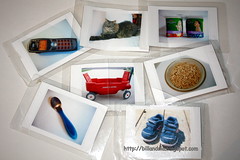
We then moved on to using flashcards or picture cards. I made picture cards for him by taking pictures of his favorite toys, food, and members of our family. The cards are approximately 2-3/4" wide x 4" long, laminated and two-sided - with the picture on one side and the word on the other. Whenever he had yogurt for a snack, I'd show him the yogurt picture card. Whenever our cat was around, I'd show him the cat picture card. Whenever we were playing with Daddy's hat, I'd show him the hat picture card as well.
Matching Like Pictures
Teaching him to match like pictures was a little trickier because he had no interest in puzzles when we started. We used wooden inset puzzles (with the picture under the puzzle piece as well) such as the farm wooden puzzle by Small World Toys. We persisted and slowly built up the interest. These days, he doesn't always push puzzles away when it is offered to him as an activity. In fact, he can successfully complete up to 4 or 5 pieces of a wooden puzzle and sometimes signs "more" - translation: "let's do this again!"
Introducing Colors
Today, we continue to work on matching objects to pictures and matching like pictures. We have also begun introducing colors and matching colors - a work in progress. Matthew's therapist uses the Guidecraft Circular Sorter as well as other customized color matching activities. Another toy we have and like is the Melissa and Doug Stack and Sort Board. It's also good for learning and matching shapes. Another fun toy is the Leapfrog Fridge Farm Magnetic Animal Set.
There are so many other toys one can use to work on matching and sorting. What matching/ sorting toys do you like?
I think it was in the summer last year when we started introducing Matthew to the concept of matching. I learned from his therapists that kids usually learn to match like objects first before matching objects to pictures and finally matching like pictures. It made sense that the learning starts out with something tangible or concrete before moving on to the abstract, i.e. pictures.
Matching Like Objects
We'd start with the simplest things like shoes or socks - anything he was very interested in. We always made sure we pointed out like objects. What was important was we gave him the input frequently. He had 3 pairs of shoes in the summer. When he began picking out matching pairs on his own, we knew he was learning. We also liked the Fisher Price Basic Shape Sorter for matching objects as well as learning basic shapes. He can now successfully sort all the shapes on this shape sorter by himself.
Matching Objects to Pictures
We then moved on to using flashcards or picture cards. I made picture cards for him by taking pictures of his favorite toys, food, and members of our family. The cards are approximately 2-3/4" wide x 4" long, laminated and two-sided - with the picture on one side and the word on the other. Whenever he had yogurt for a snack, I'd show him the yogurt picture card. Whenever our cat was around, I'd show him the cat picture card. Whenever we were playing with Daddy's hat, I'd show him the hat picture card as well. Matching Like Pictures
Teaching him to match like pictures was a little trickier because he had no interest in puzzles when we started. We used wooden inset puzzles (with the picture under the puzzle piece as well) such as the farm wooden puzzle by Small World Toys. We persisted and slowly built up the interest. These days, he doesn't always push puzzles away when it is offered to him as an activity. In fact, he can successfully complete up to 4 or 5 pieces of a wooden puzzle and sometimes signs "more" - translation: "let's do this again!"
Introducing Colors
Today, we continue to work on matching objects to pictures and matching like pictures. We have also begun introducing colors and matching colors - a work in progress. Matthew's therapist uses the Guidecraft Circular Sorter as well as other customized color matching activities. Another toy we have and like is the Melissa and Doug Stack and Sort Board. It's also good for learning and matching shapes. Another fun toy is the Leapfrog Fridge Farm Magnetic Animal Set.
There are so many other toys one can use to work on matching and sorting. What matching/ sorting toys do you like?
Thursday, August 27, 2009
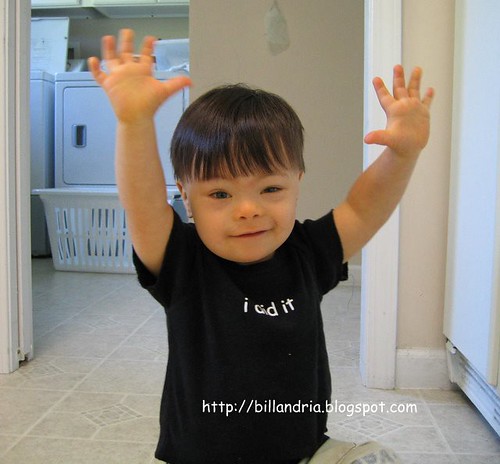
i did it
Jennifer at Three's a Charm has created "i did it" t-shirts, a wonderful idea inspired by her son, Joaquin. She wrote:
Read more at Three's a Charm: I did it.

I did it!
Matthew is going to be 23 months old in the first week of September. Here are his latest i-did-its:
1. He can crawl (backwards) down a flight of stairs, needing assistance only 20% of the time, under 101% supervision. Crawling up the stairs was much easier for him and he's been doing that for several months now.
2. Using more speech sounds (aa, oo, da, la, ba, ma, wa, guh) interchangeably and in a continuous string (da-ba-ba-ma-wa) in his babble. He used to only say dadada, lalala, aa, and oo, each speech sound by itself. His receptive language is very good. It's his expressive language that has us wondering if he has apraxia of speech.
3. His latest signs are water, hat and please.
4. If I ask him "Where are your shoes?", he'll sign shoes and head straight to them by the front door.
5. Playing with the shape sorter last night, he purposefully put the circle piece in the slot for the circle and the triangle piece in the slot for the triangle. He did this two times! I wish I got the look of excitement on his face on camera. It was priceless!
What are your kids' latest i-did-its? Do share!
Three simple words that mean so much. Accomplishments that are celebrated and cherished. All the simple little things and the big things too. First smiles, first steps, first words. Things we used to take for granted and never will again.For every infant and toddler tee purchased (retailing at $21 in honor of Trisomy 21), Jennifer will buy a copy of the new book Gifts 2, sign the inside cover with the name and/or blog of the child who the tee was purchased for, and donate the book to a local hospital, genetic counselor's office or pediatrician's office in Sacramento, California.
Read more at Three's a Charm: I did it.

I did it!
Matthew is going to be 23 months old in the first week of September. Here are his latest i-did-its:
1. He can crawl (backwards) down a flight of stairs, needing assistance only 20% of the time, under 101% supervision. Crawling up the stairs was much easier for him and he's been doing that for several months now.
2. Using more speech sounds (aa, oo, da, la, ba, ma, wa, guh) interchangeably and in a continuous string (da-ba-ba-ma-wa) in his babble. He used to only say dadada, lalala, aa, and oo, each speech sound by itself. His receptive language is very good. It's his expressive language that has us wondering if he has apraxia of speech.
3. His latest signs are water, hat and please.
4. If I ask him "Where are your shoes?", he'll sign shoes and head straight to them by the front door.
5. Playing with the shape sorter last night, he purposefully put the circle piece in the slot for the circle and the triangle piece in the slot for the triangle. He did this two times! I wish I got the look of excitement on his face on camera. It was priceless!
What are your kids' latest i-did-its? Do share!
Sunday, July 19, 2009
Walking
Breaking news: Matthew is walking!!
Eyewitnesses have confirmed that Matthew, who is 21 months old, is taking more and more independent steps. He still loses his balance but he has certainly come a long way. His Mommy and Daddy are very excited about this new outstanding achievement and very proud of Matthew.
With as much time spent training at Baby Boot Camp, in-home physical therapy sessions, and preschool gym, it is no surprise that Matthew has developed the strength, coordination, and balance needed to walk unsupported. He has always had the determination. He just needed time, guidance, and practice to put it all together.
An Overview of the Development of Infants with Down Syndrome (0-5 years) published by down syndrome online estimates that children with Down syndrome learn to walk alone at 23 months on average, with the range being 13 to 48 months. A child without Down syndrome walks alone at 12 months on average, with the range being 9 to 17 months. Other sources may have different ranges but the gist is kids with Down syndrome tend to walk later than their peers who do not have Down syndrome or other developmental delay that affects gross motor development.
Here's a general timeline of Matthew's developmental progress towards walking:
January 2009
Crawling on hands and knees. Pulling up on the coffee table. Learning to walk with a push toy/ walker.
February 2009
Walking with arms up while holding Mommy or Daddy's hands. Taking more steps with walker while leaning heavily on it.
March 2009
Cruising around the coffee table one-way. Pulling up to stand with help. Pulling up to stand on the sliding glass door or similar flat surface. Leaning less on walker while pushing, still not steering.
April 2009
Cruising around the coffee table both ways. Standing without support for about 5 seconds. Practically running with walker but not steering yet.
May 2009
Cruising from coffee table to sofa to chair to ottoman. Cruising along the sliding glass door and other similar flat surfaces. Treadmill training. Learned to steer his walker.
June 2009
Getting up from a sitting position on his own then lunging (and laughing) towards Mommy or Daddy. Taking 2 to 6 wobbly steps.
July 2009
Taking more independent steps, pivoting while walking to change direction. Better at maintaining balance.
Matthew offers a few words of encouragement to other upcoming walkers, "Da da da buh buh AAAA!! (clapping)"
Translation: "You can do it!! (clapping)"
Related posts:
Baby Boot Camp
The Crawler and the Cat
Have Walker, Will Travel
Treadmill Training for Babies with Down Syndrome
Eyewitnesses have confirmed that Matthew, who is 21 months old, is taking more and more independent steps. He still loses his balance but he has certainly come a long way. His Mommy and Daddy are very excited about this new outstanding achievement and very proud of Matthew.
With as much time spent training at Baby Boot Camp, in-home physical therapy sessions, and preschool gym, it is no surprise that Matthew has developed the strength, coordination, and balance needed to walk unsupported. He has always had the determination. He just needed time, guidance, and practice to put it all together.
An Overview of the Development of Infants with Down Syndrome (0-5 years) published by down syndrome online estimates that children with Down syndrome learn to walk alone at 23 months on average, with the range being 13 to 48 months. A child without Down syndrome walks alone at 12 months on average, with the range being 9 to 17 months. Other sources may have different ranges but the gist is kids with Down syndrome tend to walk later than their peers who do not have Down syndrome or other developmental delay that affects gross motor development.
Here's a general timeline of Matthew's developmental progress towards walking:
January 2009
Crawling on hands and knees. Pulling up on the coffee table. Learning to walk with a push toy/ walker.
February 2009
Walking with arms up while holding Mommy or Daddy's hands. Taking more steps with walker while leaning heavily on it.
March 2009
Cruising around the coffee table one-way. Pulling up to stand with help. Pulling up to stand on the sliding glass door or similar flat surface. Leaning less on walker while pushing, still not steering.
April 2009
Cruising around the coffee table both ways. Standing without support for about 5 seconds. Practically running with walker but not steering yet.
May 2009
Cruising from coffee table to sofa to chair to ottoman. Cruising along the sliding glass door and other similar flat surfaces. Treadmill training. Learned to steer his walker.
June 2009
Getting up from a sitting position on his own then lunging (and laughing) towards Mommy or Daddy. Taking 2 to 6 wobbly steps.
July 2009
Taking more independent steps, pivoting while walking to change direction. Better at maintaining balance.
Matthew offers a few words of encouragement to other upcoming walkers, "Da da da buh buh AAAA!! (clapping)"
Translation: "You can do it!! (clapping)"
Related posts:
Baby Boot Camp
The Crawler and the Cat
Have Walker, Will Travel
Treadmill Training for Babies with Down Syndrome
Saturday, May 30, 2009
Treadmill Training For Babies With Down Syndrome
Now that Matthew is a master crawler and showing more interest in walking, we are working on learning to walk. A few of the activities we've been doing to help him achieve his next goal include:
- cruising along furniture
- walking with two-hand support - We started out with me behind him and his hands up higher than his shoulders. Then we eventually switched to being in front of him, guiding him to take steps towards us while holding on to our fingers with his arms at shoulder level or lower. This second position is actually better as we notice that he has to rely on his stomach muscles more and learn to balance as he takes steps.
- walking with his push walker (and lately, the laundry basket.) Watch the video of him pushing his walker at my blog post Have Walker, Will Travel.
- walking with one-hand support
The book Gross Motor Skills in Children with Down Syndrome by Patricia C. Winders clearly explains these activities in more detail.
Last week, we started treadmill training. My dad had first found an article about it on yahoo news in 2007, about a month after Matthew was born. I had forgotten about it until about 2 weeks ago when I came across "Treadmill Training Helps Down Syndrome Babies Walk Months Earlier" on bio-medicine.org. Then yesterday, Ruby's Mom at Ruby's Life blogged about a new tiny treadmill made just for babies.
ScienceDaily () -- Kinesiologsts developed a tiny treadmill to help infants with Downs Syndrome learn to balance themselves earlier. Typically, these children learn how to walk at 24 to 28 months, later than the 12 months for those without Downs. The treadmill exercise, used about 8 minutes a day, helps to reinforce the underlying pattern of coordination in the legs. This repetition helps build core muscles and support the drive to stand up. After the babies take eight to 10 steps without help, they are outfitted with light reflecting markers. The information from these markers is recorded on cameras, revealing gait, speed and width of their steps. Researchers show walking is occuring six months sooner with the treadmill.To read the rest of the article, go to Baby Treadmill Kinesiologists Design Tiny Treadmill To Help Balance Baby Steps In Downs Syndrome Infants
Babies Can Start Treadmill Training As Early As 8 to 10 Months Of Age
Had I remembered the yahoo news article on treadmill training when Matthew was 8 months old, I don't think I would've started it that early with him. Matthew is not as motor-driven as other toddlers his age. He's more of an observer and a thinker. So I usually find that it helps him a lot if I let him watch me show him how something works several times before he tries it himself. My guess is that he would not have tolerated treadmill training when he was 8 months old. Every kid is different though. Other parents may be successful at starting treadmill training with their babies early.
Matthew's physical therapist (PT) supports treadmill training as a supplement to our therapy sessions and suggested that we have him walk on the treadmill with shoes sometimes and without shoes other times. She says this will help improve his leg and foot strength and balance. It takes a little bit more effort when walking with shoes than without. Also, the treadmill offers a different walking experience.
We don't have the mini treadmill that the ScienceDaily article mentions. The Bio-Medicine article states that these treadmills cost about $1,200 each. There should be some hospitals and Down Syndrome Organizations that might rent it out but we didn't explore that option. We have a regular treadmill that we set to the slowest pace and I hold him under his arms in front of me as he walks. The articles on treadmill training recommend 8 minutes of walking but Matthew is only able walk for a minute at a time. It works for me as I can only squat for a minute at a time. So while he's building his core muscles, I'm getting some much needed strength training too. Win-win! The plan is to slowly get him up to 8 minutes, following his lead on how much he wants to walk on the treadmill.
Is Walking Earlier Really Better?
The ScienceDaily article states that babies with Down syndrome learn to walk between 24 to 28 months without treadmill training. The milestone chart inAn Overview of the Development of Infants with Down Syndrome (0-5 years) on the Down Syndrome Online website shows the average age range for children with Down syndrome to walk alone or independently is 13 to 48 months. I know a little girl with DS, who is walking at 18 months, and a boy with DS who walked at 27 months. Both kids are doing great.
So will walking earlier advance a child's cognitive development, social skills development and language? Probably, simply because it gives the child mobility, the ability to explore his environment. What about crawling? Crawling is mobility too and seems to offer its own set of benefits that walking doesn't such as building trunk, arm, head, and neck strength, eye-hand coordination, coordination of both sides of the body, and stability. Don't we all catch up with each other later on? Kim Ayres at Ramblings of the Bearded One candidly commented on one of my previous posts, "if you look at any group of people, can you guess who were the early or late walkers? Once we get there, it makes no difference." So true. Everyone learns at their own pace, Down syndrome or not.
So why exactly are we doing treadmill training with Matthew? Simply because we can. I view it as just another tool, a very interesting one. Whether or not treadmill training does indeed make him walk sooner than later or improve the quality of his walk remains to be seen. I like to offer Matthew different opportunities to develop certain skills whenever possible. If he didn't like it, we wouldn't be doing it at all.
Related Post:
Walking
Monday, May 18, 2009
The Crawler and the Cat
The interaction between Matthew and our long-haired 4-year old Siberian cat, Yuri, is a good source of entertainment in our home. Yuri doesn't know it but he was a huge motivator for Matthew's mobility, i.e. crawling. Matthew has had his eyes on the cat from Matthew's commando (belly) crawling days at around 13 months to his perfected 4-point (hands and knees) crawl at 16 months. What can be more enticing to a toddler than a furry moving target? Now 19 months old, Matthew is an excellent crawler, much to our cat's consternation. Most "typically developing" kids are already walking or running at this age. Lucky for Yuri, Matthew isn't there yet so he has plenty of time to escape little grabby hands. Yuri is cautious enough to keep his distance. Sometimes, Yuri is brave enough to rub up against Matthew. Other times, Yuri steers clear when he sees Matthew charging toward him. Yuri knows when he's about to lose another handful of fur.Despite the fur-grabbing, they get along. Yuri is very tolerant of Matthew. They also have a few things in common.
They both like to snuggle with Bill.


They both know the true meaning of "lounge".


They both love to play.


They're both curious about their environment. Bill and I are thrilled to see our crawler explore on his own. Mobility is so important for kids to interact with the environment. When he wasn't mobile yet, we had toys within his reach and carried him around the house to show him pictures on the wall, lights, fans, etc. But with limited mobility, interaction with the environment is restricted, so Matthew was effectively getting reduced learning opportunities in relation to his crawling/walking peers. What better way for a toddler to learn independence, problem solving, and the "I did it!" feeling than crawling to a toy all the way across the room, around the chair and over the floor pillow on his own?
Getting Matthew mobile was top priority. All his therapists and other moms of older kids with Down syndrome strongly advocated crawling on hands and knees, citing reasons for 4-point crawling such as building trunk, arm, head, and neck strength, motor control and coordination, brain and vision development, eye-hand coordination, coordination of both sides of the body, and stability. These are also building blocks to developing fine motor skills such as writing. Well, that does makes sense, doesn't it? Crawling would help develop wrist stability and strength, which are important when writing. On the other hand, there are articles like Learning to Crawl on Parents.com that state "there's no proof that kids who skip crawling have impaired muscle strength or other developmental problems down the road." Being first-time parents, we relied on his therapists' advice and experiences. It was very important to us that he became mobile so he would have the social and learning opportunities sooner rather than later.
Yuri watched anxiously as we had Matthew doing exercises that would help him crawl on hands and knees including climbing steps, spending a few minutes a day in the 4-point position, and generally making him move forward inches at a time. We even used a yoga mat to provide more traction. By the time he was 16 months old, he was crawling fast and enjoying his new skill. Life was never the same for both Matthew and Yuri since then. The best thing about his mobility is seeing how pleased Matthew is with himself whenever he's able to crawl after a ball that rolls away or crawl up to the cat to grab his fur.
Subscribe to:
Posts (Atom)