Showing posts with label medical issues/ health concerns. Show all posts

Wednesday, October 12, 2011

Breathing Treatments

Say hello to our new friend, the nebulizer. It is the newest addition to our daily routine.

Matthew's pediatrician detected wheezing at his most recent appointment a few days ago. She wanted him on arbuterol, which is an inhalation solution used to relieve bronchospasm. After one breathing treatment at the doctor's office, the wheezing stopped (or at least quieted down). The good news is he doesn't have bronchitis. The other news is his bronchospasm (coughing fits) is a symptom of Reactive Airway Disease. It's not the same as asthma but I read that a small percentage of children under 5 may go on to develop asthma.

As with any medication, using arbuterol presents some possible side effects (copied from package insert):
- Central Nervous System: tremors (20%), dizziness (7%), nervousness (4%), headache (3%), insomnia (1%)
- Gastrointestinal: nausea (4%), dyspepsia (1%)
- Ear, Nose and Throat: pharyngitis (<1%), nasal congestion (1%) - Respiratory: bronchospasm (8%), cough (4%), bronchitis (4%), wheezing (1%)


He breathes in a dose every 4 to 6 hours or as needed. Each dose takes an average of 15 minutes. I am thankful that he doesn't mind the breathing treatments at all. He's even willing to hold the mask up to his face by himself.


He is content to listen to audiobooks while sitting on the couch next to the (rather loud) nebulizer. Sometimes he plays on my iPhone.

We don't know what's causing his symptoms. His allergy (blood) tests have always come back negative. Can the type of allergy test be a factor in accuracy of results?

He has not had RSV, which apparently increases the chances of developing asthma.

Maybe it's genetic. A few distant relatives have had asthma.

Maybe it's the current high level of ragweed (pollen) this time of year. His doctor did say that this is peak time for such symptoms to surface.

I hope it's not from his swimming lessons at an indoor pool. He loves swimming and he would be very sad if this was a cause. I googled a few articles using keywords "indoor swimming pool asthma" stating that by-products of chlorine and human organics (like sweat) in indoor swimming pools are suggested to increase the chance of asthma in children. However, it's not conclusive.

I hope the cat isn't the culprit either.

Right now, I am hoping that it doesn't develop into asthma or bronchitis.

Monday, October 10, 2011

The Not-So-Well Visit

It was time for Matthew's annual well visit with the pediatrician. Matthew is generally a healthy kid but his pediatrician visits are lengthier and more comprehensive than Elizabeth's doctor visits. There is just so much to go over and keep an eye on such as the thyroid, Celiac disease, blood counts to screen for leukemia, vision, hearing, and so on. Having Down syndrome, in addition to any possible family history of medical issues, puts him in a position of "higher risk" for certain health stressors.

Thankfully, Matthew has not had any major heart issues so he does not see a cardiologist on a regular basis. He had a slight murmur for a few years but that seems to have disappeared.

Reactive Airway Disease
This well visit turned into a not-so-well visit quickly when wheezing was detected through the stethoscope. Matthew had developed a cough on Saturday evening after his birthday party.

He got a breathing treatment right away, which consisted of arbetural delivered via a nebulizer and him sitting, breathing it in and cooperating for 10 whole minutes. He wanted to go home already but we were able to make a game out of using the nebulizer so he fully - and happily - cooperated with the nurse.

The wheezing was reversed after the breathing treatment. This meant that the breathing treatment worked. This also meant that he did not have bronchitis. I will be continuing breathing treatments at home for every 4 to 6 hours or as needed.

I only hope that this does not turn into asthma.

Bloodwork
The part of his annual well visit that I dread the most is bloodwork. Matthew has tiny veins and is a hard stick that many lab technicians have had to stick the needle in his arms and or heel more than once on many occasions. We have only found one lady lab technician who was more skilled at it than any other we have met. Unfortunately, I forgot her name but I know where to find her.

Tip: Once you find a really good lab tech for bloodwork, remember their name and if possible, request for the person at the next blood draw.

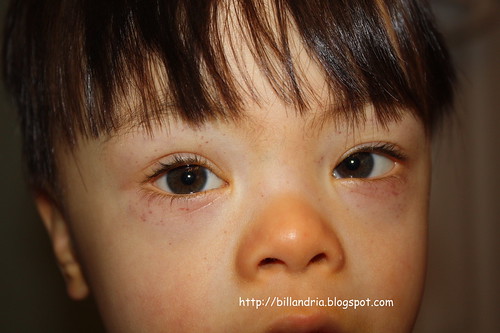
It is extremely emotionally stressful for me to have to hold him down or watch him being restrained by several people to get his blood drawn for a series of tests to check thyroid, vitamin D, ferritin, blood counts, and screen for Celiac disease. Matthew cries so hard as struggles to free himself that he breaks a few facial capillaries. This results in two patches of facial petechiae around his eyes for a couple of days.

I am thankful that this year, we did the bloodwork simultaneously with Matthew's orchiopexy surgery. There was minimal restraining involved and it went much quicker since the nurse was able to draw blood directly through the IV needle, which was already in his arm.

The results of the bloodwork: no Celiac disease, thyroid was within normal range, blood counts were within range, and Vitamin D was still on the low side.

Vision
A new concern this year involved his eyes. His neurodevelopmentalist at NACD had noticed slight strabismus so I brought it up with our pediatrician. She concurred and suggested that we have our opthamologist do a more comprehensive exam.

Strabismus is a condition in which the eyes are not properly aligned with each other. It can adversely affect depth perception.

Time to schedule an appointment with our pediatric opthamologist.

Ears, Nose, and Throat
His throat was red today. Probably another virus. But his nose hasn't been runny and he has been fever-free so hopefully this will pass quickly. I'm not sure how this is related to the wheezing though.

Ears were waxy but both ear tubes were still in. We're due for another visit to the ENT soon.

Sunday, September 4, 2011

Hand, Foot, and Mouth

On Thursday, I noticed a bumpy, pimply-like rash on his left arm near his elbow. He also had a similar rash on his legs. It looked different than the usual eczema he got on his body like in the following photo.


On Friday, a cranky, irritable Matthew whined through eating a slice of his favorite pizza. That confirmed that he wasn't feeling well.

But what was going on? Other than the physical symptoms and general tiredness, both kids still had adequate energy to play with their toys and with each other.

On Friday, Elizabeth had a slight runny nose. Both kids woke up several times that night.

On Saturday, Matthew drooled constantly. Elizabeth's nose needed frequent wiping.

Through Friday and Saturday, Matthew was drinking very little almond milk. He was drinking very little iced water. I thought that was strange. And he often put his finger in his mouth.

I finally checked their temperatures on Saturday afternoon. Both kids were at 100 degrees (Farenheit).

Then I noticed Matthew's hands and ankles had more red dots.

Mother's instinct or paranoia or lucky guess?
I suspected hand, foot, and mouth disease. I tried to look in his mouth as well as I could and spotted a sore in the back of his throat. That explained the drooling! It hurt to swallow his own saliva.

It is caused by a virus that is apparently common for young kids to catch. In an after-hours call to the pediatrician, I was told, "there is no special medication for hand, foot, and mouth disease. Ibuprofen will help provide comfort from a painful throat and high fever. Let it run its course. He can return to school when he is fever-free and no longer contagious."

Sigh.

Monday, August 22, 2011

Leukemia

Illness usually comes with little or no warning. And when life is on the line, all other problems seem small in comparison. And we remember that health matters most.

Matthew's dear friend is fighting for her life against Acute Myeloid Leukemia (AML). Gabbie is 2 weeks younger than Matthew. Like Matthew, she has Down syndrome. She will be 4 years old in October.

Thanks to a mutual friend, we first met Gabbie and her family in June 2009. (See Weekend With Friends post for photos and video). Matthew and Gabbie were 20 months old. We marveled at Gabbie's independent walking skills when Matthew still needed full support when taking steps. Both kids had some degree of food aversion and/or pickiness. They played next to each other. In 2010 they both welcomed their younger siblings into the world, born just 4 days apart. They are both determined and persistent in their own little ways.


We had planned to get together again this year - right before the diagnosis. Needless to say, plans are on hold. We have faith that Gabbie will overcome this and that we will celebrate with them soon enough.

Chemotherapy has started, a 6-month treatment that she will undergo even through her 4th birthday. She is in the hospital this week with pneumonia, which is one of the possible complications for undergoing chemotherapy. Her mom's recent update: Gabbie has begun to lose her hair. She says, "I'm not sad about the hair loss because it's just hair and it will grow back. I'm sad about what it represents and what it is constantly reminding us - that Gabbie is very ill and fighting for her life."

It makes us very sad too.

If you would like, please visit Gabbie's CaringBridge page. Stop in if you can, say hello, and please keep her in your prayers.

About Leukemia In Individuals With Down Syndrome
I personally detest statistics but in the interest of putting a few things into perspective about leukemia and Down syndrome, here are a couple of facts I found.

- According to the National Down Syndrome Society (NDSS), approximately 1 in every 100 individuals with Down syndrome will develop leukemia compared with 1 in every 2000 children without Down syndrome.

- Compared to most children with AML, children who also have Down syndrome respond to treatment better, and have survival rates as high as 85%, compared with 50-55% for children without Down syndrome. However, children with Down syndrome have more complications than children without Down syndrome.

To learn more about treatment of AML, here is an article I found on CureSearch for Children's Cancer.


Related posts:
Weekend With Friends
Mi Casa Es Su Casa

Thursday, August 4, 2011

Updated Health Guidelines for Children With Down Syndrome

Hot off the press (as of July 25, 2011): "Clinical Report - Health Supervision For Children With Down Syndrome". We will be sending a copy to Matthew's pediatrician. I am assuming that most doctors are appreciative of updated and important information shared with them.

Saturday, October 16, 2010

No Atlanto-axial Instability

What is Atlanto-axial Instability?
Increased flexibility of joints, called ligamentous laxity, is common among individuals with Down syndrome. Atlanto-axial instability (AAI) is the medical term used when referring to an increased flexibility or mobility of the 1st and 2nd cervical vertebrae (bones of the neck). The vertebrae protects the spinal cord so if there is instability of this joint, the spinal cord could be at risk for injury.

Here are a few articles on AAI for further reading:
Atlantoaxial Instability in Down Syndrome
AAI information from the NDSC
Atlantoaxial Instability Among People with Down Syndrome
An overview of the development of infants with Down syndrome (0-5 years) - Health

Reasons for Assessment
Matthew turned 3 this month. Generally, the first screening with an x-ray is done between ages 3 and 5, when the bones are more likely to have developed enough to show clearly. However, if Matthew was showing symptoms of spinal cord damage (which he's not), then his pediatrician would have recommended the x-ray sooner.

Another reason for getting this done now instead of a little later is his upcoming surgery. He will be undergoing a tonsillectomy, adenoidectomy and bilateral myringotomy. Translation: getting his tonsils removed, adenoid removed and ear tubes put in both ears. This surgery will require a general anesthesia and a breathing tube placed down the windpipe. There are rare, but possible, cases of neck injury such as joint dislocation from placement of the breathing tube. (Writing about this makes me more anxious about his upcoming surgery). The findings of the x-ray is good information for his ENT who will be performing the surgery.

Findings
Direct quote from the x-ray report:
The study includes flexion, extension and neutral positioning in the lateral projection, demonstrating the distance between the odontoid projection, and the anterior arch of C1 to measure between 2.7 and 3.9 nodes, felt to be within normal limits.

The study is otherwise unremarkable. No fracture or subluxation is seen.

Normal study.

According to our pediatrician and what I've read, anything above 4.5 millimeters (mm) or 5mm suggests AAI.

What does this mean for Matthew?
It simply means that he doesn't have particular restrictions on activities that put extra strain on the neck. We can explore the possibility of signing up for therapeutic horse riding lessons. He doesn't necessarily have to avoid activities like jumping on a trampoline and tumbling. For now.

He'll need another x-ray in his teens or when he goes through a growth spurt. I hope they don't find AAI then.

Sunday, October 10, 2010

Heart Issues

Up to 50% of children with Down syndrome are also born with a congenital heart defect, often requiring surgery.

At birth, Matthew was diagnosed with:
1. moderate Patent Ductus Arteriosus (PDA) - To quote an article on the Cincinnati Children's website,
"The ductus arteriosus is a blood vessel that is present in all babies while still in the womb that allows blood to bypass the pathway to the lungs; it allows blood to flow from the pulmonary artery to the aorta. When the baby is born and the umbilical cord is cut, the lungs are now needed to supply oxygen. The lungs expand, their blood vessels relax to accept more flow and the ductus arteriosus usually closes within the first hours of life. On occasion, however, the ductus arteriosus ductus arteriosus does not close on its own and this is referred to as a patent ("Patent" mean open) ductus arteriosus."

2. moderate pulmonary artery hypertension - increased blood pressure in the pulmonary atery, which carries blood from the heart to the lungs.

3. Potent Foramen Ovale - a hole in the heart that didn't close the way it should after birth

4. moderate tricuspid insufficiency, also known as tricuspid regurgitation - a condition where the tricuspid valve does not close properly, causing blood to leak backward into the right upper heart chamber when the right lower right chamber contracts.

special nurseryThe doctors monitored him very closely in the hospital's special nursery. He had a oxygen hood over his head to help supply his little body with oxygen. As his saturation levels improved, the oxygen hood was replaced with a nasal cannula.

On October 8, three days after he was born, he was weaned to room air with acceptable oxygen saturation levels. Miraculously, the PDA resolved also itself and there was significant improvement with the pulmonary hypertension. A Grade 1, meaning very faint, murmur replaced all of the initial diagnoses. This was for noted follow-up with his pediatrician.

After about a week in the hospital, we were given the green light to go home.

An echocardiogram when he was 2 months old revealed a trivial amount of tricuspid regurgitation, which is considered fine. Many people live healthy lives with a small amount of tricuspid regurgitation. We are so thankful that he didn't require open heart surgery (OHS).

I can only imagine how stressful that experience would be. Melissa at Moos Crossing blog, offers some open heart surgery advice. We offer good thoughts and prayers for a quick recovery to the little ones who need to undergo OHS.

Thursday, July 29, 2010

Brainstem Auditory Evoked Response

We were at the hospital this past Tuesday for Matthew's scheduled BAER (Brainstem Auditory Evoked Response) test. He had to be sedated for the test and we were told that the test would take anywhere from 1 to 4 hours depending on how well the test was going. He was not to have anything to eat after midnight and allowed only clear liquids (water, Sprite, apple juice) until 5am with the hearing test at 8am.

before the BAERWe woke Matthew at 5:45am. He wasn't mad that we woke him up, just confused but more than happy to get into the car. (He loves car rides.) We left the house at 6am and arrived at the hospital at 7am and checked in at the Pediatric Outpatient Sedation Unit. A pediatric nurse took Matthew's vitals and administered Versed mixed with a small amount of apple juice. Matthew loves apple juice but he drank this reluctantly, tasting the medicine in it.

The audiologist and anesthesiologist met with us before the test to give us a run down of what was going to happen before, during and after the test and to answer any other questions we had about the test. The plan was to administer general anesthesia via a gas mask and start with two other hearing tests - a tympanogram and an OAE (Otoaccoustic Emissions) test - before proceeding with the BAER.

At 8am, the nurse took a very drowsy Matthew to the testing room. The wait began for Bill and I. We had left Elizabeth home with my mom so we took the opportunity to eat a decent breakfast and nap.

What is BAER?
Brainstem auditory evoked response (BAER) is also known as Auditory Brainstem Response (ABR). The BAER is done under general anesthesia with younger patients. It is a painless test to measure the brain wave activity that occurs in response to clicks or certain tones conducted through earpieces in the ear canals. Sticky pad electrodes are attached to the scalp to track sound moving through the ear to the brain. The anesthesiologist and pediatric nurse are present during the whole procedure to monitor breathing and vitals. Matthew was intubated (breathing tube down his throat) to help with his breathing during the test.

We opted for a diagnostic BAER for Matthew, also upon his ENT's (doctor) suggestion, to find out how well he was hearing. The literature on Down syndrome points out that up to 80% of individuals with Down syndrome have hearing issues. Matthew has proven that he can hear quite well, being able to hear a doorknob turn even if he was two rooms away. And except for his speech delay and occasional fluid in his middle ears, there was no specific indication that he had any significant hearing loss.

The BAER would answer questions we had: Can he hear different pitches/ sound frequencies well? Can he not hear some pitches? What decibels (loudness & softness of sound) can he hear? It would also give us a good idea of how well Matthew is hearing various sounds, especially in relation to speech. For example, the letter "a" is a high frequency sound/ pitch compared to "d", which is a low frequency/ pitch. If Matthew wasn't hearing some tonal pitches, then I think that would significantly slow down his speech development. Of course, there may be other causes of speech delay, such as verbal apraxia, and we want to check what we can to either rule them out or determine the best possible strategy to overcome it.

Other Hearing Tests
Matthew has never had a BAER test before. As a newborn, he passed the OAE (Otoaccoustic Emissions), which is a routine hearing test done on sleeping newborns before they are discharged from the hospital. The OAE test measures the weak echo sounds made by the ear as soon as it hears. If no echo sounds are detected through this test, there may be possible hearing loss.

When he was about 6 months old, he had a tympanogram, which is another type of hearing test but it measures movement of the eardrum only in response to a sound. The result of a tympanogram is charted by a computer. A peak in the chart indicates movement of the eardrum. A flat line on the chart is an indication of no eardrum movement and fluid in the ear. There may be some degree of hearing loss or hearing distortion depending on how much fluid is present. After the first couple tympanograms, he got tubes in both ears when he was 8 months old. He had fluid in his ears. Both tubes fell out after about a year or so. He has had several tympanograms since then and they've always been flatliners. This was another reason why we wanted a BAER done as it is known to be more accurate and can get more information compared to the OAE and tympanogram.

The Results
The test took 2-1/2 hours and the results were discussed with us immediately after. According to the tympanogram, Matthew has fluid in both ears. We came to the hospital with the knowledge that he had fluid in one ear since his June 2010 visit with his ENT. Having fluid in both ears isn't good especially if it doesn't drain well into his eustachian tubes, making him susceptible to ear infections, which could in turn affect his hearing. The tympanogram doesn't detect how much fluid is present so we'll need to schedule an appointment with his ENT within the next month or two.

According to the BAER, Matthew can hear all pitches and decibels tested within normal hearing levels. So perhaps there isn't a lot of fluid in his ears if the audiologist successfully used a BAER to test his hearing. But the only way to tell for sure is to have the ENT look into both ears with a microscope to determine if Matthew will need another set of ear tubes.

Recovery
Matthew was out of sorts and mad after waking from the anesthesia. The anesthesiologist explained that this was expected. He was taking in very (scary) deep noisy breaths every few minutes - also expected since his was intubated and under general anesthesia. We were to give him clear liquids if he wanted to drink. We stayed at the hospital until Matthew was feeling a little better, probably another 30 minutes, before heading home.

Once home, Matthew had some lunch and kept everything down. He was still a little unstable on his feet. After his afternoon nap, he was back to his usual playful self.

Monday, June 7, 2010

Matthew's 1st Visit to the Dentist

We spent months contemplating when to take Matthew to the dentist. My dentist had given me a brochure with information that a child should first be seen by a dentist as soon as the first tooth erupts. Matthew's first tooth sprouted when he was 7 months old. Other dentists suggest that kids should be seen when they are 2, 3 or 4 years old, sooner if needed.

I looked up pediatric dentists near our area and asked friends for recommendations. I also looked through a list of pediatric dentists recommended by other parents in our local Down Syndrome Association (DSA). The list, which is available at the DSA, is a wonderful resource based on recommendations from other parents who have kids with Down syndrome. It was put together to help other parents like me find doctors who have a keener understanding of Down syndrome in relation to their specialties because they have patients with Down syndrome.

Chronological Eruption of Teeth
Some studies cited in an article on the ds-health website report that individuals with Down syndrome tend to get teeth later than usual and in an unusual order. Apparently, the delay can be as long as two to three years.

Matthew is 2-1/2 years old. He had a full set of primary teeth by the time he was a little over 2. I chronologically charted the order in which his teeth erupted except for his second molars. He has them but I wasn't exactly sure when they appeared so I never noted the dates.

According to primary teeth eruption charts at MedicineNet and All Day All Night Dental, Matthew's teeth appeared in the usual pattern of primary tooth eruption within the usual timeframes, except for his upper lateral incisors. I read somewhere that it isn't uncommon for some kids to teethe out of the usual order, whether they have Down syndrome or not.
Matthew's primary teeth eruption chart
Upper Teeth
Central Incisor (8-12 months) - Matthew (11 months)
Lateral Incisor (9-13 months) - Matthew (15 & 17 months)
Cuspid (16-22 months) - Matthew (18 months)
First Molar (13-19 months) - Matthew (14 & 15 months)
Second Molar (25-33 months) - Matthew (approximately 27 months?)

Lower Teeth
Second Molar (23-31 months) - Matthew (approximately 27 months?)
First Molar (14-18 months) - Matthew (16 months)
Cuspid (17-23 months) - Matthew (17 months)
Lateral Incisor (10-16 months) - Matthew (14 months)
Central Incisor (6-10 months) - Matthew (7 months)

Common Concerns
We decided it was time for him to see a dentist to check for cavities and plaque build-up. We knew he didn't have any missing primary teeth so that wasn't a concern for us. We scheduled an appointment with a lady pediatric dentist and Bill took him to his first dental appointment a couple of weeks ago.

The Dentist's Report
The dentist was able to get a fairly good look in Matthew's mouth when he was pinned down and screaming. The good news is Matthew doesn't have cavities. He has a little bit of build-up though. His tooth alignment is decent with some spacing between his teeth, which just means he has room in his mouth to accommodate the bigger permanent teeth later on. There was no mention of when he will need to be x-rayed. We're guessing it'll be done when he can cooperate willingly during the dental exam and doesn't need to be held down for it. He'll be seeing the dentist again in 6 months.

Related post:
This is the Way We Brush Our Teeth

Tuesday, January 12, 2010

Ear Tubes Update

It seems that hearing problems are common among kids with Down syndrome according to many articles and books that I have read. The hearing loss, whether slight or severe, usually stems from ear infections, having fluid in the middle ear that does not drain quickly enough (or at all) due to narrower Eustachian tubes compared to the "average" individual. So from the very beginning, we took a very pro-active stance when it came to Matthew's ears. We had many questions. After two successive tympanometry tests, a type of hearing test that measures how sound waves travel through the ear, indicating fluid behind the ears, Matthew underwent a Bilateral Myringotomy with tubes, which is a surgical procedure for ear tubes in both ears, when he was barely 8 months old (June 2008). It was a 10-15 minute surgery and the doctor didn't think we needed to stay in the hospital overnight for observation. Everything went just fine.

We believe the ear tubes really helped Matthew avoid major ear infections as the tubes helped drain fluid from his middle ear. We also attribute his good hearing to having the ear tubes in.

In June 2009, our new Pediatric Otolaryngologist (Ear, Nose & Throat doctor) we went to, removed the left ear tube that was just sitting in Matthew's ear. It had come out of the eardrum on its own - part of the natural progression of things with ear tubes. In December 2009, the right ear tube was removed. It too had dislodged itself from the eardrum.

The Not-so-good news and the Good News
As of December 2009, the hole where the left ear tube had been was completely healed. The right one had just fallen out so the hole was still in the process of healing. The not-so-good news is that the doctor saw a scab or some skin in the area that might potentially hinder the healing process in the right ear. We're going to have it checked in June this year. If there is skin in the way at his next appointment, then he will need to undergo a minor surgical procedure to remove it. We're hoping that he won't need surgery.

The good news is that the doctor doesn't think Matthew needs another set of ear tubes (right now anyway) because there is no fluid in his ears. The doctor said, "His ears look great!"

Update on Sleep Apnea Concern
Adenoidectomy (surgical procedure to remove the adenoid) and Tonsillectomy (surgical procedure to remove the tonsils) had been discussed at past Otolaryngologist appointments. We were (and still are) concerned about sleep apnea. However, we're not as concerned about it anymore since Matthew's good nights far outweigh bad nights, where he'd wake up coughing and sounding very congested. He also has bad night wakings due to congestion when he has a cold, which is expected for any child.

One of the pros of these procedures is that he'll breathe easier. One of the cons of these procedures is that it could undermine the structure of his nasal passage. After weighing the pros and cons of adenoidectomy and tonsillectomy, our decision is to have surgery only when it is necessary. Our doctor concurs that it is not necessary right now, even if Matthew's tonsils are on the large side of the scale. He suggested a sleep study when Matthew is 4 years old. So we will do that and continue getting his ears checked twice a year.

Freckles?
The only thing I dread right now when going to see the Otolaryngologist is having to hold Matthew down on the examining chair/ table while the doctor looks into his ears with the special magnifying lens and special instruments designed for very small ears. It took three people to hold Matthew steady - a nurse held his head, Bill pinned his arms and I pinned his legs down. Matthew cried so hard that it seems he burst several capillaries around his eyes. It's very faint in this picture but he looks like he has freckles around his eyes.
see the freckles?
If this is the only price to pay for making sure his ears are in good shape, then we will endure it no matter how it breaks my heart to hear him cry and struggle through it.

Related posts:
A New Pediatric ENT
ENT Appointment - Surgery?

Monday, December 14, 2009

The 20th Week With Baby #2

Yes, all pregnancies are different. Half-way through my second pregnancy, I recall how this pregnancy is the same as the first and how it is different at the same time.

Was I nauseated in the first trimester?
Matthew - Yes. Very tired too. I also experienced some heartburn but it wasn't bad.
#2 - More nauseated and seemingly more tired but thankfully I still managed to keep my food down. There were a few close calls though. The heartburn was constant. It was bad.

When did I start showing?
Matthew - Not til the 2nd trimester.
#2 - I started showing in my 3rd month and I felt very bloated too so I was wearing maternity pants much sooner.

When did I start to feel the baby move?
Matthew - Around the 17th week.
#2 - Approximately in the 16th or 17th week.

What food did I crave in the 1st trimester?
Matthew - Kentucky fried chicken, McDonald's pancakes, vegetarian sushi, french fries, mandarin oranges.
#2 - same food cravings as when I was pregnant with Matthew. I wanted anything salty and I couldn't stand pickles.

What other issues did I have in the 1st trimester?
Matthew - my TSH (thyroid stimulating hormone) level was low, which meant I had an overactive thyroid (hyperthyroid), while my T4 level was within normal range. My OB explained that it may have been my hCG (a hormone) interfering with the blood test and that I would only need medication for it if my TSH level did not normalize in the 2nd trimester after the follow-up blood test. By the 2nd trimester, an endocronologist concurred that I did not need medication. My TSH level had normalized.
#2 - my TSH level was low when I was initially tested around the 12th week. After the follow-up blood test 4 weeks later, my TSH had still not normalized. Another blood test was done at my 20th week appointment (last week) and I expect the results this week. If my TSH level is still low, I would need to see an endocronologist to help determine if I need to be on thyroid medication.

The 20th week is also when we have the gender-revealing ultrasound as well as checking on the baby's overall development. Baby #2 looked good overall, weighing 11 ounces, and actively kicking, punching and doing somersaults. I'm going to need another ultrasound in January to check on the location of the placenta. Apparently the placenta is a little too near my cervix at this point in time but thankfully it is not blocking the cervix, a condition known as placenta previa, which would indicate that the baby may have to be born via c-section. Another ultrasound is necessary to monitor whether it shifts upwards away from the cervix as my OB is predicting.

I'll have a separate post to announce whether baby #2 is a boy or a girl. Stay tuned!

Wednesday, September 30, 2009

Bloodwork at 2nd Year Pediatrician Appointment

Matthew is turning 2 next week. We're looking forward to celebrating his birthday. However, I'm not looking forward to his pediatrician appointment next week. I'm not worried about the scheduled vaccines. I'm fretting over the bloodwork needed to check on a few things. Does every kid go through this at the 2nd year appointment?

Just the thought of holding him down and keeping him still breaks my heart. Memories of previous bloodwork are etched in my mind and his screams break my heart over and over. They will need to stick his arm. Hopefully it will only take one try this time. When he was a baby, there was one visit that made me so mad. The nurse ended up sticking him 4 or 5 times and ended up drawing blood from his heel. After that I made sure we never got that particular nurse again. But it doesn't help that Matthew's veins are hard to find.

Matthew has had blood drawn when he was born, when he was 1 month old, 2 months old, 6 months old, 9 months old, and 12 months old. Various things were checked at these past laboratory visits including:
- Bilirubin levels
- CBC w/ differential
- Comprehensive Metabolic Panel
- Full Thyroid Panel
- Lead

I've been looking up the possible things to check at 2nd year visit through bloodwork. The long list below drains the color from my face. I'm hoping it's not as much as it seems. I realize that some things on the list may be necessary if Matthew were on a vitamin therapy such as Nutrivene. He isn't on Nutrivene right now so maybe there are a few things we don't need to include for bloodwork.
- Full thyroid panel - TSH, T3, T4, free T3, free T4
- CBC
- Celiac panel
- Leukemia
- zinc
- selenium
- ferritin
- iron
- Vitamin A
- Homocysteine
- Magnesium
- Copper
- B12
- Vitamin D
- Amino Acid profile
- Glucose
- urea nitrogen
- creatinine
- calcium
- sodium
- potassium
- chloride
- total CO2

I'm wondering - is this too much? What are absolute must-checks? What can we do without?

Maybe the less we have to check, the less heartache I will have over this bloodwork. In the back of my mind though, I know that any bloodwork at all will be agonizing for me, wishing the nurse can stick me instead of Matthew.

Monday, July 13, 2009

Breathe In, Breathe Out

jammin' with cousins
We spent this past weekend at the lake with Matthew's grandparents, uncle, auntie, and cousins. Unfortunately, Matthew came down with a cold when we arrived on Friday afternoon. Despite not feeling so well, he still had fun hanging out with everyone, giving high fives when requested and smiling.

I'm a cowboy
While he seemed to cope well enough during the day, his breathing worried me at night especially with the concern of apnea already lingering in my mind. He had caught a few cold viruses when he was younger, but nothing that seemed as bad as this.

Friday night
I checked on him a few times in the middle of the night. He stirred a lot and he was breathing like a bear.

Saturday night
We had quite the scare in the wee hours on Sunday. After a few times of rushing into his room when he woke up fussing in the middle of the night, I decided to sleep in Matthew's room. He was sleeping restlessly and breathing like a bear.

Then at around 3:30am, he sounded terrible. He was having a very hard time breathing, even with the humidifier on. I picked him up. I held him close. Bill burst into the room just as I thought of calling to him over the baby monitor. We turned the light on to check Matthew's color. His lips weren't blue (Thank God!) but every breath he took was tight and labored, like breathing through a very narrow straw. Should we take him to the hospital? Call 911? Do something fast PLEASE!

Bill went to wake his sister and her husband, who is a doctor - not a pediatrician, but a medical doctor nonetheless. We were so grateful they were there. He quickly tried to listen to Matthew's lungs but couldn't hear anything more alarming (like wheezing) other than the obvious labored breathing. He suggested that we take him into a steamed-up bathroom and stay there for as long as we could or until Matthew sounded better. The humidity helped tremendously! It loosened the congestion that seemed to have accumulated and maybe dried up in his throat. What a relief!

Sunday night
We were back from the lake on Sunday afternoon. That night was another restless one for Matthew and I. I whisked him into the bathroom for the "steam treatment" at 9:30pm and then again at 3am.

A Nasty Summer Cold?
I took him to his pediatrician today. He has not had a fever with this cold, his nose was running, he had a hoarse voice, his throat was red, and he had a hard time breathing at nap time and at night. His appetite has waned but overall, he's doing fine and getting plenty of fluids. The diagnosis: It could just be a nasty summer cold with croup-like symptoms.

our home remedies for cold symptomsHis lungs sounded fine and that the noisy breathing was coming from his upper airway caused by his swollen throat and (most likely) swollen vocal cords, which are. He is to take a minimal dosage of a liquid steroid for 3 days to reduce the swelling. With it being for a short period of time, he should not experience any side effects. The home remedies for easing cold symptoms, which have always worked for us in the past, seem to have very little effect for this particular bout with this virus including:
  • Warm baths in a steamed-up bathroom.
  • Saline solution - a few drops or sprays in each nostril as needed.
  • Nasal aspirator to clear his nose.
  • Aquaphor or Vaseline under the nose to keep that area moisturized.
  • Vicks babyrub on the chest and back.
  • Using a humidifier in his room.
  • Using a crib wedge under his sheets. We use DEX Safe Lift Deluxe, whether he has a cold or not, since sleeping at an incline is supposed to help drain the airway of congestion. However, Matthew is such a wiggly sleeper that he ends up sleeping with his head on the opposite end of the incline. Oh well. He also likes to sleep with his bottom in the air.
  • Steam treatments (latest addition to our list since Saturday night). This basically involves taking him in a bathroom with the door closed and the hot shower running so he can breathe in the steam to ease any congestion that may have accumulated in his throat.
I'm not quite sure how I feel about the steroid. I do know that I want Matthew to breathe better and not risk having his narrow airway close up on him at night. Breathe in...breathe out.

Related posts:
ENT appointment - Surgery?

Monday, June 1, 2009

ENT Appointment - Surgery?

So here's an interesting fact that I learned today: the adenoid, once surgically removed, CAN grow back in some cases. Tonsils don't grow back when surgically removed. We had an appointment with Matthew's new ENT (Ear, Nose, & Throat) doctor today.

Checking Ear Tubes and Tonsils
Bill took the day off work so he could come to the appointment and help hold Matthew down when the doctor checked his ears. I was holding his legs down, Bill was holding his arms down and a nurse was holding Matthew's head in place while the doctor scooped out wax from his left ear. Needless to say, Matthew was very upset about being restrained. Upon inspection under the microscope, the doctor discovered that the ear tube in the left ear had already fallen out so that was scooped out too. There is now a hole in Matthew's eardrum where the tube was set. It may or may not heal on its own but the doctor said that hole will help with drainage and function as if the ear tube was still there. So at the moment, the ear tube does not need to be replaced.

After checking the ears, the doctor checked his tonsils. Yup, they are indeed large. We told him that Matthew snores too. Sometimes, we sometimes hear him gasp for air (sounds like it) over the baby monitor. And when he was younger, he used to wake up in the middle of the night, coughing and congested, but not sick. He'd just have a hard time breathing because of the congestion, yet he did not have a cold. Could he have developed allergies? The doctor explained that it's not usually the case for kids in his age range. Bouts of congestion like that are usually viral-related, he said.

Possible Solution to Breathing Issue - Surgery?
He suggested that a sleep study was an available option for us if we were very worried about Matthew's breathing at night. Possible apnea? At the same time, he advised us that kids Matthew's age usually yank off the wires that they would attach to his body from the apnea monitor. We won't get accurate results, if any, that way. So maybe watching him sleep at home might be better to see if there are any lapses in his breathing.

Because of his occasional breathing issues and large tonsils, Matthew is a candidate for tonsilectomy (surgical removal of tonsils). And because 50% of the time, removing the tonsils isn't enough to clear the airway for kids with Down syndrome, he would need to remove part of the adenoid at the same time. The procedure starts after 45 minutes of being under anesthesia. The surgery is done through the mouth. If we opt for surgery in the next few months, he will need to stay overnight at the hospital after surgery for monitoring since he is under 4 years of age. Throat pain usually lasts 1 to 2 weeks after surgery. We are to expect having a hard time getting Matthew to drink during the recovery period. And no travelling while he is recovering.

According to our ENT, (approx.) 90% of kids without Down syndrome, who undergo this type of surgery, do not experience any recurrence of their breathing issue. But for (approx.) 40%-50% of kids with Down syndrome who undergo this type of surgery, another breathing issue may surface, possibly caused by other factors. (unknown to us at this time. We can't tell what Matthew's future is going to be).

The decision for surgery, even if it is a relatively simple one, is not easy for us. It's still surgery no matter how minor. We're going to bide our time and see how he does over the summer. Maybe we'll even wait until he's 4 years old. In the meantime, we'll continue with our nightly routine of warm baths in a steamed-up bathroom, saline solution and using a bulb to clear his nose, and a cool mist humidifier in his room at night. We'll see this ENT doctor again for a follow-up visit in approximately six months. We liked how he answered our questions and provided possible courses of action. We also noticed that whenever he said "normal children", he immediately corrected himself saying, "children without Down syndrome" and then finishes his sentence. Hey, at least he's trying to be sensitive about his choice of words.

Bill and I are now wondering about experiences of other parents who have opted for this type of surgery for their kids, with or without Down syndrome. Also, we are wondering if there are older kids/ adults that have not had their tonsils and/or adenoid removed. Do they or their parents wish they opted for surgery earlier or maybe even regret it?

Thursday, May 28, 2009

These Shoes Are Made For Walkin'

The first pair of shoes Matthew ever owned were a size 4 brown pair sneakers from Target after his first birthday. I spent around $15, not wanting to spend much more on a pair of shoes that he would wear for conceivably just a few months, especially since he wasn't walking yet. I quickly learned it was a mistake. He only wore the shoes a couple of times. The shoes were too narrow.

In January, I took him to get his foot measured at the local Brown's Shoe Center. $32 and priceless comfort later, he's in a pair of navy blue New Balance toddler shoes, size 5, extra wide. I should've known better. Wide AND thick feet run in the family, i.e. Bill.
new shoes in January
Flat Foot & Weak Ankle
Any child can have a flat foot but it is more common for kids with Down syndrome due to loose ligaments at the ankle (ligament laxity) and low muscle tone (hypotonia). Ligament laxity causes joint instability. I can imagine that gravity compounds this problem by allowing the ankle to roll inward once a child starts walking. My understanding of flatfeet is that it is only a problem if the condition is severe, where one is walking on the inside of the heel, and it causes foot or leg pain. The feet may be turned outward when walking instead of straight ahead.

At Matthew's physical therapy (PT) session this week, I learned that he is flat-footed. Isn't it too young to say for sure though? I thought the arch of the foot doesn't generally appear until the age of 2 or 3 (or 4?). Apparently, his therapist could already tell. I don't have her experience and trained eye so I trust her observations. 70%-80% of the kids who have Down syndrome that she has worked with required ankle braces (in severe cases) or physician-prescribed plastic foot supports called orthotics. Matthew's ankles weren't rolling inward excessively enough to need orthotics.

There are several ways to test whether an arch is being developed. One that I know of is by creating a footprint of your child’s damp foot on colored paper. Another is to walk (barefoot of course) on sand. Then check whether the foot arch leaves a noticeable gap. We'll do this when Matthew is walking independently. He still walks with two-hand support these days and sometimes with one-hand support very gingerly.

Ways To Strengthen The Ankles & Develop The Arch
Matthew's PT suggested a few exercises/ activities to help develop tendons, muscles, and ligaments. Of course, I don't think these exercises are a guarantee that an arch will develop, but if it will improve muscle tone in the legs and feet, I'm all for it.

  • Walk barefoot on soft uneven surfaces - Sand on the beach is a good example but since we don't live anywhere near a beach, we can create soft uneven surfaces indoors using blankets and pillows or a bed mattress on the floor. Walking barefoot on the grass is also an option for us.
  • Walk with shoes on both level and uneven hard terrains, such as the driveway, gravel road, or rocks.
  • Pushing a weighted toy/ object - This requires him to push off more with his feet to move forward. A laundry basket half filled with clothes is perfect! Matthew enjoys pushing our laundry basket and fusses when I say it's time to stop.
  • Activities where he needs to tiptoe and maintain the position for a few seconds at a time. He's getting tall enough to hold on to the top of our sturdy dining table. Perhaps a good motivator is having a toy on the edge of the table, just slightly out of reach so he has to tiptoe to get it.

Special Shoes?
Custom shoes, arch supports, or braces prevent flat feet from worsening and alleviate pain (only in cases of severe flatfeet) but they don't help develop an arch or correct a problem. Whether Matthew may need orthotics or not remains to be seen. He'll probably need arch supports and hopefully, the off-the-shelf kinds will work just fine. Orthotics aren't as affordable but we won't hesitate to get them if that's what Matthew will need in the future.

New Balance Size 5 extra wideShoes with a flexible sole are recommended for kids learning to walk. And in Matthew's case, we're going to need extra wide shoes as well. I know of two brands that have extra wide sizes: New Balance and Stride Rite. Recently, I stumbled upon Piedro Boots and Ricosta(German brand) in Foot Problems in Children with Down Syndrome at the Down Syndrome Centre website. There are probably other good shoes out there that are available in extra wide with flexible soles but I haven't come across them yet. Has anyone had any luck with other brands and/or styles?

Size 5 Circo sandals and slippersIn the meantime, his New Balance shoes are just fine. Target, my favorite store, hasn't failed me completely. I recently found a pair of Circo brand sandals ($13) with adjustable velcro straps near the toes and the ankle. This helps compensate for his wide, thick feet. I also found a pair of slippers ($7), which are great for when he's playing at his water table.
Circo sandals

Thursday, May 21, 2009

A New Pediatric ENT

Since Matthew's birth, we have seen several doctors other than the pediatrician - pediatric cardiologist, pediatric opthamologist, and pediatric otolaryngologist (ear, nose, throat or ENT specialist). There are many good pediatric doctors, but I personally like to specifically seek out the ones that are highly regarded by other parents who have kids with Down syndrome (and covered by our insurance). For me, that is an indicator that these doctors understand the nuances of medical care for kids with Down syndrome.

Questions for the Pediatric ENT
At Matthew's first appointment with the Pediatric ENT, we had many questions, as most new parents of a child with Down syndrome would have. Matthew was 6 months old.

Does he have fluid in his middle ears?
Fluid in the middle ear interferes with the vibration of the eardrum and reduces hearing sensitivity. The eustachian tube, which is located between the middle ear and the back of the throat, controls air pressure in the ear and drains fluid from the middle ear. When the eustachian tube is not functioning properly or is blocked, there is an increased risk of ear infections and fluid can be retained in the middle ear. Basically, any sounds that Matthew hears would be distorted, likened to hearing underwater. What a huge setback this would be for speech and language development if he was unable to hear properly!

A tympanometry was performed to test his hearing. This is an objective type of hearing test where a plastic probe containing both a transmitter and a microphone was inserted into Matthew's ears, one side at a time. It was non-invasive, not uncomfortable and it was over in a few seconds. The probe creates a vacuum seal and thus changes the air pressure in the ear. The transmitter in the probe sends sounds down into the inner ear and the microphone measure and records the vibrations the hair cells make in response. The test revealed that he may have some fluid accumulated in his middle ear. A repeat test 3 weeks later revealed the same results.

Do kids with Down syndrome tend to have an overproduction of ear wax?
At 6 months, Matthew's left ear was completely blocked with earwax. Removing the earwax was an ordeal in itself. Restraining him in the exam chair and listening to him scream while the doctor scooped the ear wax out was just so heartbreaking. I couldn't believe how much ear wax they dug out of his little ears. Thankfully, we haven't had to get his ears cleaned since then.

Will he need ear tubes and when should that be done?
We had two options: 1) wait and see if the fluid would eventually drain from the middle ear or 2) Bilateral Myringotomy Tubes in a couple of months. After doing our research, we decided we were comfortable with the more aggressive preventive treatment. So Matthew underwent surgery when he was 8 months old. It was a 10-15 minute outpatient procedure where he needed to be anesthesized. Not a big deal compared to many other surgical procedures but it made us anxious nonetheless.

Does he need to wear ear plugs at swim class?
It's a matter of choice. Ear plugs will keep water out of the ears. On the flip side, it may push ear wax inwards and possibly cause ear wax impaction. Our conclusion: If he wasn't immersing his head underwater or doing anything in the swim class that would let a lot of water in his ear, then he should be fine without ear plugs.

No Thanks to Dumb Parent Treatment
For the 4 visits, the doctor proved to be a competent enough pediatric ENT although there were a few instances where my mommy instincts picked up a hint of the "dumb parent treatment". I shrugged it off. I shouldn't have. I should've acted on it immediately and said something back but at the time, I didn't know what to say. I needed more practice in speaking up. I needed to process thoughts faster. I needed to learn to advocate for my son better.

The most recent visit in February left me with many more questions than answers. These are questions I had asked this doctor but it seemed like they were quietly brushed aside. Plus, it didn't help to get a little lecture on the importance of restraining my baby during the ear exam. How do you single-handedly do that sitting in the chair with Matthew, who is extremely squirmy and strong?!? I didn't like how he assumed that I didn't know why I needed to hold on to him very tightly!! So Matthew's ear tubes are still in place. When is he going to check Matthew's tonsils? This is the fourth visit and he has not once checked Matthew's tonsils, which are a little large according to our very thorough pediatrician. What about his adenoid? What are the odds of Matthew needing tonsillectomy (surgical removal of tonsils) and/or adenoidectomy (surgical removal of adenoid)? Does he have sleep apnea? Why does he get so congested while he's asleep some nights when he has no cold and is not sick? Has he developed allergies? Are there other ENT's that might be more thorough and actually look at the throat too, not just the ears?

After asking a few friends and Matthew's pediatrician for recommendations, I scheduled an appointment with another highly recommended pediatric ENT in St. Louis. I'm told that this other doctor is thorough and has a better bedside manner. Hopefully, I'll get my other questions answered without the dumb parent treatment.

Friday, May 15, 2009

This is the Way We Brush Our Teeth

6 months old and toothlessWho likes to go to the dentist? I know I don't, yet I should especially since my teeth aren't the greatest unlike my husband who never had cavities. I eat a lot of chocolate though and I could've done better taking care of my teeth when I was growing up. Then again, my husband drinks a lot of soda and has seen the dentist fewer times than I have within the past 5 years. Sigh, so unfair. I hope that Matthew takes after his dad in the dental department. However, everything I've read so far about dental health of children with Down syndrome indicate that kids with Down syndrome are predispositioned to develop problems with their teeth and gums (so what's NOT on that depressing long list of health issues associated with Down syndrome??)

more chompers at 16 monthsGood basic dental care is important to maintain a healthy mouth, Down syndrome or not. I brush his teeth twice a day with a non-fluoride kid toothpaste but I often wonder whether I'm brushing his teeth well enough. He likes to bite and suck on his toothbrush. I can never seem to get to all his teeth. Maybe I'm an anomaly, but my guess is many parents have a hard time with thoroughly brushing their children's teeth too, especially when they're less than 2 years old. Matthew is also on a fluoride supplement since the water in our town doesn't have fluoride in it. I imagine that should help cut down on cavities. But then again, according to the experts, periodontal disease is a greater concern than cavities in individuals with Down syndrome.

So when should we take Matthew to the dentist? Two articles I've read, "Dentistry in Children with Down Syndrome" by Dr. Elizabeth Mueller, DDS and "Caring for the Teeth and Gums of Children with Down Syndrome" by Dr. Jonathan Sierk, DDS, recommend the first dental visit between 12 to 18 months of age or within six months of the eruption of the child's first tooth. Matthew's first tooth, lower left central incisor (lower front tooth), came in when he was 7 months old. At 19 months, he has the upper cuspids half way out and has yet to get all his second molars. So it seems we are overdue for a visit, aren't we? Matthew's pediatrician recommends starting dental visits at age 2. I also called a pediatric dentist today said they said their rule of thumb is generally age 3, but they see kids younger than that too when necessary. I guess it's really up to us when to take him. The articles I read make the process sound so easy. Even if the first visit is just a consultation, no cleaning(?) or x-rays(?), how do these pediatric dentists expect kids so young to open up and cooperate despite sitting on mom or dad's lap in the dental chair?

At this point, I'm hoping other parents would chime in about their kids' dental visit experiences and suggestions for making it a fairly painless ordeal. Also, how different is dental treatment and care for children with Down syndrome? More regular x-rays? More frequent visits required - maybe every 3 or 4 months, not the usual 6 month interval? I'm sure a pediatric dentist can answer all my questions, but I'm interested in personal experiences. It doesn't hurt to ask, does it?

Monday, April 27, 2009

P is for ...

feeding picky eater

Picky eater - Most toddlers are very picky eaters. Matthew is no exception. Time to eat has become time for a power struggle, one of many to come, of him asserting his independence and control over the situation. He can shake his head "no", push the spoon away (or try to grab it), and since I've been teaching him sign language, he signs "all done" even before he has any food. Most of the time, all I have to do is try to get some of the food on his lips just so he can taste it. And usually (not all the time) once he gets that initial contact with the food, he's amiable to eating more. He drinks a good amount of formula/ milk that I'm not too worried about whether he's getting enough nutrition at this point. If he had his way, he would eat cheerios and Yogurt all the time. That's certainly not a bad thing as I know of more extreme and difficult food circumstances than what I'm experiencing with Matthew. Nevertheless, that doesn't make it less frustrating for me. And I'm not convinced that being a picky eater is a stage that he will necessarily get over. (Pointing finger at Bill). For those of you who don't know my husband, he mainly eats pizza, wheat thins, chicken, beef, and Gala apples. So the saying goes... the apple doesn't fall far from the tree.

By the way, Matthew is still on jarred baby food. The only "table food" he eats to-date are cheerios, Yogurt, applesauce, and blueberry toaster waffles. Getting him to transition to regular table food is an entirely different issue, which I'll probably blog about another time.

Poop - While I'm not too worried about his nutritional intake, I am constantly concerned about his poopie diapers. Is it too hard, large, small, of 'normal' color? Ah yes, another discovery about motherhood is that you'll learn to be very comfortable talking about BM. Matthew battles constipation constantly. Thankfully, he doesn't skip more than one day at a time but he obviously struggles (sometimes crying, sometimes short of screaming) with his BM often enough for me to be concerned.

Constipation is a common problem among kids with Down syndrome and may be due to a combination of low muscle tone, poor mobility, diet and inadequate fluid intake. In some cases, hypothyroidism (underactivity of the thyroid gland) can also cause constipation. I've ruled out thyroid disorders for now since his blood test showed normal results when he was a year old. He gets another blood test when he turns 2. Matthew has low muscle tone, compared to typically developing children his age, but he crawls around a lot so I know he's getting his exercise. Foods that are high in fiber help - prunes, pears, whole grain oatmeal - so long as his pickiness doesn't interfere. I'm also trying to get him to drink more water and juice during the day. I read that low serotonin may cause constipation in individuals with Down syndrome. Curious proposition. I'll be looking into that. If anyone has heard of this, please let me know. Also, has anyone heard of Fruit Ease and NuTriVene-D?

Please share resources - Here are a few reading materials that I found useful and interesting (not listed in any particular order). If anyone has other resources, please feel free to share them with me.


1. High fiber foods listed at Mayoclinic


4. Gastrointestinal tract and Down syndrome article at National Down Syndrome Society