I am usually thinking of ways to provide hands-on activities for Matthew. He learns best by being completely immersed in the experience instead of being a mere spectator. By being completely immersed, he is getting visual, auditory, tactile, and whenever possible, olfactory and vestibular input as well. His mind and body are completely engaged and this active stimulation is the ideal way for him to learn. It seems to be an effective way to get him processing and retaining information. On that note, I try to pair fun gross motor activities with more academic activities.
I love the glimmer he gets in his eyes and the verbal and non-verbal excitement he shows when I show him photos of an experience he enjoyed immensely. It usually is a "full contact" experience that triggers such a reaction.
A simple trip to Grandpa's farm is in Matthew's memory bank in the "fun and exciting" category. Such memories usually motivate him to talk more therefore, stimulating more speech and language and adding to his fast-expanding vocabulary. And even if he may not verbally demonstrate his learning right away as Elizabeth typically would, the fact that he gets that glimmer I described is proof enough for me that he gets it, i.e. learning input was successful.
Two of his top favorite things to do at Grandpa's farm include spending time with Grandpa and riding in Grandpa's electric car. He loves to give Grandpa hugs and he laughs and giggles in the electric car, especially when we drive through walls of thick weed overgrowth. Fast is the only speed he loves.
Showing posts with label sensory. Show all posts
Saturday, October 22, 2011
Friday, September 23, 2011
Book Review: Fine Motor Skills for Children with Down Syndrome
As an occupational therapist and a mom of a daughter with Down syndrome, Maryanne Bruni, offers a combination of professional knowledge and practical ideas in her book "Fine Motor Skills for Children with Down Syndrome."
I've had this book since before Matthew could roll over. It's been a wonderful resource to have on my bookshelf.
I referred to the book when Matthew was only a few months old, trying to get a better understanding of "fine motor" and what activities can help Matthew's fine motor development. I like the activity and toy ideas. The book served as a good guide when preparing for Matthew's annual IFSP (Individualized Family Services Plan) while in the Early Intervention program and I still find it useful when preparing for Matthew's preschool IEP (Individualized Education Plan).
Also included are practical and useful information on self-help skills, pre-writing skills, and how sensory system affects learning and behavior in individuals with Down syndrome.
I wish I paid more attention to the chapter on sensory processing early on. We did some oral stimulating activities with Matthew when he was in Early Intervention. But understanding how some targeted activities can be calming while others can be awakening or stimulating to all the senses, not just the mouth, would have been useful for me to know even when Matthew was a baby. Looking back with the knowledge I have not, I think I could have done more for Matthew when he was only a few months old. He didn't use his arms and hands much actively until he was maybe 7 months old. Knowing what I know now, I might have asked about and researched more proprioceptive activities for his arms and hands to give them the input they would ordinarily be getting if his upper extremities were more active.
Some of the information was good for me to re-read as reminders. Some of the information is more relevant to me now than they were 2 years ago so I am able to get more out of the material. Now I understand that Matthew's high tolerance for pain is probably due to his under-responsiveness to sensations. I also thought the table comparing "typical behaviors for many children with Down syndrome" and "behavior that may indicate sensory processing difficulties" was very interesting.
According to the table, Matthew mostly exhibits "typical behavior" except for he was only eating a limited selection of food and was extremely picky about consistency and texture. Thank goodness that has slowly been changing since the beginning of this year! It was addressed as a sensory difficulty so facial and oral stimulation activities were applied. In fact, we still do them everyday. Seeing other kids eat and being with persistent, patient teachers at preschool has also helped him overcome his food aversion.
Overall, a very useful book.
For more in-depth (but still practical and easy-to-understand) discussion of sensory processing issues, I recommend reading the book Sensational Kids by Lucy Jane Miller, PhD OTR.
I've had this book since before Matthew could roll over. It's been a wonderful resource to have on my bookshelf.
I referred to the book when Matthew was only a few months old, trying to get a better understanding of "fine motor" and what activities can help Matthew's fine motor development. I like the activity and toy ideas. The book served as a good guide when preparing for Matthew's annual IFSP (Individualized Family Services Plan) while in the Early Intervention program and I still find it useful when preparing for Matthew's preschool IEP (Individualized Education Plan).
Also included are practical and useful information on self-help skills, pre-writing skills, and how sensory system affects learning and behavior in individuals with Down syndrome.
I wish I paid more attention to the chapter on sensory processing early on. We did some oral stimulating activities with Matthew when he was in Early Intervention. But understanding how some targeted activities can be calming while others can be awakening or stimulating to all the senses, not just the mouth, would have been useful for me to know even when Matthew was a baby. Looking back with the knowledge I have not, I think I could have done more for Matthew when he was only a few months old. He didn't use his arms and hands much actively until he was maybe 7 months old. Knowing what I know now, I might have asked about and researched more proprioceptive activities for his arms and hands to give them the input they would ordinarily be getting if his upper extremities were more active.
Some of the information was good for me to re-read as reminders. Some of the information is more relevant to me now than they were 2 years ago so I am able to get more out of the material. Now I understand that Matthew's high tolerance for pain is probably due to his under-responsiveness to sensations. I also thought the table comparing "typical behaviors for many children with Down syndrome" and "behavior that may indicate sensory processing difficulties" was very interesting.
According to the table, Matthew mostly exhibits "typical behavior" except for he was only eating a limited selection of food and was extremely picky about consistency and texture. Thank goodness that has slowly been changing since the beginning of this year! It was addressed as a sensory difficulty so facial and oral stimulation activities were applied. In fact, we still do them everyday. Seeing other kids eat and being with persistent, patient teachers at preschool has also helped him overcome his food aversion.
Overall, a very useful book.
For more in-depth (but still practical and easy-to-understand) discussion of sensory processing issues, I recommend reading the book Sensational Kids by Lucy Jane Miller, PhD OTR.
Labels:
behavior issues,
book review,
fine motor skills,
independence,
self-help,
sensory
Tuesday, September 20, 2011
Toy Review Tuesday: Watering Can
Pouring a drink from a shallow pitcher is one of the fine motor skills that I plan on teaching Matthew this year. A watering can is one of the many ways that provides fun learning and practice time for moving his wrist a certain way and how much to tilt it so that a steady stream comes out. It takes some wrist strength and stability and a certain level of control to pour. And when pouring from one container to another, that sense of control and ability to gauge just the right amount of wrist movement becomes more important in order to avoid spills or overpouring. Watering plants doesn't require such precision but it may be a good way to start developing that precision.
Both kids love playing with water so they each have little plastic watering cans, which have been fun additions to our Water Table play and kiddie pool.
They also love to imitate what Bill and I do. We planted tomato plants in pots on our back deck this year and both kids eagerly want to participate in watering all our plants. So yes, we let them "help". They enjoy it so much that they ask to water the plants.
Letting Matthew use the big watering has added benefits for him. A half-full big watering can is heavy enough to improve his muscle tone. He learns to gauge how much "power" he will need to apply to lift the watering can. He learns how to hold it upright to minimize spills as he walks from the faucet to the plants. He learns to hold it different way to water the plants.
It is considered a "heavy work activity". Many books on sensory processing talk about heavy work activities as a way to provide proprioceptive input to the body. According to a site called Sensory Processing Disorder,
Intense proprioceptive input has been beneficial for Matthew. He doesn't have an "excessive need to crash and bump into objects, walls, and people" like the Sensory Processing Disorder website describes wherein the input is calming. On the contrary, I believe the right intensity of input helps awaken and stimulate his muscles and nervous system thereby helping him attend better to an activity and allowing him to get more out of the experience cognitively.
Since Elizabeth can't manage the big watering can yet, she's content using the little plastic one.
She's also more than willing to tell Matthew where to water. "There!" she says, as she points. She's proving to be quite a natural at directing.
Both kids love playing with water so they each have little plastic watering cans, which have been fun additions to our Water Table play and kiddie pool.
They also love to imitate what Bill and I do. We planted tomato plants in pots on our back deck this year and both kids eagerly want to participate in watering all our plants. So yes, we let them "help". They enjoy it so much that they ask to water the plants.
Letting Matthew use the big watering has added benefits for him. A half-full big watering can is heavy enough to improve his muscle tone. He learns to gauge how much "power" he will need to apply to lift the watering can. He learns how to hold it upright to minimize spills as he walks from the faucet to the plants. He learns to hold it different way to water the plants.
It is considered a "heavy work activity". Many books on sensory processing talk about heavy work activities as a way to provide proprioceptive input to the body. According to a site called Sensory Processing Disorder,
Proprioceptive input is the performance of tasks that involves heavy resistance and input to the muscles and joints, and is essential in helping our bodies assimilate and process both movement (vestibular) and touch (tactile) information.
Intense proprioceptive input has been beneficial for Matthew. He doesn't have an "excessive need to crash and bump into objects, walls, and people" like the Sensory Processing Disorder website describes wherein the input is calming. On the contrary, I believe the right intensity of input helps awaken and stimulate his muscles and nervous system thereby helping him attend better to an activity and allowing him to get more out of the experience cognitively.
Since Elizabeth can't manage the big watering can yet, she's content using the little plastic one.
She's also more than willing to tell Matthew where to water. "There!" she says, as she points. She's proving to be quite a natural at directing.
Sunday, September 11, 2011
Matthew Likes Jazz
Simple, spontaneous moments can be a lot of fun. Sometimes they turn out to be one of the most special moments I have with my kids.
We usually listen to kid music. Matthew enjoys songs by Greg and Steve, The Laurie Berkner Band, songs from the Kindermusik class he was in a couple years ago, and other similar kid music.
The other day, I had my iTunes playing an audio recording of Matthew's cousin reading a book for him. It was in the iTunes list on my laptop. Before I could click on the stop button, a lively jazzy song came on.
Matthew started dancing. He could not contain his excitement. He loves music. He loves to dance. I turned up the volume and we danced. We twirled. We moved around the kitchen. We made up simple dance moves (a fun way to practice listening to directions, reinforce body awareness and body movement).
Elizabeth danced for a little bit then decided to play with cups instead.
"The Blue Room" by Tommy Dorsey from the album "Anthology of Big Band Swing".
It was a lot of fun and brings a smile to my face whenever I think about it. We're going to do this more often.
We usually listen to kid music. Matthew enjoys songs by Greg and Steve, The Laurie Berkner Band, songs from the Kindermusik class he was in a couple years ago, and other similar kid music.
The other day, I had my iTunes playing an audio recording of Matthew's cousin reading a book for him. It was in the iTunes list on my laptop. Before I could click on the stop button, a lively jazzy song came on.
Matthew started dancing. He could not contain his excitement. He loves music. He loves to dance. I turned up the volume and we danced. We twirled. We moved around the kitchen. We made up simple dance moves (a fun way to practice listening to directions, reinforce body awareness and body movement).
Elizabeth danced for a little bit then decided to play with cups instead.
"The Blue Room" by Tommy Dorsey from the album "Anthology of Big Band Swing".
It was a lot of fun and brings a smile to my face whenever I think about it. We're going to do this more often.
Tuesday, August 30, 2011
Toy Review Tuesday: Foam Soap on Glass
Bath foam soap is our alternative to using shaving cream as a sensory tool. It's non-toxic. It's not sticky or slimy. It's like hair mousse.
I've allowed them to use the outside of our sliding glass door as their canvas. It's much easier to clean up outside and less worrying about messes. Sometimes they use their hands. Most times they use a paintbrush.
Elizabeth is mildly sensitive to textures so this has been a good activity to expose her to this mushy, foamy texture. Matthew generally doesn't like messes and will ask for his hands to be wiped clean if there is just a little dirt on it. Bill was anti-mess when he was a kid. But Matthew will tolerate textures as part of an art activity. He also doesn't mind bubble solution all over his hands or legs. And he doesn't mind ink or marker on his hands.
Painting with foam soap has kept them entertained (at least for a few minutes) on nice, warm days outside. Using it to paint a vertical surface either with hands or a paintbrush is good for encouraging wrist strength and a good way to promote being upright instead of slouched in a chair (if they have a tendency to slouch). Not to mention, it's fun for them to get creative, make a mess, and not get into trouble. (Both kids know that I don't like messes. When Elizabeth makes a mess, she points to it and says "mess." If I give Matthew a paper towel, he will usually, not always, help me clean up messes.) They're helpful and intuitive and I love them both so much!
I've allowed them to use the outside of our sliding glass door as their canvas. It's much easier to clean up outside and less worrying about messes. Sometimes they use their hands. Most times they use a paintbrush.
Elizabeth is mildly sensitive to textures so this has been a good activity to expose her to this mushy, foamy texture. Matthew generally doesn't like messes and will ask for his hands to be wiped clean if there is just a little dirt on it. Bill was anti-mess when he was a kid. But Matthew will tolerate textures as part of an art activity. He also doesn't mind bubble solution all over his hands or legs. And he doesn't mind ink or marker on his hands.
Painting with foam soap has kept them entertained (at least for a few minutes) on nice, warm days outside. Using it to paint a vertical surface either with hands or a paintbrush is good for encouraging wrist strength and a good way to promote being upright instead of slouched in a chair (if they have a tendency to slouch). Not to mention, it's fun for them to get creative, make a mess, and not get into trouble. (Both kids know that I don't like messes. When Elizabeth makes a mess, she points to it and says "mess." If I give Matthew a paper towel, he will usually, not always, help me clean up messes.) They're helpful and intuitive and I love them both so much!
Monday, April 4, 2011
Monkeys Wrestling on the Bed
After a few minutes of wrestling and rough-housing on our bed with Daddy, Matthew is suddenly more verbal than usual. I think it's an effect of the high dose of FUN. Elizabeth purposely falls back first on the bed, enjoying its plushness, and giggles hysterically. They have a blast hiding under the covers and getting tickled. Besides, it's just the best time ever on the weekends!
Three monkeys wrestling on the bed.
Thankfully, no one has fallen off or bumped their head.
Mama took these photos as she said,
"Oh, be careful wrestling on the bed!"


Three monkeys wrestling on the bed.
Thankfully, no one has fallen off or bumped their head.
Mama took these photos as she said,
"Oh, be careful wrestling on the bed!"


Tuesday, October 12, 2010
Toy Review Tuesday: Sand Table by Step2
Taking advantage of the last few warm days in the fall, we have set up the sand table. It's one of the gifts Matthew received on his 3rd birthday. He had played with sand at someone else's house last year so I knew he wouldn't have any sensory aversion to it.

This sand table by Step2 gets a 2-thumbs up rating from Matthew. It's the perfect height and size for him. He's 36 months old and 34.6 inches tall. It can probably accommodate up to 3 little kids playing at the table at the same time. We have yet to test that though. I definitely like the fact that he's not sitting in the sand when playing and getting sand in his diaper like he would if this were a ground-level sandbox.
After about 20 minutes of digging, filling the bucket and cup with sand, pushing a little bulldozer on the sand and hiding and finding toys in the sand, he was done. We secured the lid to the sand table with the attached elastic tie-downs. The top of the lid can double as a racetrack. The lid is supposed to keep water out but we'll see how well it does when it rains.
There's practically no major clean-up necessary except for the little bit of sand that ended up on the wooden deck floor, which Matthew enjoyed sweeping into the gaps in the floor.

Other Sand Table Fillers
Instead of sand, we might also try filling the table with other materials like dried corn, dried beans or feathers for indoor use. However, I imagine it would be a tiresome but very necessary task to pick up corn or dried beans off the floor especially when Elizabeth becomes more mobile.

This sand table by Step2 gets a 2-thumbs up rating from Matthew. It's the perfect height and size for him. He's 36 months old and 34.6 inches tall. It can probably accommodate up to 3 little kids playing at the table at the same time. We have yet to test that though. I definitely like the fact that he's not sitting in the sand when playing and getting sand in his diaper like he would if this were a ground-level sandbox.
After about 20 minutes of digging, filling the bucket and cup with sand, pushing a little bulldozer on the sand and hiding and finding toys in the sand, he was done. We secured the lid to the sand table with the attached elastic tie-downs. The top of the lid can double as a racetrack. The lid is supposed to keep water out but we'll see how well it does when it rains.
There's practically no major clean-up necessary except for the little bit of sand that ended up on the wooden deck floor, which Matthew enjoyed sweeping into the gaps in the floor.

Other Sand Table Fillers
Instead of sand, we might also try filling the table with other materials like dried corn, dried beans or feathers for indoor use. However, I imagine it would be a tiresome but very necessary task to pick up corn or dried beans off the floor especially when Elizabeth becomes more mobile.
Tuesday, September 7, 2010
Toy Review Tuesday: Feathers

One of the things we use in speech therapy is feathers. Matthew enjoys playing with feathers. He doesn't mind the feel of feathers in his hands or when we tickle his face or neck with one. In fact, he'll tickle right back with a feather in his hand and say "kel, kel, kel" (tickle, tickle, tickle).
When we started teaching Matthew to blow bubbles, we used feathers to reinforce the concept of blowing. The visual of seeing a feather blown off his hand was very reinforcing. Now, he's a pro at blowing feathers and bubbles.
Hiding small toys in a box of feathers is another fun game. He says, "dig, dig, dig" as he searches for the little cow that his speech therapist has hidden in the feathers. He searches for just one item at a time now. Maybe when he's a little older, we can work on number concepts and have him look for 2 or more items. Another idea is to have him look for two things hidden in the box of feathers.
Sometimes he likes hiding the toys in the feathers himself. His speech therapist modeled how the little plastic animals can "hop, hop, hop, jump" into the feathers and bury them. Matthew says, "hop hop hop dyump!" most emphatically.
One thing about playing with feathers though is it can get messy. Be prepared to clean up!

Related post:
Toy Review Tuesday: Homemade Tactile Sensory Boxes
Tuesday, June 8, 2010
Toy Review Tuesday: Bucket-O-Water
How do you spell "fun"?With a bucket of water and 2 cups!
Ok, so this isn't exactly a manufactured toy. But it's a fun activity for the summer especially for someone who loves water and being outside. This is an easy, low-cost alternative to a water table such as the Step 2 WaterWheel Table, which we have.
Bill planted a few bell pepper and tomato seeds in pots on our back deck this year. The seedlings have sprouted and they need to be watered. We skipped the watering can and garden hose. Instead, we filled a bucket with water and gave Matthew 2 plastic cups for scooping and pouring water and encouraged him to help water the plants. He helped but we directed him to the other pots when he was over-watering one. We also had to remind him to be gentle with the plants. At one point, he smashed one of the little tomato seedlings with a cup. The plant lived. Luckily, he didn't come down on it too hard.I like this activity for a couple of reasons:
1. A daily mundane chore becomes a fun learning experience for Matthew and I.
2. It encourages imaginative play.
A word of advice when playing with a bucket-o-water: always have a bath towel on hand. Matthew once thought it was a good idea to pour water on himself instead of into the pots. He thought it was so funny. After about ten cups of cold water over his head, he decided it was time to go inside the house, drenched from head to toe.

Related post:
Toy Review Tuesday: Step 2 WaterWheel Table
Tuesday, September 22, 2009
Toy Review Tuesday: Homemade Tactile Sensory Boxes

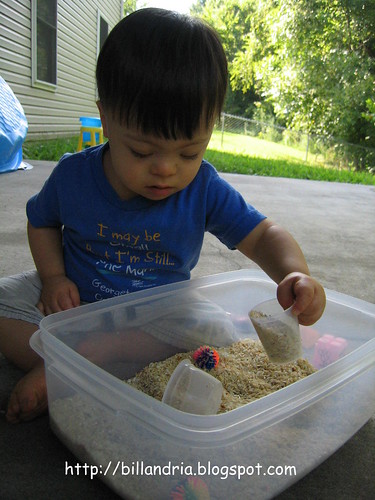
I think I can safely say that Matthew is not tactile defensive. This simply means he is not sensitive to touch sensations or easily overwhelmed by our ordinary daily experiences and activities such as hair brushing, walking barefoot on grass, petting our long-haired cat, playing with water, and so on. While these are good indicators that he is neither tactile sensory defensive, I think it is still important to provide the tactile (touch) sensory experience and input that will help Matthew continue to learn and develop a better understanding of the world around him.
Matthew's therapists have given me great ideas for tactile play. We have created homemade tactile sensory boxes using a medium/ large plastic storage box and a variety of materials. I use this type of play to help build language or concepts like 'scoop' and 'pour' and 'stir' while purposefully working on fine motor skills. Here are some materials that Matthew enjoys playing with:
- Uncooked rice or beans
- Uncooked pasta
- Feathers
- Sand (Moon Sand is also fun)
- Cotton balls or craft pom poms
I've also tried messier, gooier substances but with little to no success as he is highly suspicious and averse to handling them. I've tried painting with pudding on a tray with no success. I've tried playing with Cool Whip or Funny Foam Soap with some success.
Overall, he likes the dry stuff a lot more than the messy, gooey stuff. I think he gets that from me as I have a low tolerance for messy, gooey, and slimy things. So I can't blame the guy for not wanting to play with certain textures, I do have to encourage him to try.
1. Never force him to touch a material.
2. If he is averse to touching a certain material with his hands, I offer him another object such as a spoon to touch, poke, stir, roll, etc, it with.
I'm sure there are so many more materials one can use for tactile sensory play. The few that I mentioned are things we have tried. Please feel free to share other ideas with us.
Tuesday, June 2, 2009
Toy Review Tuesday: Step 2 WaterWheel Table

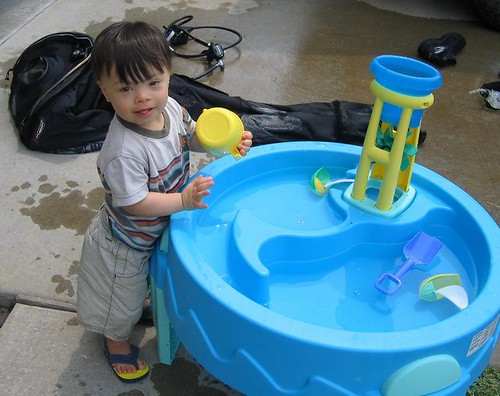
Summer's here! The best toys for the summer are mostly ones that squirt water, hold water, splash water, or anything water. We got this Step 2 WaterWheel Play Table for Christmas last year and we're excited to finally have it out for the summer. A few other versions of this water table include the Sand and Water Transportation Station and Arctic Splash Water Table. There are many more choices on amazon.com but we liked this one because of the simple design and the fun waterwheel. It comes with a 2 boats, a cup and a waterwheel tower.
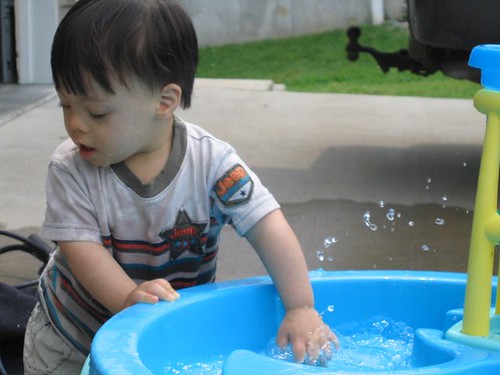
I like that the table elevated and at a perfect height for my 19-month old to play comfortably. Not only does he have fun playing with water, he also gets to practice standing. Sometimes I notice that he does not hold on or lean on the table for support for a few seconds! It's also sturdy enough for Matthew to pull up on and lean on, yet light enough for me to lift (without water in it of course). Matthew's too little to pour water into the bucket above the waterwheel right now but he can manually spin the wheel and watch it go. I'm sure he'll have fun pouring water into it when he's tall enough to reach the top of the water tower. The table is big enough to accommodate 2 or 3 toddler friends. Anyone want to come and play? Be prepared to get splashed though!I do wish the table had a plug at the bottom of the basin to make it easier to drain the water. But I suppose it's light enough anyway that it's just as easy and quicker to pour the water out.
Overall, I think this is a great deal for what we paid. I have also used this for snow in the winter. I set it up in our kitchen. Matthew wasn't interested in the snow but our indoor cat, Yuri, sure had a ball! The table is great for kids and pets!
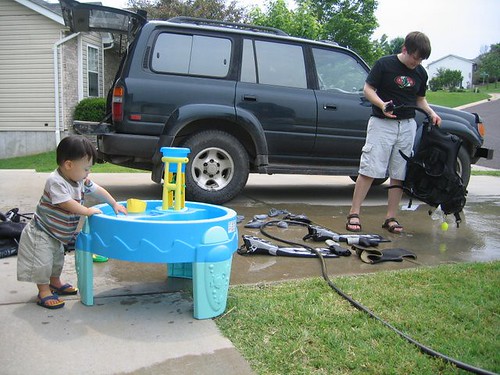
In the photo below: Father and son love water. Matthew is having fun at his water table while Daddy cleans his scuba diving gear.

Approximate retail price as of today: $29.32
About 'Toy Review Tuesday': Every Tuesday, I write about our experience with a toy, while trying to incorporate thoughts on how it may help a child with Down syndrome. This review is not to be construed as an endorsement of the product nor do I intend to put pressure on parents to purchase the toys reviewed. Questions, sharing your own experience, or any other helpful insights are welcome in the comment section.
Subscribe to:
Posts (Atom)