
It was time for Matthew's annual well visit with the pediatrician. Matthew is generally a healthy kid but his pediatrician visits are lengthier and more comprehensive than Elizabeth's doctor visits. There is just so much to go over and keep an eye on such as the thyroid, Celiac disease, blood counts to screen for leukemia, vision, hearing, and so on. Having Down syndrome, in addition to any possible family history of medical issues, puts him in a position of "higher risk" for certain health stressors.
Thankfully, Matthew has not had any major heart issues so he does not see a cardiologist on a regular basis. He had a slight murmur for a few years but that seems to have disappeared.
Reactive Airway Disease
This well visit turned into a not-so-well visit quickly when wheezing was detected through the stethoscope. Matthew had developed a cough on Saturday evening after his birthday party.
He got a breathing treatment right away, which consisted of arbetural delivered via a nebulizer and him sitting, breathing it in and cooperating for 10 whole minutes. He wanted to go home already but we were able to make a game out of using the nebulizer so he fully - and happily - cooperated with the nurse.
The wheezing was reversed after the breathing treatment. This meant that the breathing treatment worked. This also meant that he did not have bronchitis. I will be continuing breathing treatments at home for every 4 to 6 hours or as needed.
I only hope that this does not turn into asthma.
Bloodwork
The part of his annual well visit that I dread the most is bloodwork. Matthew has tiny veins and is a hard stick that many lab technicians have had to stick the needle in his arms and or heel more than once on many occasions. We have only found one lady lab technician who was more skilled at it than any other we have met. Unfortunately, I forgot her name but I know where to find her.
Tip: Once you find a really good lab tech for bloodwork, remember their name and if possible, request for the person at the next blood draw.
It is extremely emotionally stressful for me to have to hold him down or watch him being restrained by several people to get his blood drawn for a series of tests to check thyroid, vitamin D, ferritin, blood counts, and screen for Celiac disease. Matthew cries so hard as struggles to free himself that he breaks a few facial capillaries. This results in two patches of facial petechiae around his eyes for a couple of days.
I am thankful that this year, we did the bloodwork simultaneously with Matthew's orchiopexy surgery. There was minimal restraining involved and it went much quicker since the nurse was able to draw blood directly through the IV needle, which was already in his arm.
The results of the bloodwork: no Celiac disease, thyroid was within normal range, blood counts were within range, and Vitamin D was still on the low side.
Vision
A new concern this year involved his eyes. His neurodevelopmentalist at NACD had noticed slight strabismus so I brought it up with our pediatrician. She concurred and suggested that we have our opthamologist do a more comprehensive exam.
Strabismus is a condition in which the eyes are not properly aligned with each other. It can adversely affect depth perception.
Time to schedule an appointment with our pediatric opthamologist.
Ears, Nose, and Throat
His throat was red today. Probably another virus. But his nose hasn't been runny and he has been fever-free so hopefully this will pass quickly. I'm not sure how this is related to the wheezing though.
Ears were waxy but both ear tubes were still in. We're due for another visit to the ENT soon.
Showing posts with label ENT. Show all posts
Showing posts with label ENT. Show all posts
Monday, October 10, 2011


Saturday, March 5, 2011
Pike Swim Class
Matthew is a frog in the water. He kicks and kicks and kicks. He's all smiles and laughter with water running down his face. I can only see this from the "viewing deck" though. He is in a swim class without me in the pool.

There are four other kids, ages 3 to 5, in the class with two swim instructors. One of the instructors is with Matthew at all times as I had requested. Why? Mainly to help him stay focused and engaged in the class as he tends to zone out or get distracted with everything else around the pool. He has a good attention span when he gets one-to-one time but when he's in a group, his attention seems to wane. I could've enrolled him in private swim lessons but I wanted him to experience being in a group taking turns and having other kids as role models.

He has ear tubes so he wore ear plugs as recommended by his ENT. He popped them out a few times. He had never worn ear plugs before since I had never had his head submerged in the water. So this was a new sensation that he will have to get used to. From what I've heard, all ENT's have different opinions on ear plugs being mandatory in the pool. Some say ear plugs aren't necessary while some would disagree. Lake water is a different story though. I'm hoping Matthew won't need a 3rd set of ear tubes when the ones he has now fall out.

They did laps in the pool today with floaties on their backs and a foam noodle under their arms. They were also taught basic swim strokes, how to float on their belly, float on their back, blow bubbles in the water, jump in, and wade to the pool side. He was shivering by the end of the class but Matthew enjoyed every minute.
There are four other kids, ages 3 to 5, in the class with two swim instructors. One of the instructors is with Matthew at all times as I had requested. Why? Mainly to help him stay focused and engaged in the class as he tends to zone out or get distracted with everything else around the pool. He has a good attention span when he gets one-to-one time but when he's in a group, his attention seems to wane. I could've enrolled him in private swim lessons but I wanted him to experience being in a group taking turns and having other kids as role models.
He has ear tubes so he wore ear plugs as recommended by his ENT. He popped them out a few times. He had never worn ear plugs before since I had never had his head submerged in the water. So this was a new sensation that he will have to get used to. From what I've heard, all ENT's have different opinions on ear plugs being mandatory in the pool. Some say ear plugs aren't necessary while some would disagree. Lake water is a different story though. I'm hoping Matthew won't need a 3rd set of ear tubes when the ones he has now fall out.
They did laps in the pool today with floaties on their backs and a foam noodle under their arms. They were also taught basic swim strokes, how to float on their belly, float on their back, blow bubbles in the water, jump in, and wade to the pool side. He was shivering by the end of the class but Matthew enjoyed every minute.
Saturday, November 6, 2010
Recovering From Surgery: Days 1 to 9 Daily Diary
I kept a daily diary of Matthew's recovery from the tonsillectomy, adenoidectomy and bilateral myringotomy. It took 8 days before Matthew was back to his usual smiley, playful, mischievous self. I'd have to say days 2 to 7 were the hardest for me.
Day 1 - October 27
The day after surgery.
 Matthew has hardly said anything. It's been mostly sporadic bouts of whimpering and crying. Matthew has a high tolerance for pain so for him to be acting this way is indicative of how raw and sore his throat is from the surgery. Plus, he's overtired from the whole ordeal.
We're managing the pain with regular liquid generic tylenol every 4 hours, including late night (9pm) and early morning (1am and 5pm) doses.
We have the option of giving him liquid Tylenol with codeine, which is a narcotic, but I don't want to be dealing with the possible adverse effects such as abdominal pain, nausea and constipation. The ENT also cautioned us about using it as he has seen kids in Matthew's age group (2 to 3?) have trouble with codeine and tend to do just fine with regular Tylenol. But he wrote us a prescription for it just in case we absolutely have to switch to it.
Other meds that we started today are liquid strawberry-flavored Amoxicillin twice a day for 10 days and Ciprodex ear drops twice a day for 3 days. Ibuprofen isn't allowed until after 2 weeks due to a bleeding risk.
 We were discharged from the hospital after a restless night's stay. A tonsillectomy and adenoidectomy is typically an outpatient procedure but we opted to spend the night at the hospital to monitor Matthew's oxygen saturation level post-surgery and make sure he was doing fine overall. I was glad to see the IV removed from his hand yet I was very thankful that he had it in the whole time after the surgery, keeping him hydrated.
He has been refusing to drink or eat anything except for when I got him out of the hospital bed to play on the floor with his current favorite toy - Alphie the Learning Robot. At that time, he actually drank a small amount of apple juice and ate a serving of applesauce without any problems.
He hoarsely said, "Hi Dee" when Bill and Elizabeth arrived to take us home. I requested for a wagon, instead of a wheelchair, to transport Matthew to our car. Matthew loves wagon rides and I was hoping that would cheer him up a little but he was too wore out to manage a smile.


Day 2 - October 28
We had a rough first night at home. His breathing was horribly loud, rattly and a little wheezy. He snored when we were at the hospital but it wasn't bad like last night. I took him into the bathroom for a steam treatment at 1am, very worried about his breathing and hoping we didn't have to resort to using Prednisolone (liquid steroid), which his pediatrician prescribed last year to reduce airway swelling and make it easier for him to breathe. I'm not totally opposed to using it but I like to avoid it if I can due to the associated possible side effects. I'll have to see how he does tonight before talking to his pediatrician about it.
Overall, he's still very tired. He usually only takes one nap in the afternoon. Today, he napped from 9am to noon and again from 3pm to 5pm, making up for lost sleep.
Our main priorities during the recovery period are pain management and hydration.
This is such a frustrating time for him. He doesn't understand why I'm not allowing him to eat his favorite blueberry toaster waffles. On the bright side, the fact that he's not completely weaned off 2nd and 3rd stage baby food is a major PLUS considering he has to be on a soft food diet for 2 weeks. He uncomfortably ate a few spoonfuls of baby food, applesauce and yogurt melts today. He'd take a few spoonfuls of his baby food and then not want any more. His hunger motivates him to eat but the pain makes him not want to eat. He has been refusing milk and most food.
 As for fluid intake, one of the best advice I received was from Maggie (from the blog Take a Walk on the Happy Side). She suggested ice cold water via oral syringe every 20 minutes or as often as possible to keep him hydrated. Dehydration will earn us a trip to the emergency room for IV fluids - something we'd like to avoid at all costs. With a lot of coaxing, he's been amenable to this method of drinking water, which is a good thing as he has refused water from ANY kind of cup.
Despite the pain and discomfort, my sweet little guy still made sure his little sister had enough toys to play with. She was the only one who has managed a little smile out of him today.

Day 3 - October 29
Last night was better. Seems like we will not have to use Prednisolone.
Tonight should be the last night for the 4-hour tylenol dosage. I feel bad waking him up in the middle of the night when he's sleeping so soundly. But I know the pain will be worse for him if I skip a dose this soon. And when the pain is worse, he will be less likely to drink or eat anything.
Today has been harder than yesterday. Numerous times, I was faced with a quandry - Do I comfort the 3-year old who is whimpering and crying from post-surgery discomfort and constipation? Or do I hold my crying 6-month old? Elizabeth was moved many times - from high chair to bumbo to playmat to exersaucer to jumperoo to rocking infant seat - so I could keep her semi-content and Matthew comforted in my arms and on my lap.
 My sister-in-law and her 2 children came over to spend some time with Matthew and help keep his mind off his misery. Matthew was very happy to see his auntie and cousins. He was finally smiling! He and his big cousin played the classic game of "fetch" with a balloon. Repeatedly, he let it float up to the ceiling and enjoyed watching his big cousin get up on a little stool to reach up and retrieve it for him. They had lots of fun with that.

But as soon as they left, he was back to whimpering and crying.
Matthew ate and drank a little more today but he's still hurting. I've been pushing pears in an effort to solve his constipation issue. Pears have always helped him. He had skipped 3 days since Tuesday, which is unusual for him. He finally went today, straining and crying.
Today was the last day for the Ciprodex ear drops. That means one less struggle to deal with.
Day 4 - October 30
Matthew used to grind his teeth before the surgery but it was rare. It has gotten 10 times worse since the surgery. Is this his coping mechanism? Bill and I don't like it but there's nothing we can do. I've offered him his chewy tube, hoping he would chew that instead but he refuses and continues to grind. I can hear him grinding his teeth through the baby monitor.
He has also been drooling a lot, refusing to swallow his own saliva.
I'm beginning to quietly entertain the option of using Tylenol with codeine. Maybe that will help knock the pain down more. But the thought of the possible adverse effects hold me back.
Eating was tougher today. The ENT did say that the pain would peak on Day 4. He took a few sips of ice cold milk and some ice cold apple juice. His fluid intake is still nowhere near what he usually drank pre-surgery but administering ice cold water via oral syringe seems to be keeping him hydrated enough to avoid a hospital visit.
Our clothes have pink stains from the Amoxicillin and Tylenol. Not that I mind. The stains are simply a testament to the medicine battles that have ensued since Day 1. Most of the time he cooperates very well with taking his medicine. But there are a few times when he doesn't. The stains will easily come off in the wash.
I'm so thankful for the weekend. With Bill home during the day, taking care of Matthew was easier.
Day 5 - October 31
Matthew woke up better rested today. We skipped the middle of the night Tylenol doses and he did fine. He did wake up twice in the night coughing very badly though. I was sure he was going to throw up but he didn't. A little water via oral syringe helped. I guess his throat was dry. We've had the humidifier running in his room since Day 1. He had a dose of Tylenol as soon as he was up for the day.
A few more smiles and laughter than whimpers and cries today. But the smiles were short-lived. The pain was far from gone. Just when I begin to think he's feeling better, he burst into tears again. It was a see-saw throughout the day. The only way he would nap in the afternoon was on Bill in the rocker-recliner.

We managed to take him trick-or-treating with our neighbor for a short while around our neighborhood. We almost didn't because he was crying inconsolably leading up to the time we had planned to go. Thankfully, he calmed down and had a nice time trick-or-treating.

He finally ate some pasta shells with cheese sauce for dinner today and that seemed to help him feel better.
Day 6 - November 1
Our morning started out with crying after another rough night with a couple bouts of coughing and crying. Matthew wanted to be held. Elizabeth wanted to be held at the same time. I found myself with Matthew on my left arm and Elizabeth on my right most of the day. I wished I had more arms. I wished I had a clone to help me during this time. I wished it was the weekend already so Bill would be home to help during the day.
Matthew has lost weight, as expected. He was noticeably lighter. The good news is we've successfully kept him hydrated so far though. Yay for little victories! In addition to taking water from an oral syringe, he sometimes timidly licked frozen apple juice.

I called the ENT's office today to ask if Matthew could have waffles and crackers. I was happily surprised when the doctor gave us the green light. Actually, it was more a yellow light - proceed with caution. If he has trouble swallowing or started bleeding, then we pull back.
 Matthew had been begging for waffles since Day 1. He was happy that I actually let him have a waffle today. He did not have trouble swallowing it. After he ate 2 blueberry toaster waffles, he miraculously drank his milk, stopped whimpering and was content playing with his toys. The magical effects of the waffles lasted about 2 hours. Then it was back to whimpering and wanting to be held constantly, which I don't mind at all. I would cuddle with him all day if I didn't have to feed Elizabeth, change her diaper, eat, drink or go to the bathroom.
Day 7 - November 2
Today was the most frustrating day for me. The frustration, helplessness, stress and lack of sleep that had been building since Day 2 overwhelmed me today. I had a difficult time coping. Where was my clone when I needed one?
Matthew refused to nap in the afternoon but he could've used one. His crying woke up Elizabeth. I held both of them. Elizabeth was in the baby bjorn, off-centered toward my left, and Matthew on my right. If I sat down, Elizabeth started crying. If I walked, Elizabeth calmed down but Matthew started crying.

I captured this moment for posterity sake, carrying about a total of 45 pounds. Maybe 5 years from now, I will look at this photo and laugh.
He only needed Tylenol once today. Hoping for a better day tomorrow.
Day 8 - November 3
I let Matthew eat animal crackers today. He was shoving animal crackers into his mouth and leaving crumbs all around him, much like Sesame Street's Cookie Monster.
Overall, Matthew was in a better mood today. He whimpered wanted to be held twice in the morning only afterwhich he happily played with his toys. He was refusing to cuddle with me the rest of the day. No Tylenol today. Signs of a full recovery? I'm hoping!
Teeth grinding continues but it doesn't seem like it's as bad or as loud. It needs to stop.
Day 9 - November 4
Matthew has fully recovered! Matthew is definitely back to his usual self except he still grinds his teeth and he's still not drinking as much milk as he used to. He's down to 8 oz. of milk per day when he used to drink at least 32 oz. in a day.
I'm happy to report that we did not experience any post-surgery bleeding. I had also expected him to have horrible bad breath, as reported by some parents who had gone through this experience as well, but his breath was fine. We also did not use the liquid Tylenol with codeine at all.
Day 1 - October 27
The day after surgery.
Matthew has hardly said anything. It's been mostly sporadic bouts of whimpering and crying. Matthew has a high tolerance for pain so for him to be acting this way is indicative of how raw and sore his throat is from the surgery. Plus, he's overtired from the whole ordeal.We're managing the pain with regular liquid generic tylenol every 4 hours, including late night (9pm) and early morning (1am and 5pm) doses.
We have the option of giving him liquid Tylenol with codeine, which is a narcotic, but I don't want to be dealing with the possible adverse effects such as abdominal pain, nausea and constipation. The ENT also cautioned us about using it as he has seen kids in Matthew's age group (2 to 3?) have trouble with codeine and tend to do just fine with regular Tylenol. But he wrote us a prescription for it just in case we absolutely have to switch to it.
Other meds that we started today are liquid strawberry-flavored Amoxicillin twice a day for 10 days and Ciprodex ear drops twice a day for 3 days. Ibuprofen isn't allowed until after 2 weeks due to a bleeding risk.
We were discharged from the hospital after a restless night's stay. A tonsillectomy and adenoidectomy is typically an outpatient procedure but we opted to spend the night at the hospital to monitor Matthew's oxygen saturation level post-surgery and make sure he was doing fine overall. I was glad to see the IV removed from his hand yet I was very thankful that he had it in the whole time after the surgery, keeping him hydrated. He has been refusing to drink or eat anything except for when I got him out of the hospital bed to play on the floor with his current favorite toy - Alphie the Learning Robot. At that time, he actually drank a small amount of apple juice and ate a serving of applesauce without any problems.
He hoarsely said, "Hi Dee" when Bill and Elizabeth arrived to take us home. I requested for a wagon, instead of a wheelchair, to transport Matthew to our car. Matthew loves wagon rides and I was hoping that would cheer him up a little but he was too wore out to manage a smile.
Day 2 - October 28
We had a rough first night at home. His breathing was horribly loud, rattly and a little wheezy. He snored when we were at the hospital but it wasn't bad like last night. I took him into the bathroom for a steam treatment at 1am, very worried about his breathing and hoping we didn't have to resort to using Prednisolone (liquid steroid), which his pediatrician prescribed last year to reduce airway swelling and make it easier for him to breathe. I'm not totally opposed to using it but I like to avoid it if I can due to the associated possible side effects. I'll have to see how he does tonight before talking to his pediatrician about it.
Overall, he's still very tired. He usually only takes one nap in the afternoon. Today, he napped from 9am to noon and again from 3pm to 5pm, making up for lost sleep.
Our main priorities during the recovery period are pain management and hydration.
This is such a frustrating time for him. He doesn't understand why I'm not allowing him to eat his favorite blueberry toaster waffles. On the bright side, the fact that he's not completely weaned off 2nd and 3rd stage baby food is a major PLUS considering he has to be on a soft food diet for 2 weeks. He uncomfortably ate a few spoonfuls of baby food, applesauce and yogurt melts today. He'd take a few spoonfuls of his baby food and then not want any more. His hunger motivates him to eat but the pain makes him not want to eat. He has been refusing milk and most food.
As for fluid intake, one of the best advice I received was from Maggie (from the blog Take a Walk on the Happy Side). She suggested ice cold water via oral syringe every 20 minutes or as often as possible to keep him hydrated. Dehydration will earn us a trip to the emergency room for IV fluids - something we'd like to avoid at all costs. With a lot of coaxing, he's been amenable to this method of drinking water, which is a good thing as he has refused water from ANY kind of cup.Despite the pain and discomfort, my sweet little guy still made sure his little sister had enough toys to play with. She was the only one who has managed a little smile out of him today.
Day 3 - October 29
Last night was better. Seems like we will not have to use Prednisolone.
Tonight should be the last night for the 4-hour tylenol dosage. I feel bad waking him up in the middle of the night when he's sleeping so soundly. But I know the pain will be worse for him if I skip a dose this soon. And when the pain is worse, he will be less likely to drink or eat anything.
Today has been harder than yesterday. Numerous times, I was faced with a quandry - Do I comfort the 3-year old who is whimpering and crying from post-surgery discomfort and constipation? Or do I hold my crying 6-month old? Elizabeth was moved many times - from high chair to bumbo to playmat to exersaucer to jumperoo to rocking infant seat - so I could keep her semi-content and Matthew comforted in my arms and on my lap.
My sister-in-law and her 2 children came over to spend some time with Matthew and help keep his mind off his misery. Matthew was very happy to see his auntie and cousins. He was finally smiling! He and his big cousin played the classic game of "fetch" with a balloon. Repeatedly, he let it float up to the ceiling and enjoyed watching his big cousin get up on a little stool to reach up and retrieve it for him. They had lots of fun with that. But as soon as they left, he was back to whimpering and crying.
Matthew ate and drank a little more today but he's still hurting. I've been pushing pears in an effort to solve his constipation issue. Pears have always helped him. He had skipped 3 days since Tuesday, which is unusual for him. He finally went today, straining and crying.
Today was the last day for the Ciprodex ear drops. That means one less struggle to deal with.
Day 4 - October 30
Matthew used to grind his teeth before the surgery but it was rare. It has gotten 10 times worse since the surgery. Is this his coping mechanism? Bill and I don't like it but there's nothing we can do. I've offered him his chewy tube, hoping he would chew that instead but he refuses and continues to grind. I can hear him grinding his teeth through the baby monitor.
He has also been drooling a lot, refusing to swallow his own saliva.
I'm beginning to quietly entertain the option of using Tylenol with codeine. Maybe that will help knock the pain down more. But the thought of the possible adverse effects hold me back.
Eating was tougher today. The ENT did say that the pain would peak on Day 4. He took a few sips of ice cold milk and some ice cold apple juice. His fluid intake is still nowhere near what he usually drank pre-surgery but administering ice cold water via oral syringe seems to be keeping him hydrated enough to avoid a hospital visit.
Our clothes have pink stains from the Amoxicillin and Tylenol. Not that I mind. The stains are simply a testament to the medicine battles that have ensued since Day 1. Most of the time he cooperates very well with taking his medicine. But there are a few times when he doesn't. The stains will easily come off in the wash.
I'm so thankful for the weekend. With Bill home during the day, taking care of Matthew was easier.
Day 5 - October 31
Matthew woke up better rested today. We skipped the middle of the night Tylenol doses and he did fine. He did wake up twice in the night coughing very badly though. I was sure he was going to throw up but he didn't. A little water via oral syringe helped. I guess his throat was dry. We've had the humidifier running in his room since Day 1. He had a dose of Tylenol as soon as he was up for the day.
A few more smiles and laughter than whimpers and cries today. But the smiles were short-lived. The pain was far from gone. Just when I begin to think he's feeling better, he burst into tears again. It was a see-saw throughout the day. The only way he would nap in the afternoon was on Bill in the rocker-recliner.
We managed to take him trick-or-treating with our neighbor for a short while around our neighborhood. We almost didn't because he was crying inconsolably leading up to the time we had planned to go. Thankfully, he calmed down and had a nice time trick-or-treating.
He finally ate some pasta shells with cheese sauce for dinner today and that seemed to help him feel better.
Day 6 - November 1
Our morning started out with crying after another rough night with a couple bouts of coughing and crying. Matthew wanted to be held. Elizabeth wanted to be held at the same time. I found myself with Matthew on my left arm and Elizabeth on my right most of the day. I wished I had more arms. I wished I had a clone to help me during this time. I wished it was the weekend already so Bill would be home to help during the day.
Matthew has lost weight, as expected. He was noticeably lighter. The good news is we've successfully kept him hydrated so far though. Yay for little victories! In addition to taking water from an oral syringe, he sometimes timidly licked frozen apple juice.
I called the ENT's office today to ask if Matthew could have waffles and crackers. I was happily surprised when the doctor gave us the green light. Actually, it was more a yellow light - proceed with caution. If he has trouble swallowing or started bleeding, then we pull back.
Matthew had been begging for waffles since Day 1. He was happy that I actually let him have a waffle today. He did not have trouble swallowing it. After he ate 2 blueberry toaster waffles, he miraculously drank his milk, stopped whimpering and was content playing with his toys. The magical effects of the waffles lasted about 2 hours. Then it was back to whimpering and wanting to be held constantly, which I don't mind at all. I would cuddle with him all day if I didn't have to feed Elizabeth, change her diaper, eat, drink or go to the bathroom. Day 7 - November 2
Today was the most frustrating day for me. The frustration, helplessness, stress and lack of sleep that had been building since Day 2 overwhelmed me today. I had a difficult time coping. Where was my clone when I needed one?
Matthew refused to nap in the afternoon but he could've used one. His crying woke up Elizabeth. I held both of them. Elizabeth was in the baby bjorn, off-centered toward my left, and Matthew on my right. If I sat down, Elizabeth started crying. If I walked, Elizabeth calmed down but Matthew started crying.
I captured this moment for posterity sake, carrying about a total of 45 pounds. Maybe 5 years from now, I will look at this photo and laugh.
He only needed Tylenol once today. Hoping for a better day tomorrow.
Day 8 - November 3
I let Matthew eat animal crackers today. He was shoving animal crackers into his mouth and leaving crumbs all around him, much like Sesame Street's Cookie Monster.
Overall, Matthew was in a better mood today. He whimpered wanted to be held twice in the morning only afterwhich he happily played with his toys. He was refusing to cuddle with me the rest of the day. No Tylenol today. Signs of a full recovery? I'm hoping!
Teeth grinding continues but it doesn't seem like it's as bad or as loud. It needs to stop.
Day 9 - November 4
Matthew has fully recovered! Matthew is definitely back to his usual self except he still grinds his teeth and he's still not drinking as much milk as he used to. He's down to 8 oz. of milk per day when he used to drink at least 32 oz. in a day.
I'm happy to report that we did not experience any post-surgery bleeding. I had also expected him to have horrible bad breath, as reported by some parents who had gone through this experience as well, but his breath was fine. We also did not use the liquid Tylenol with codeine at all.
Thursday, October 28, 2010
Tonsillectomy, Adenoidectomy & Bilateral Myringotomy Surgery Day
A 3 for 1! 3 surgical procedures under 1 general anesthesia. Matthew's large tonsils and large adenoid were surgically removed on October 26. Ear tubes were also put in both ears.
A Little Background
He didn't go through a sleep study to test if he had sleep apnea but my mommy instincts told me he did. We watched him on the video monitor. He sometimes woke up in the middle of the night with a little *gasp* and sat up, was restless and sounded congested. After discussing our concerns with his pediatric ENT over 3 visits, we decided to go ahead with the tonsillectomy and superior adenoidectomy as a solution for the sleep apnea issues. (See blog entry from June 2009 ENT Appointment - Surgery?).
A superior adenoidectomy means that only the top part of the adenoid will be removed. The pediatric ENT will leave the bottom part of the adenoid so that the palate still has something to go up against.
"A child with Down syndrome has a naturally hypotonic palate," the ENT explained. "This is different from a submucous cleft palate but similar in that the palate is softer to the touch than it usually is. The adenoid is basically a 3rd tonsil in the back of the throat and nose which pushes against the palate allowing us to make certain speech sounds accurately. Removing all of the adenoid may cause voice quality issues." Bill and I viewed this as undermining the structure of Matthew's palate. Leaving the bottom part of the adenoid was a precautionary measure to preserve Matthew's voice quality - a way to avoid developing a nasal resonance in his voice.
Ear tubes were needed to help his ears drain middle ear fluid more efficiently. This would be his 2nd set of ear tubes. The first set that was in when he was about 8 months old had already fallen out and the holes from the 1st set of tubes had healed well. He has had fluid in his right ear for many months now and the doctor noted that his ear drum was "purple and bulging." His left ear, however, was fluid-free. Despite the clear ear, both ears still got tubes - a procedure called bilateral myringotomy.
Surgery Day
7:25 am: Matthew had 6 ounces of apple juice, a clear liquid that he was allowed to have until 7;30am. He wasn't allowed food after midnight.
 9:10 am: We arrived at the waiting area half an hour earlier than we were told to be there. Matthew enjoyed looking at fish while waiting our turn. I had a knot in my stomach from the anxiety that had been building up over the past few weeks, anticipating today's surgery.
 10:00 am: Matthew was called in to prep for surgery. While waiting, he enjoyed coloring this book, the bed and pillow. He also enjoyed watching Elizabeth play.

11:00 am: Matthew was becoming irritable from hunger. Several times, he said, "Bibi, crkrs" (Mommy, crackers) while signing crackers. I felt so sorry that I couldn't give him what he wanted. We turned the tv on to the Mickey Mouse channel in our pre-surgery room to keep him occupied.
 11:30 am: Versed, an anti-anxiety drug, and liquid tylenol were administered orally with a syringe. A few nurses and the anesthesiologist came to introduce themselves and talk to us about their role in Matthew's surgery.
12:00 pm: A very calm and drowsy Matthew was taken to the operating room. I bought sandwiches for Bill and I to eat while waiting. Elizabeth was so tired.

1:00 pm: The ENT came to talk to us with a post-surgery update. "The surgery went well. Matthew's adenoid was large," he said, "and it may be the chunk of his problem. Our priority now is pain management. Regular tylenol every 4 hours works the best for kids in Matthew's age group. Prescription tylenol with a narcotic called codeine would knock the pain down a few more levels but it seems to cause stomach problems and other side effects in young children. The pain will subside over a few days but may suddenly peak around day 7 of recovery. A few streaks of blood in saliva can be expected but if he starts coughing up bright red blood, call the office and he may need to be taken to the emergency room." So we agreed that we would use regular tylenol and only switch to tylenol with codeine if needed. A nurse led me to the recovery area. Matthew was just waking up from the anesthesia. He was upset, cranky and disoriented. The nurse reassured me that this was nothing out of the ordinary and that Matthew was probably seeing double or had blurred vision as he was waking up. With the tonsillectomy, his voice was also very rough and rattly due to the swelling in his throat and felt like he had something caught in his throat. Matthew eventually calmed down, hugging me, but still attempted to pull his IV out of his hand.
 2:00 pm: A nurse wheeled us up to our post-operation room in the Pediatrics unit of the hospital. Bill and Elizabeth were already there waiting for us. Bill and I took turns snuggling with our very tired little guy. Matthew had given up on trying to pull the IV out of his hand.

 5:00 pm: Matthew received his first post-op dose of regular grape-flavored Tylenol (acetominophen) for pain management. The next dose was in 4 hours. After Elizabeth had another bottle of milk, she and Bill headed home. Matthew and I watched cartoons on TV and snuggled in bed. He still refused to drink any water or juice even with a syringe. At least he was getting IV fluid so dehydration wasn't a concern at this time. The ENT came by to see how he was doing.
 9:00pm: Another dose of regular tylenol. He had been sleeping in approximately 1-hour increments. He snored due to the swelling in his throat. Coughing would wake him up and upset him. I wanted to take the pain away from him but all I could do was comfort him. So far, the regular tylenol seemed to be working just fine.
11:00pm: As expected, it was a long and sleepless night for me, a restless night for Matthew, but I was thankful for a successful surgery. I was thankful for being at the hospital and for the IV fluid Matthew was receiving. He was still refusing to drink and the IV fluid was keeping him hydrated. I was thankful for all the thoughts and prayers from family and friends. Thank you!
Now, we begin the 9 to 14 day recovery period.
Related posts:
ENT Appointment - Surgery?
Recovering from Surgery: Days 1 to 9 Daily Diary
A Little Background
He didn't go through a sleep study to test if he had sleep apnea but my mommy instincts told me he did. We watched him on the video monitor. He sometimes woke up in the middle of the night with a little *gasp* and sat up, was restless and sounded congested. After discussing our concerns with his pediatric ENT over 3 visits, we decided to go ahead with the tonsillectomy and superior adenoidectomy as a solution for the sleep apnea issues. (See blog entry from June 2009 ENT Appointment - Surgery?).
A superior adenoidectomy means that only the top part of the adenoid will be removed. The pediatric ENT will leave the bottom part of the adenoid so that the palate still has something to go up against.
"A child with Down syndrome has a naturally hypotonic palate," the ENT explained. "This is different from a submucous cleft palate but similar in that the palate is softer to the touch than it usually is. The adenoid is basically a 3rd tonsil in the back of the throat and nose which pushes against the palate allowing us to make certain speech sounds accurately. Removing all of the adenoid may cause voice quality issues." Bill and I viewed this as undermining the structure of Matthew's palate. Leaving the bottom part of the adenoid was a precautionary measure to preserve Matthew's voice quality - a way to avoid developing a nasal resonance in his voice.
Ear tubes were needed to help his ears drain middle ear fluid more efficiently. This would be his 2nd set of ear tubes. The first set that was in when he was about 8 months old had already fallen out and the holes from the 1st set of tubes had healed well. He has had fluid in his right ear for many months now and the doctor noted that his ear drum was "purple and bulging." His left ear, however, was fluid-free. Despite the clear ear, both ears still got tubes - a procedure called bilateral myringotomy.
Surgery Day
7:25 am: Matthew had 6 ounces of apple juice, a clear liquid that he was allowed to have until 7;30am. He wasn't allowed food after midnight.
9:10 am: We arrived at the waiting area half an hour earlier than we were told to be there. Matthew enjoyed looking at fish while waiting our turn. I had a knot in my stomach from the anxiety that had been building up over the past few weeks, anticipating today's surgery.10:00 am: Matthew was called in to prep for surgery. While waiting, he enjoyed coloring this book, the bed and pillow. He also enjoyed watching Elizabeth play.11:00 am: Matthew was becoming irritable from hunger. Several times, he said, "Bibi, crkrs" (Mommy, crackers) while signing crackers. I felt so sorry that I couldn't give him what he wanted. We turned the tv on to the Mickey Mouse channel in our pre-surgery room to keep him occupied.
11:30 am: Versed, an anti-anxiety drug, and liquid tylenol were administered orally with a syringe. A few nurses and the anesthesiologist came to introduce themselves and talk to us about their role in Matthew's surgery.12:00 pm: A very calm and drowsy Matthew was taken to the operating room. I bought sandwiches for Bill and I to eat while waiting. Elizabeth was so tired.
1:00 pm: The ENT came to talk to us with a post-surgery update. "The surgery went well. Matthew's adenoid was large," he said, "and it may be the chunk of his problem. Our priority now is pain management. Regular tylenol every 4 hours works the best for kids in Matthew's age group. Prescription tylenol with a narcotic called codeine would knock the pain down a few more levels but it seems to cause stomach problems and other side effects in young children. The pain will subside over a few days but may suddenly peak around day 7 of recovery. A few streaks of blood in saliva can be expected but if he starts coughing up bright red blood, call the office and he may need to be taken to the emergency room." So we agreed that we would use regular tylenol and only switch to tylenol with codeine if needed. A nurse led me to the recovery area. Matthew was just waking up from the anesthesia. He was upset, cranky and disoriented. The nurse reassured me that this was nothing out of the ordinary and that Matthew was probably seeing double or had blurred vision as he was waking up. With the tonsillectomy, his voice was also very rough and rattly due to the swelling in his throat and felt like he had something caught in his throat. Matthew eventually calmed down, hugging me, but still attempted to pull his IV out of his hand.
2:00 pm: A nurse wheeled us up to our post-operation room in the Pediatrics unit of the hospital. Bill and Elizabeth were already there waiting for us. Bill and I took turns snuggling with our very tired little guy. Matthew had given up on trying to pull the IV out of his hand. 5:00 pm: Matthew received his first post-op dose of regular grape-flavored Tylenol (acetominophen) for pain management. The next dose was in 4 hours. After Elizabeth had another bottle of milk, she and Bill headed home. Matthew and I watched cartoons on TV and snuggled in bed. He still refused to drink any water or juice even with a syringe. At least he was getting IV fluid so dehydration wasn't a concern at this time. The ENT came by to see how he was doing.9:00pm: Another dose of regular tylenol. He had been sleeping in approximately 1-hour increments. He snored due to the swelling in his throat. Coughing would wake him up and upset him. I wanted to take the pain away from him but all I could do was comfort him. So far, the regular tylenol seemed to be working just fine. 11:00pm: As expected, it was a long and sleepless night for me, a restless night for Matthew, but I was thankful for a successful surgery. I was thankful for being at the hospital and for the IV fluid Matthew was receiving. He was still refusing to drink and the IV fluid was keeping him hydrated. I was thankful for all the thoughts and prayers from family and friends. Thank you!
Now, we begin the 9 to 14 day recovery period.
Related posts:
ENT Appointment - Surgery?
Recovering from Surgery: Days 1 to 9 Daily Diary
Thursday, July 29, 2010
Brainstem Auditory Evoked Response
We were at the hospital this past Tuesday for Matthew's scheduled BAER (Brainstem Auditory Evoked Response) test. He had to be sedated for the test and we were told that the test would take anywhere from 1 to 4 hours depending on how well the test was going. He was not to have anything to eat after midnight and allowed only clear liquids (water, Sprite, apple juice) until 5am with the hearing test at 8am.
 We woke Matthew at 5:45am. He wasn't mad that we woke him up, just confused but more than happy to get into the car. (He loves car rides.) We left the house at 6am and arrived at the hospital at 7am and checked in at the Pediatric Outpatient Sedation Unit. A pediatric nurse took Matthew's vitals and administered Versed mixed with a small amount of apple juice. Matthew loves apple juice but he drank this reluctantly, tasting the medicine in it.
The audiologist and anesthesiologist met with us before the test to give us a run down of what was going to happen before, during and after the test and to answer any other questions we had about the test. The plan was to administer general anesthesia via a gas mask and start with two other hearing tests - a tympanogram and an OAE (Otoaccoustic Emissions) test - before proceeding with the BAER.
At 8am, the nurse took a very drowsy Matthew to the testing room. The wait began for Bill and I. We had left Elizabeth home with my mom so we took the opportunity to eat a decent breakfast and nap.
What is BAER?
Brainstem auditory evoked response (BAER) is also known as Auditory Brainstem Response (ABR). The BAER is done under general anesthesia with younger patients. It is a painless test to measure the brain wave activity that occurs in response to clicks or certain tones conducted through earpieces in the ear canals. Sticky pad electrodes are attached to the scalp to track sound moving through the ear to the brain. The anesthesiologist and pediatric nurse are present during the whole procedure to monitor breathing and vitals. Matthew was intubated (breathing tube down his throat) to help with his breathing during the test.
We opted for a diagnostic BAER for Matthew, also upon his ENT's (doctor) suggestion, to find out how well he was hearing. The literature on Down syndrome points out that up to 80% of individuals with Down syndrome have hearing issues. Matthew has proven that he can hear quite well, being able to hear a doorknob turn even if he was two rooms away. And except for his speech delay and occasional fluid in his middle ears, there was no specific indication that he had any significant hearing loss.
The BAER would answer questions we had: Can he hear different pitches/ sound frequencies well? Can he not hear some pitches? What decibels (loudness & softness of sound) can he hear? It would also give us a good idea of how well Matthew is hearing various sounds, especially in relation to speech. For example, the letter "a" is a high frequency sound/ pitch compared to "d", which is a low frequency/ pitch. If Matthew wasn't hearing some tonal pitches, then I think that would significantly slow down his speech development. Of course, there may be other causes of speech delay, such as verbal apraxia, and we want to check what we can to either rule them out or determine the best possible strategy to overcome it.
Other Hearing Tests
Matthew has never had a BAER test before. As a newborn, he passed the OAE (Otoaccoustic Emissions), which is a routine hearing test done on sleeping newborns before they are discharged from the hospital. The OAE test measures the weak echo sounds made by the ear as soon as it hears. If no echo sounds are detected through this test, there may be possible hearing loss.
When he was about 6 months old, he had a tympanogram, which is another type of hearing test but it measures movement of the eardrum only in response to a sound. The result of a tympanogram is charted by a computer. A peak in the chart indicates movement of the eardrum. A flat line on the chart is an indication of no eardrum movement and fluid in the ear. There may be some degree of hearing loss or hearing distortion depending on how much fluid is present. After the first couple tympanograms, he got tubes in both ears when he was 8 months old. He had fluid in his ears. Both tubes fell out after about a year or so. He has had several tympanograms since then and they've always been flatliners. This was another reason why we wanted a BAER done as it is known to be more accurate and can get more information compared to the OAE and tympanogram.
The Results
The test took 2-1/2 hours and the results were discussed with us immediately after. According to the tympanogram, Matthew has fluid in both ears. We came to the hospital with the knowledge that he had fluid in one ear since his June 2010 visit with his ENT. Having fluid in both ears isn't good especially if it doesn't drain well into his eustachian tubes, making him susceptible to ear infections, which could in turn affect his hearing. The tympanogram doesn't detect how much fluid is present so we'll need to schedule an appointment with his ENT within the next month or two.
According to the BAER, Matthew can hear all pitches and decibels tested within normal hearing levels. So perhaps there isn't a lot of fluid in his ears if the audiologist successfully used a BAER to test his hearing. But the only way to tell for sure is to have the ENT look into both ears with a microscope to determine if Matthew will need another set of ear tubes.
Recovery
Matthew was out of sorts and mad after waking from the anesthesia. The anesthesiologist explained that this was expected. He was taking in very (scary) deep noisy breaths every few minutes - also expected since his was intubated and under general anesthesia. We were to give him clear liquids if he wanted to drink. We stayed at the hospital until Matthew was feeling a little better, probably another 30 minutes, before heading home.
Once home, Matthew had some lunch and kept everything down. He was still a little unstable on his feet. After his afternoon nap, he was back to his usual playful self.
We woke Matthew at 5:45am. He wasn't mad that we woke him up, just confused but more than happy to get into the car. (He loves car rides.) We left the house at 6am and arrived at the hospital at 7am and checked in at the Pediatric Outpatient Sedation Unit. A pediatric nurse took Matthew's vitals and administered Versed mixed with a small amount of apple juice. Matthew loves apple juice but he drank this reluctantly, tasting the medicine in it. The audiologist and anesthesiologist met with us before the test to give us a run down of what was going to happen before, during and after the test and to answer any other questions we had about the test. The plan was to administer general anesthesia via a gas mask and start with two other hearing tests - a tympanogram and an OAE (Otoaccoustic Emissions) test - before proceeding with the BAER.
At 8am, the nurse took a very drowsy Matthew to the testing room. The wait began for Bill and I. We had left Elizabeth home with my mom so we took the opportunity to eat a decent breakfast and nap.
What is BAER?
Brainstem auditory evoked response (BAER) is also known as Auditory Brainstem Response (ABR). The BAER is done under general anesthesia with younger patients. It is a painless test to measure the brain wave activity that occurs in response to clicks or certain tones conducted through earpieces in the ear canals. Sticky pad electrodes are attached to the scalp to track sound moving through the ear to the brain. The anesthesiologist and pediatric nurse are present during the whole procedure to monitor breathing and vitals. Matthew was intubated (breathing tube down his throat) to help with his breathing during the test.
We opted for a diagnostic BAER for Matthew, also upon his ENT's (doctor) suggestion, to find out how well he was hearing. The literature on Down syndrome points out that up to 80% of individuals with Down syndrome have hearing issues. Matthew has proven that he can hear quite well, being able to hear a doorknob turn even if he was two rooms away. And except for his speech delay and occasional fluid in his middle ears, there was no specific indication that he had any significant hearing loss.
The BAER would answer questions we had: Can he hear different pitches/ sound frequencies well? Can he not hear some pitches? What decibels (loudness & softness of sound) can he hear? It would also give us a good idea of how well Matthew is hearing various sounds, especially in relation to speech. For example, the letter "a" is a high frequency sound/ pitch compared to "d", which is a low frequency/ pitch. If Matthew wasn't hearing some tonal pitches, then I think that would significantly slow down his speech development. Of course, there may be other causes of speech delay, such as verbal apraxia, and we want to check what we can to either rule them out or determine the best possible strategy to overcome it.
Other Hearing Tests
Matthew has never had a BAER test before. As a newborn, he passed the OAE (Otoaccoustic Emissions), which is a routine hearing test done on sleeping newborns before they are discharged from the hospital. The OAE test measures the weak echo sounds made by the ear as soon as it hears. If no echo sounds are detected through this test, there may be possible hearing loss.
When he was about 6 months old, he had a tympanogram, which is another type of hearing test but it measures movement of the eardrum only in response to a sound. The result of a tympanogram is charted by a computer. A peak in the chart indicates movement of the eardrum. A flat line on the chart is an indication of no eardrum movement and fluid in the ear. There may be some degree of hearing loss or hearing distortion depending on how much fluid is present. After the first couple tympanograms, he got tubes in both ears when he was 8 months old. He had fluid in his ears. Both tubes fell out after about a year or so. He has had several tympanograms since then and they've always been flatliners. This was another reason why we wanted a BAER done as it is known to be more accurate and can get more information compared to the OAE and tympanogram.
The Results
The test took 2-1/2 hours and the results were discussed with us immediately after. According to the tympanogram, Matthew has fluid in both ears. We came to the hospital with the knowledge that he had fluid in one ear since his June 2010 visit with his ENT. Having fluid in both ears isn't good especially if it doesn't drain well into his eustachian tubes, making him susceptible to ear infections, which could in turn affect his hearing. The tympanogram doesn't detect how much fluid is present so we'll need to schedule an appointment with his ENT within the next month or two.
According to the BAER, Matthew can hear all pitches and decibels tested within normal hearing levels. So perhaps there isn't a lot of fluid in his ears if the audiologist successfully used a BAER to test his hearing. But the only way to tell for sure is to have the ENT look into both ears with a microscope to determine if Matthew will need another set of ear tubes.
Recovery
Matthew was out of sorts and mad after waking from the anesthesia. The anesthesiologist explained that this was expected. He was taking in very (scary) deep noisy breaths every few minutes - also expected since his was intubated and under general anesthesia. We were to give him clear liquids if he wanted to drink. We stayed at the hospital until Matthew was feeling a little better, probably another 30 minutes, before heading home.
Once home, Matthew had some lunch and kept everything down. He was still a little unstable on his feet. After his afternoon nap, he was back to his usual playful self.
Tuesday, January 12, 2010
Ear Tubes Update
It seems that hearing problems are common among kids with Down syndrome according to many articles and books that I have read. The hearing loss, whether slight or severe, usually stems from ear infections, having fluid in the middle ear that does not drain quickly enough (or at all) due to narrower Eustachian tubes compared to the "average" individual. So from the very beginning, we took a very pro-active stance when it came to Matthew's ears. We had many questions. After two successive tympanometry tests, a type of hearing test that measures how sound waves travel through the ear, indicating fluid behind the ears, Matthew underwent a Bilateral Myringotomy with tubes, which is a surgical procedure for ear tubes in both ears, when he was barely 8 months old (June 2008). It was a 10-15 minute surgery and the doctor didn't think we needed to stay in the hospital overnight for observation. Everything went just fine.
We believe the ear tubes really helped Matthew avoid major ear infections as the tubes helped drain fluid from his middle ear. We also attribute his good hearing to having the ear tubes in.
In June 2009, our new Pediatric Otolaryngologist (Ear, Nose & Throat doctor) we went to, removed the left ear tube that was just sitting in Matthew's ear. It had come out of the eardrum on its own - part of the natural progression of things with ear tubes. In December 2009, the right ear tube was removed. It too had dislodged itself from the eardrum.
The Not-so-good news and the Good News
As of December 2009, the hole where the left ear tube had been was completely healed. The right one had just fallen out so the hole was still in the process of healing. The not-so-good news is that the doctor saw a scab or some skin in the area that might potentially hinder the healing process in the right ear. We're going to have it checked in June this year. If there is skin in the way at his next appointment, then he will need to undergo a minor surgical procedure to remove it. We're hoping that he won't need surgery.
The good news is that the doctor doesn't think Matthew needs another set of ear tubes (right now anyway) because there is no fluid in his ears. The doctor said, "His ears look great!"
Update on Sleep Apnea Concern
Adenoidectomy (surgical procedure to remove the adenoid) and Tonsillectomy (surgical procedure to remove the tonsils) had been discussed at past Otolaryngologist appointments. We were (and still are) concerned about sleep apnea. However, we're not as concerned about it anymore since Matthew's good nights far outweigh bad nights, where he'd wake up coughing and sounding very congested. He also has bad night wakings due to congestion when he has a cold, which is expected for any child.
One of the pros of these procedures is that he'll breathe easier. One of the cons of these procedures is that it could undermine the structure of his nasal passage. After weighing the pros and cons of adenoidectomy and tonsillectomy, our decision is to have surgery only when it is necessary. Our doctor concurs that it is not necessary right now, even if Matthew's tonsils are on the large side of the scale. He suggested a sleep study when Matthew is 4 years old. So we will do that and continue getting his ears checked twice a year.
Freckles?
The only thing I dread right now when going to see the Otolaryngologist is having to hold Matthew down on the examining chair/ table while the doctor looks into his ears with the special magnifying lens and special instruments designed for very small ears. It took three people to hold Matthew steady - a nurse held his head, Bill pinned his arms and I pinned his legs down. Matthew cried so hard that it seems he burst several capillaries around his eyes. It's very faint in this picture but he looks like he has freckles around his eyes.
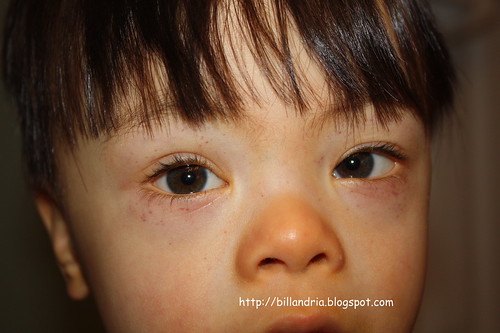
If this is the only price to pay for making sure his ears are in good shape, then we will endure it no matter how it breaks my heart to hear him cry and struggle through it.
Related posts:
A New Pediatric ENT
ENT Appointment - Surgery?
We believe the ear tubes really helped Matthew avoid major ear infections as the tubes helped drain fluid from his middle ear. We also attribute his good hearing to having the ear tubes in.
In June 2009, our new Pediatric Otolaryngologist (Ear, Nose & Throat doctor) we went to, removed the left ear tube that was just sitting in Matthew's ear. It had come out of the eardrum on its own - part of the natural progression of things with ear tubes. In December 2009, the right ear tube was removed. It too had dislodged itself from the eardrum.
The Not-so-good news and the Good News
As of December 2009, the hole where the left ear tube had been was completely healed. The right one had just fallen out so the hole was still in the process of healing. The not-so-good news is that the doctor saw a scab or some skin in the area that might potentially hinder the healing process in the right ear. We're going to have it checked in June this year. If there is skin in the way at his next appointment, then he will need to undergo a minor surgical procedure to remove it. We're hoping that he won't need surgery.
The good news is that the doctor doesn't think Matthew needs another set of ear tubes (right now anyway) because there is no fluid in his ears. The doctor said, "His ears look great!"
Update on Sleep Apnea Concern
Adenoidectomy (surgical procedure to remove the adenoid) and Tonsillectomy (surgical procedure to remove the tonsils) had been discussed at past Otolaryngologist appointments. We were (and still are) concerned about sleep apnea. However, we're not as concerned about it anymore since Matthew's good nights far outweigh bad nights, where he'd wake up coughing and sounding very congested. He also has bad night wakings due to congestion when he has a cold, which is expected for any child.
One of the pros of these procedures is that he'll breathe easier. One of the cons of these procedures is that it could undermine the structure of his nasal passage. After weighing the pros and cons of adenoidectomy and tonsillectomy, our decision is to have surgery only when it is necessary. Our doctor concurs that it is not necessary right now, even if Matthew's tonsils are on the large side of the scale. He suggested a sleep study when Matthew is 4 years old. So we will do that and continue getting his ears checked twice a year.
Freckles?
The only thing I dread right now when going to see the Otolaryngologist is having to hold Matthew down on the examining chair/ table while the doctor looks into his ears with the special magnifying lens and special instruments designed for very small ears. It took three people to hold Matthew steady - a nurse held his head, Bill pinned his arms and I pinned his legs down. Matthew cried so hard that it seems he burst several capillaries around his eyes. It's very faint in this picture but he looks like he has freckles around his eyes.
If this is the only price to pay for making sure his ears are in good shape, then we will endure it no matter how it breaks my heart to hear him cry and struggle through it.
Related posts:
A New Pediatric ENT
ENT Appointment - Surgery?
Monday, June 1, 2009
ENT Appointment - Surgery?
So here's an interesting fact that I learned today: the adenoid, once surgically removed, CAN grow back in some cases. Tonsils don't grow back when surgically removed. We had an appointment with Matthew's new ENT (Ear, Nose, & Throat) doctor today.
Checking Ear Tubes and Tonsils
Bill took the day off work so he could come to the appointment and help hold Matthew down when the doctor checked his ears. I was holding his legs down, Bill was holding his arms down and a nurse was holding Matthew's head in place while the doctor scooped out wax from his left ear. Needless to say, Matthew was very upset about being restrained. Upon inspection under the microscope, the doctor discovered that the ear tube in the left ear had already fallen out so that was scooped out too. There is now a hole in Matthew's eardrum where the tube was set. It may or may not heal on its own but the doctor said that hole will help with drainage and function as if the ear tube was still there. So at the moment, the ear tube does not need to be replaced.
After checking the ears, the doctor checked his tonsils. Yup, they are indeed large. We told him that Matthew snores too. Sometimes, we sometimes hear him gasp for air (sounds like it) over the baby monitor. And when he was younger, he used to wake up in the middle of the night, coughing and congested, but not sick. He'd just have a hard time breathing because of the congestion, yet he did not have a cold. Could he have developed allergies? The doctor explained that it's not usually the case for kids in his age range. Bouts of congestion like that are usually viral-related, he said.
Possible Solution to Breathing Issue - Surgery?
He suggested that a sleep study was an available option for us if we were very worried about Matthew's breathing at night. Possible apnea? At the same time, he advised us that kids Matthew's age usually yank off the wires that they would attach to his body from the apnea monitor. We won't get accurate results, if any, that way. So maybe watching him sleep at home might be better to see if there are any lapses in his breathing.
Because of his occasional breathing issues and large tonsils, Matthew is a candidate for tonsilectomy (surgical removal of tonsils). And because 50% of the time, removing the tonsils isn't enough to clear the airway for kids with Down syndrome, he would need to remove part of the adenoid at the same time. The procedure starts after 45 minutes of being under anesthesia. The surgery is done through the mouth. If we opt for surgery in the next few months, he will need to stay overnight at the hospital after surgery for monitoring since he is under 4 years of age. Throat pain usually lasts 1 to 2 weeks after surgery. We are to expect having a hard time getting Matthew to drink during the recovery period. And no travelling while he is recovering.
According to our ENT, (approx.) 90% of kids without Down syndrome, who undergo this type of surgery, do not experience any recurrence of their breathing issue. But for (approx.) 40%-50% of kids with Down syndrome who undergo this type of surgery, another breathing issue may surface, possibly caused by other factors. (unknown to us at this time. We can't tell what Matthew's future is going to be).
The decision for surgery, even if it is a relatively simple one, is not easy for us. It's still surgery no matter how minor. We're going to bide our time and see how he does over the summer. Maybe we'll even wait until he's 4 years old. In the meantime, we'll continue with our nightly routine of warm baths in a steamed-up bathroom, saline solution and using a bulb to clear his nose, and a cool mist humidifier in his room at night. We'll see this ENT doctor again for a follow-up visit in approximately six months. We liked how he answered our questions and provided possible courses of action. We also noticed that whenever he said "normal children", he immediately corrected himself saying, "children without Down syndrome" and then finishes his sentence. Hey, at least he's trying to be sensitive about his choice of words.
Bill and I are now wondering about experiences of other parents who have opted for this type of surgery for their kids, with or without Down syndrome. Also, we are wondering if there are older kids/ adults that have not had their tonsils and/or adenoid removed. Do they or their parents wish they opted for surgery earlier or maybe even regret it?
Checking Ear Tubes and Tonsils
Bill took the day off work so he could come to the appointment and help hold Matthew down when the doctor checked his ears. I was holding his legs down, Bill was holding his arms down and a nurse was holding Matthew's head in place while the doctor scooped out wax from his left ear. Needless to say, Matthew was very upset about being restrained. Upon inspection under the microscope, the doctor discovered that the ear tube in the left ear had already fallen out so that was scooped out too. There is now a hole in Matthew's eardrum where the tube was set. It may or may not heal on its own but the doctor said that hole will help with drainage and function as if the ear tube was still there. So at the moment, the ear tube does not need to be replaced.
After checking the ears, the doctor checked his tonsils. Yup, they are indeed large. We told him that Matthew snores too. Sometimes, we sometimes hear him gasp for air (sounds like it) over the baby monitor. And when he was younger, he used to wake up in the middle of the night, coughing and congested, but not sick. He'd just have a hard time breathing because of the congestion, yet he did not have a cold. Could he have developed allergies? The doctor explained that it's not usually the case for kids in his age range. Bouts of congestion like that are usually viral-related, he said.
Possible Solution to Breathing Issue - Surgery?
He suggested that a sleep study was an available option for us if we were very worried about Matthew's breathing at night. Possible apnea? At the same time, he advised us that kids Matthew's age usually yank off the wires that they would attach to his body from the apnea monitor. We won't get accurate results, if any, that way. So maybe watching him sleep at home might be better to see if there are any lapses in his breathing.
Because of his occasional breathing issues and large tonsils, Matthew is a candidate for tonsilectomy (surgical removal of tonsils). And because 50% of the time, removing the tonsils isn't enough to clear the airway for kids with Down syndrome, he would need to remove part of the adenoid at the same time. The procedure starts after 45 minutes of being under anesthesia. The surgery is done through the mouth. If we opt for surgery in the next few months, he will need to stay overnight at the hospital after surgery for monitoring since he is under 4 years of age. Throat pain usually lasts 1 to 2 weeks after surgery. We are to expect having a hard time getting Matthew to drink during the recovery period. And no travelling while he is recovering.
According to our ENT, (approx.) 90% of kids without Down syndrome, who undergo this type of surgery, do not experience any recurrence of their breathing issue. But for (approx.) 40%-50% of kids with Down syndrome who undergo this type of surgery, another breathing issue may surface, possibly caused by other factors. (unknown to us at this time. We can't tell what Matthew's future is going to be).
The decision for surgery, even if it is a relatively simple one, is not easy for us. It's still surgery no matter how minor. We're going to bide our time and see how he does over the summer. Maybe we'll even wait until he's 4 years old. In the meantime, we'll continue with our nightly routine of warm baths in a steamed-up bathroom, saline solution and using a bulb to clear his nose, and a cool mist humidifier in his room at night. We'll see this ENT doctor again for a follow-up visit in approximately six months. We liked how he answered our questions and provided possible courses of action. We also noticed that whenever he said "normal children", he immediately corrected himself saying, "children without Down syndrome" and then finishes his sentence. Hey, at least he's trying to be sensitive about his choice of words.
Bill and I are now wondering about experiences of other parents who have opted for this type of surgery for their kids, with or without Down syndrome. Also, we are wondering if there are older kids/ adults that have not had their tonsils and/or adenoid removed. Do they or their parents wish they opted for surgery earlier or maybe even regret it?
Thursday, May 21, 2009
A New Pediatric ENT
Since Matthew's birth, we have seen several doctors other than the pediatrician - pediatric cardiologist, pediatric opthamologist, and pediatric otolaryngologist (ear, nose, throat or ENT specialist). There are many good pediatric doctors, but I personally like to specifically seek out the ones that are highly regarded by other parents who have kids with Down syndrome (and covered by our insurance). For me, that is an indicator that these doctors understand the nuances of medical care for kids with Down syndrome.
Questions for the Pediatric ENT
At Matthew's first appointment with the Pediatric ENT, we had many questions, as most new parents of a child with Down syndrome would have. Matthew was 6 months old.
Does he have fluid in his middle ears?
Fluid in the middle ear interferes with the vibration of the eardrum and reduces hearing sensitivity. The eustachian tube, which is located between the middle ear and the back of the throat, controls air pressure in the ear and drains fluid from the middle ear. When the eustachian tube is not functioning properly or is blocked, there is an increased risk of ear infections and fluid can be retained in the middle ear. Basically, any sounds that Matthew hears would be distorted, likened to hearing underwater. What a huge setback this would be for speech and language development if he was unable to hear properly!
A tympanometry was performed to test his hearing. This is an objective type of hearing test where a plastic probe containing both a transmitter and a microphone was inserted into Matthew's ears, one side at a time. It was non-invasive, not uncomfortable and it was over in a few seconds. The probe creates a vacuum seal and thus changes the air pressure in the ear. The transmitter in the probe sends sounds down into the inner ear and the microphone measure and records the vibrations the hair cells make in response. The test revealed that he may have some fluid accumulated in his middle ear. A repeat test 3 weeks later revealed the same results.
Do kids with Down syndrome tend to have an overproduction of ear wax?
At 6 months, Matthew's left ear was completely blocked with earwax. Removing the earwax was an ordeal in itself. Restraining him in the exam chair and listening to him scream while the doctor scooped the ear wax out was just so heartbreaking. I couldn't believe how much ear wax they dug out of his little ears. Thankfully, we haven't had to get his ears cleaned since then.
Will he need ear tubes and when should that be done?
We had two options: 1) wait and see if the fluid would eventually drain from the middle ear or 2) Bilateral Myringotomy Tubes in a couple of months. After doing our research, we decided we were comfortable with the more aggressive preventive treatment. So Matthew underwent surgery when he was 8 months old. It was a 10-15 minute outpatient procedure where he needed to be anesthesized. Not a big deal compared to many other surgical procedures but it made us anxious nonetheless.
Does he need to wear ear plugs at swim class?
It's a matter of choice. Ear plugs will keep water out of the ears. On the flip side, it may push ear wax inwards and possibly cause ear wax impaction. Our conclusion: If he wasn't immersing his head underwater or doing anything in the swim class that would let a lot of water in his ear, then he should be fine without ear plugs.
No Thanks to Dumb Parent Treatment
For the 4 visits, the doctor proved to be a competent enough pediatric ENT although there were a few instances where my mommy instincts picked up a hint of the "dumb parent treatment". I shrugged it off. I shouldn't have. I should've acted on it immediately and said something back but at the time, I didn't know what to say. I needed more practice in speaking up. I needed to process thoughts faster. I needed to learn to advocate for my son better.
The most recent visit in February left me with many more questions than answers. These are questions I had asked this doctor but it seemed like they were quietly brushed aside. Plus, it didn't help to get a little lecture on the importance of restraining my baby during the ear exam. How do you single-handedly do that sitting in the chair with Matthew, who is extremely squirmy and strong?!? I didn't like how he assumed that I didn't know why I needed to hold on to him very tightly!! So Matthew's ear tubes are still in place. When is he going to check Matthew's tonsils? This is the fourth visit and he has not once checked Matthew's tonsils, which are a little large according to our very thorough pediatrician. What about his adenoid? What are the odds of Matthew needing tonsillectomy (surgical removal of tonsils) and/or adenoidectomy (surgical removal of adenoid)? Does he have sleep apnea? Why does he get so congested while he's asleep some nights when he has no cold and is not sick? Has he developed allergies? Are there other ENT's that might be more thorough and actually look at the throat too, not just the ears?
After asking a few friends and Matthew's pediatrician for recommendations, I scheduled an appointment with another highly recommended pediatric ENT in St. Louis. I'm told that this other doctor is thorough and has a better bedside manner. Hopefully, I'll get my other questions answered without the dumb parent treatment.
Questions for the Pediatric ENT
At Matthew's first appointment with the Pediatric ENT, we had many questions, as most new parents of a child with Down syndrome would have. Matthew was 6 months old.
Does he have fluid in his middle ears?
Fluid in the middle ear interferes with the vibration of the eardrum and reduces hearing sensitivity. The eustachian tube, which is located between the middle ear and the back of the throat, controls air pressure in the ear and drains fluid from the middle ear. When the eustachian tube is not functioning properly or is blocked, there is an increased risk of ear infections and fluid can be retained in the middle ear. Basically, any sounds that Matthew hears would be distorted, likened to hearing underwater. What a huge setback this would be for speech and language development if he was unable to hear properly!
A tympanometry was performed to test his hearing. This is an objective type of hearing test where a plastic probe containing both a transmitter and a microphone was inserted into Matthew's ears, one side at a time. It was non-invasive, not uncomfortable and it was over in a few seconds. The probe creates a vacuum seal and thus changes the air pressure in the ear. The transmitter in the probe sends sounds down into the inner ear and the microphone measure and records the vibrations the hair cells make in response. The test revealed that he may have some fluid accumulated in his middle ear. A repeat test 3 weeks later revealed the same results.
Do kids with Down syndrome tend to have an overproduction of ear wax?
At 6 months, Matthew's left ear was completely blocked with earwax. Removing the earwax was an ordeal in itself. Restraining him in the exam chair and listening to him scream while the doctor scooped the ear wax out was just so heartbreaking. I couldn't believe how much ear wax they dug out of his little ears. Thankfully, we haven't had to get his ears cleaned since then.
Will he need ear tubes and when should that be done?
We had two options: 1) wait and see if the fluid would eventually drain from the middle ear or 2) Bilateral Myringotomy Tubes in a couple of months. After doing our research, we decided we were comfortable with the more aggressive preventive treatment. So Matthew underwent surgery when he was 8 months old. It was a 10-15 minute outpatient procedure where he needed to be anesthesized. Not a big deal compared to many other surgical procedures but it made us anxious nonetheless.
Does he need to wear ear plugs at swim class?
It's a matter of choice. Ear plugs will keep water out of the ears. On the flip side, it may push ear wax inwards and possibly cause ear wax impaction. Our conclusion: If he wasn't immersing his head underwater or doing anything in the swim class that would let a lot of water in his ear, then he should be fine without ear plugs.
No Thanks to Dumb Parent Treatment
For the 4 visits, the doctor proved to be a competent enough pediatric ENT although there were a few instances where my mommy instincts picked up a hint of the "dumb parent treatment". I shrugged it off. I shouldn't have. I should've acted on it immediately and said something back but at the time, I didn't know what to say. I needed more practice in speaking up. I needed to process thoughts faster. I needed to learn to advocate for my son better.
The most recent visit in February left me with many more questions than answers. These are questions I had asked this doctor but it seemed like they were quietly brushed aside. Plus, it didn't help to get a little lecture on the importance of restraining my baby during the ear exam. How do you single-handedly do that sitting in the chair with Matthew, who is extremely squirmy and strong?!? I didn't like how he assumed that I didn't know why I needed to hold on to him very tightly!! So Matthew's ear tubes are still in place. When is he going to check Matthew's tonsils? This is the fourth visit and he has not once checked Matthew's tonsils, which are a little large according to our very thorough pediatrician. What about his adenoid? What are the odds of Matthew needing tonsillectomy (surgical removal of tonsils) and/or adenoidectomy (surgical removal of adenoid)? Does he have sleep apnea? Why does he get so congested while he's asleep some nights when he has no cold and is not sick? Has he developed allergies? Are there other ENT's that might be more thorough and actually look at the throat too, not just the ears?
After asking a few friends and Matthew's pediatrician for recommendations, I scheduled an appointment with another highly recommended pediatric ENT in St. Louis. I'm told that this other doctor is thorough and has a better bedside manner. Hopefully, I'll get my other questions answered without the dumb parent treatment.
Subscribe to:
Posts (Atom)