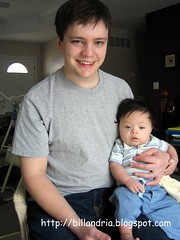
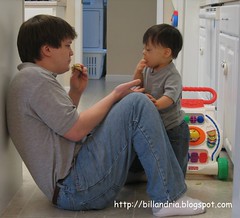
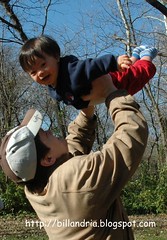
Just a couple months ago, I experienced one of the sweetest moments in my life. Matthew spontaneously said for the first time as I tucked him in bed, "Love you (3-second pause) so much!"
Today, he is 4.
Today, he continues to inspire many people.
Today is another step (or little trampoline jump) into tomorrow as he makes his way in this life, believing that he CAN!
Matthew, we love you (3-second pause) SOOOO much!
I believe
fate smiled at destiny.
Laughed as she came to my cradle
"Know this child will be able"
And laughed as my body she lifted
"Know this child will be gifted
with love, with patience and with faith."
A cheaper and quicker blood sampling method to test for Down syndrome is reportedly going to be available to pregnant women by 2013. I'm all for non-invasive testing that takes away the risk to the unborn child. But it seems like the risk to an unborn baby with Down syndrome increases - the risk of termination.
"He said...[this] will encourage more couples to take the test and therefore slowly eradicate the disease." The "disease" being Down syndrome. MY KID. Could they be any more obvious? I'm all for early detection if it means bringing babies into this world more safely; we knew ahead and I'm glad for that. But suggesting this as a means of eradicating my child and people like him is just sickening.
It's so sad.
If tested positive, why not encourage more proactive prenatal care and perhaps a form of targeted nutritional intervention (TNI) as the baby develops in utero instead of suggesting or encouraging termination? Is there scientific research about prenatal care for preventing or lessening the chances for heart defects and other common issues in newborns with DS, thus giving them a healthier start in life?
There is no cure for Down syndrome. But many individuals with Down syndrome are leading happy and productive lives. The general consensus among families and friends of people with Down syndrome is that people with DS bring out the best in us and give our lives more meaning. I agree 100%.
What's next? There is no cure for autism, cerebral palsy, and other conditions. If a non-invasive blood test to detect these in utero is developed, would it also be viewed as a means for eradicating fetuses diagnosed with such conditions?
The sky is falling. And I'm not referring to snow.
Having two kids, who are fairly close in age, when they are both sick is not easy. I have snot on my shirt from both kids laying or crying over my shoulders. At least the Tylenol took care of Elizabeth's 102 degree fever.
Yesterday, Elizabeth coated me with vomit. It is not the best alternative to hair gel. They seem to have an unspoken agreement to want to be held at the same exact time. The good news is that I don't need to pay for gym membership to work my arm muscles. When held, Matthew is ok with me sitting on the couch but Elizabeth wants me to be walking. Sigh.
On top of having cough and runny nose, Matthew is constipated. He had been regular up until he made pee potty progress and saying "wet." He was learning to hold it in. Unfortunately, he had also learned to hold in bowel movements. A glycerin suppository fixed that today but not without a lot of tears and struggling. I let him go in a pull-up since he was extremely opposed to sitting on the potty for it.
Naptime officially started 30 minutes early today. Even with both kids asleep, I still hear their cries in my head. So I turn on the iPod to help replace the crying echoes with some soothing jazz while blogging, planning my next set of flashcards for Matthew, and learning to bake sweet potato fries to keep my mind preoccupied. The house chores can wait another day as they usually do.
The mommy gig with two sick kids has certainly pushed me to tears. But I'm learning to deal, slowly but surely. It's a steep learning curve for me having had no siblings and babysitting experience.
The sky is falling. I may stress. I may have burnt my experimental baked sweet potatoes. I may sometimes think I'm not wired to be a mom. But at the end of the day, everything will be ok. Looking at both sick kids, I know that I still would rather be doing the mommy gig than anything else.
Our artificial pre-lit Christmas tree is up. Thankfully, the cat and kids aren't interested in climbing it or pulling it down or yanking off the ornaments.
Four stockings line our stair banister waiting for Santa to fill them with goodies. Christmas lights cast a soft, inviting glow on our front porch at night, setting the perfect Christmas mood with every twinkle.
Matthew's favorite musical Christmas toys are out. With one squeeze of his hand, this snowman dances to the tune of Frosty the Snowman.
The nativity play set is set up under the Christmas tree but baby Jesus has found his way to the cozier-looking crib in the Fisher Price Little People house. I think Bill inadvertently put baby Jesus there for pretend play time with Matthew.
Christmas music streams from the iPod speakers. Matthew sings along.
"Rudolph the Red-Nosed Reindeer" prompts me to sing along. Up until 3 years ago, I viewed Rudolph as pretty cool with his shiny red nose. Other than that, I didn't internalize the song like I did after Matthew was born. I began to see Rudolph's uniqueness from an entirely different level - through the eyes of a mom who has a child with special needs. Rudolph's uniqueness took on a deeper meaning in my mind.
"All of the other reindeer used to laugh and call him names. They never let poor Rudolph join in any reindeer games."
This part of the song makes me so sad that I actually cry. I ponder Matthew's social life. I think of how I don't ever want him to feel like an outcast. I think of how I might react if I hear people call him offensive names.
Then one foggy Christmas Eve Santa came to say: "Rudolph with your nose so bright, won't you guide my sleigh tonight?"
Then all the reindeer loved him as they shouted out with glee, Rudolph the red-nosed reindeer, you'll go down in history!
As the song ends, I'm still teary but with happy tears. I dream that Matthew will have lots of friends. I dream of how people will accept and respect him for who he is. I dream of how many lives he will inspire and has inspired, including mine.
Amazing how having a child with Down syndrome has changed my outlook on even the simplest things! In this case, it's a simple song that's not even about Down syndrome. Or maybe I'm just emotional at Christmas...
Growing up, I had always wanted a brother or a sister. That decision wasn't mine to make. "My child will not be an only child," I promised myself.
When Matthew was a baby, I struggled with the thought of wanting a sibling for him. The diagnosis of Down syndrome brought many questions that I couldn't answer at that time. However, I obviously got over my self-doubt. Elizabeth was born 2-1/2 years later.
Questions and Realizations What were our chances of having another child with Down syndrome? With all the doctor visits, therapies and extra time and effort needed, I didn't know if I could handle another child with Down syndrome.
Newsflash to self: Every child has needs! Every child is unique and special.
Having Down syndrome means that Matthew's development is slower than his typical peers, which is why he gets therapy for certain areas of development and I put more effort into his development.
Having Down syndrome means he may have more health issues that need extra attention, which is why he has many doctor visits. Some kids with Down syndrome see more doctors and specialists than we do, some see less. We take Matthew to a pediatric opthamologist once a year or once every 2 years, his pediatrician every year and a pediatric otolaryngologist (ENT) every 6 months on average.
Matthew is just like his typical peers - all needing varying degrees of time and attention. Down syndrome is just a part of him. It doesn't define who he is.
When I was pregnant with Elizabeth, it didn't matter to me if she was born with Down syndrome or not. I wanted her to be healthy just like I prayed for Matthew to be healthy when I was pregnant with him.
How would he be as an older brother? Early on, I didn't know many families at all who had other kids after having a child with Down syndrome. After writing "Another Baby After Having A Child with Down Syndrome" and reading the many wonderful, supportive comments on it, I found more blogs of families who have had one or more children after having one with Down syndrome. Reading their stories helped me picture how Matthew might be as an older brother.
How will I find time for the things that Matthew needs extra help with? I try to make time. I give up something else to give him and Elizabeth time. I think it's a similar story with every parent who has 2 or more kids. I definitely have less time for Matthew. It's inevitable.
I multi-task. I find myself constantly trying to synchronize both kids' schedules whenever possible - naps, meals, playtime. I'm a planner and an organizer so I try to orchestrate things so that they work out just right. At the same time, I have to learn to go with the flow when things aren't "just so." It's a constant struggle and some days I feel like a total failure, even if Bill tells me I'm not. I wouldn't trade this job for anything else though.
Matthew plays independently when I take care of Elizabeth's needs. I try to devote some time for one-on-one play with her everyday. Matthew usually enjoys participating and gives her toys while she's in the bumbo seat.
I try to take advantage of Elizabeth's naps and use them for one-on-one teaching or "play therapy" time with Matthew. When she was little and she was up, I'd put her in her bouncy seat or swing. These days, she can sit independently so I sit her near me and surround her with toys to keep her busy while I spend a few uninterrupted minutes with Matthew.
Having two kids is doubly harder than one but I love the fact that I have two. I love them both - equally and unconditionally. I'm so happy we added on to our family.
The Best Big Brother So how is Matthew as a big brother? So far, he is wonderful!
He always looks out for Elizabeth. He makes sure she has plenty of toys to play with. He gives her kisses and hugs even when I don't ask him to. He likes to tickle her tummy. They make each other smile. He makes her laugh. They love playing peek-a-boo. He even offers to share some of his toys with her.
I have no first-hand experience with sibling relations but I think Matthew and Elizabeth have a great start to forming a strong bond. It'll be up to us to encourage that as they grow up. They may have their disagreements later on but at the end of the day, my wish is for them to be able to rely on each other and have each other's back.
Sharing a letter from my dad about my previous post "Why Us?" and his thoughts on being on this journey with us.
Your feelings were perfectly understandable at that time, and I guess we all felt the same way you did because of our ignorance, our mindset, and our fears. Now all those are gone, thanks to Matthew and the unconditional love from you and Bill, and of course from all of us in the family. I realize now that it's just one less traveled (therefore, grassier!) road that we are made to travel with Matthew, and thankfully one without regrets "as way leads on to way" like the one that Robert Frost discovered in his famous poem here...
The Road Not Taken
Two roads diverged in a yellow wood, And sorry I could not travel both And be one traveler, long I stood And looked down one as far as I could To where it bent in the undergrowth;
Then took the other, as just as fair, And having perhaps the better claim Because it was grassy and wanted wear, Though as for that the passing there Had worn them really about the same,
And both that morning equally lay In leaves no step had trodden black. Oh, I marked the first for another day! Yet knowing how way leads on to way I doubted if I should ever come back.
I shall be telling this with a sigh Somewhere ages and ages hence: Two roads diverged in a wood, and I, I took the one less traveled by, And that has made all the difference.
And guess what...we get to travel both roads! What could be better? :-)
Why me? Why us? These questions nagged me when waiting for Matthew's chromosome test results after his birth. "I'm not strong enough to handle this," I recall saying in my distressed emotional state. "You'll find the strength," my oldest sister-in-law gently reassured me. It sounded promising. But how?
Without fully realizing it at the time, my family was my strength during the wait and the first few months that followed. I listened to everything positive and leaned on them because all I had was doubt. God doesn't make mistakes. God has a plan which may not be known at the present time. God will reveal it through time.
Over time, the doubt went away. In it's place was strength, as promised. I found it from loving Matthew and caring for him with every breath and wanting only what was best for him. I found it in Bill. I found it in the encouragement offered from extended family. I found it in supportive old friends. I found it within the large network of families who have kids with Down syndrome. That's how I found strength.
Today, a facebook friend posted inspiring words that ring so true for me. I consider it the answer to my "Why me? Why us?" questions.
"God doesn't give children with special needs to strong people; He gives children with special needs to ordinary, weak people and then gives them strength. Raising a child with special needs doesn't TAKE a special family, it MAKES a special family."
The audiologist whom I wrote to about the use of the term "Down's Syndrome boy" emailed me last week. It was an email thanking me for my letter and interesting and informative language guide, which was also shared with the audiologist's colleagues. The audiologist said, "I apologize for my word choices as they were not meant to offend you, your husband or Matthew." I replied, thanking her for her email and shared with her how we had to learn about using preferred language ourselves.
If we hadn't been close to someone who has Down syndrome, this would not be on our radar. We might have been using some no-no terminologies or common misstatements and unknowingly being offensive. We try to keep this in mind when offering this information to others. We would've probably been on the receiving end at some point in our lives if we didn't have Matthew.
We've only become accutely aware about specific terminologies when referring to individuals with a diagnosis of Down syndrome after Matthew was born. Because of Matthew, we are learning to be more sensitive about our choice of words in consideration for other people's feelings. We are discovering our own tolerance levels for what we find offensive in relation to Down syndrome.
The gift of awareness - one of the many gifts Matthew has given to us.
When she arrived in April, 3-1/2 months seemed like a lengthy period of time. When I saw her off at the airport earlier today, it felt like the time was cut short. It was a tearful goodbye. Now, I find myself wishing she could've stayed here longer and didn't have to leave yet.
I am thankful that she made the trip here. I am thankful for her tremendous help around the house and with the kids, especially right before and after Elizabeth was born. I am thankful for the countless hours of play she and Matthew shared. I am thankful for the countless times she took Elizabeth off my hands so I could run errands more easily or spend one-on-one time with Matthew. I am thankful for our conversations and the time we spent together even if we didn't get along 100% of the time. But isn't that how most mother-daughter relationships are?
I am thankful for her and I look forward to the next time she can visit, whenever that may be.
A blogger friend who writes at Chase and More shared an interesting article called "The Impact of Childhood Disability: The Parent's Struggle" written by Ken Moses, a psychologist who helps people with crisis, trauma and loss. His article describes the grief that many parents of a child with an unexpected disability experience after receiving the diagnosis. It reminded me of the kind doctor who spoke to us after receiving Matthew's diagnosis. He told us that it was ok to grieve and that it was part of allowing ourselves to let go of the child we thought we were going to have. It was a process that helped us move on to love our child as we would any other child we would have and build new dreams together.
Here is an excerpt from the article that accurately describes the grief that I experienced:
Parents attach to children through core-level dreams, fantasies, illusions, and projections into the future. Disability dashes these cherished dreams. The impairment, not the child, irreversibly spoils a parent's fundamental. heart-felt yearning. Disability shatters the dreams, fantasies, illusions, and projections into the future that parents generate as pan of their struggle to accomplish basic life missions. Parents of impaired children grieve for the loss of dreams that are key to the meaning of their existence, to their sense of being. Recovering from such a loss depends on one's ability to separate from the lost dream, and to generate new, more attainable, dreams.
As disability bluntly shatters the dreams, parents face a complicated, draining, challenging, frightening, and consuming task. They must raise the child they have, while letting go of the child they dreamed of. They must go on with their lives, cope with their child as he or she is now, let go of the lost dreams, and generate new dreams. To do all this, the parent must experience the process of grieving.
I'm still blown away by the fact that Elizabeth is 6 weeks old and is holding her head up fairly well, cooing and smiling. Her rapid development is pretty amazing to us (Bill and I) and the more amazing thing is that it makes us feel so much more appreciative and prouder of Matthew than we were of him before Elizabeth came on the scene. We see just how much more he has to work to learn and achieve developmental goals. Most things are a real challenge for Matthew - things that would come so easily, almost effortlessly, for the 'typical' child. One day, Elizabeth started cooing and smiling. Another day, she started holding her head up. Another day, she started turning her head 180 degrees. We think she'll start rolling over on her own before we know it. No teaching. No work. No therapy. Everything seems to "just happen". She generally has it easy.
In a way, it also helps us appreciate other families who do not have kids with Down syndrome. Unless a family has raised or is raising a child with Down syndrome, that family may never truly understand how much work is involved, how much teaching has to be done, and how emotional the journey can be. But there's nothing wrong with not knowing, not understanding. Bill and I would probably not understand either if we didn't have Matthew.
Life changes with one kid. The landscape changes again with two and we discover that the parenting map for kid #1 doesn't quite apply to kid #2. We begin to experience first-hand the significant differences between having one child with Down syndrome and one without.
When Matthew was born 2-1/2 years ago, we left the hospital feeling like his destiny had been pre-written, (no) thanks to books that discussed all the possible medical issues associated with having Down syndrome. We were emotionally-stressed and faced the uncertain future with much trepidation. We had questions - How developmentally delayed will he be? How much help will he need? What medical issues will he have to deal with? Will he live independently? Will he drive a car? Where will he work? How will he support himself? - and more questions that one wouldn't ordinarily ask when bringing a newborn home. On the other hand, bringing Elizabeth home was strangely stress-free.
When Elizabeth was born, we immediately noticed the difference in muscle tone that she had compared to Matthew when he was a baby. She could effortlessly pull her arms close to her body or stretch them out in front of her. She kicked like a bucking bronco. Because of Matthew's low muscle tone (hypotonia), which is a common condition among babies with Down syndrome, his arms and legs just mostly flopped to the sides of his body.
Matthew started to lift his head up for seconds at a time when he was almost 3 months old. And he did this when lying face downward (prone position) on Bill's chest. On the other hand, Elizabeth started showing similar head control a week after she was born.
Matthew first smiled when he was 2 months old, a few days before Christmas. It was the best Christmas gift that year. Elizabeth is just over 2 weeks old and she's already smiling in her sleep. Sometimes she laughs in her sleep too.
While we know we shouldn't compare, we can't help but notice these differences and think, So is this what it's like to have a child without Down syndrome or any other diagnosis that would cause developmental delays? The milestones seem to just happen at the blink of an eye. Doctor visits aren't as stressful. We had grown accustomed to the slower pace - the scenic route in our life's journey - with Matthew that it has become the norm for us. With Elizabeth, it seems like someone hit the fast forward button. It will take some time to get used to this new pace.
I continue to be amazed, but not surprised, by the strong bonds formed in the Down syndrome community. Whether it's celebrating the birth of a new baby, celebrating a milestone, deciphering the Early Intervention program, struggling with health issues, or grieving the loss of a loved one, the Down syndrome community doesn't hesitate to offer support, words of wisdom, or encouragement. These are people from different parts of the world. Most have not even met in person and only know each other through blogs or facebook. Down syndrome is the common factor that pulls us all together like one big, wonderful, and diverse family. I feel blessed to be part of this community.
A friend in the blogging community unexpectedly lost her 8-year old daughter, Carly, very recently. I only know the family from reading their blog as Carly and Matthew had one thing in common - Down syndrome. There has been an outpour of prayers and emotional support from their own family as well as the DS community. Michelle at Big Blueberry Eyes has a beautiful idea for the DS community to show our support. Read about her idea on her blog post, Big Blueberry Eyes: Doing Something.
(The button below was designed and provided by Jasmine at Windmills and Tulips.)
"We lost our sweet girl. She is now my sweet angel." - Joany (Carly's mom)
Please keep the George family in your thoughts and prayers as they go through a very difficult time in their lives.
February 14, 2007 - It was the day I received a blood test confirmation that I was pregnant (with Matthew). We hadn't exactly planned on adding to the family yet. But I was excited. I couldn't believe it - our first child. I couldn't help but smile. And even if I wasn't smiling on the outside, I was beaming inside. I plotted to tell Bill in the evening when we were both home from the office via a "Congratulations, soon-to-be-dad" greeting card.
But as life gives us something to celebrate, it also gives us pause. The same day I found out I was expecting, I also learned of my Grandpa's battle with colon cancer in the Philippines. Stage 4 - the final stage. The prognosis wasn't good. The last time I saw him was Christmas 2006. I was so thankful to have made that trip so my last memory of time spent with him was a happy one. He passed away a few months after the diagnosis.
A few weeks before he left this world, I told him via text message (he was always not in any condition to talk on the phone when I called) that we were expecting and he was going to be a Great Grandpa. He replied via text message, "Congratulations! I'm sure you will be blessed with a beautiful, healthy baby boy." At that time, I thought we were having a girl. He was right.
Sometimes our decisions in life take us to places for different reasons other than which we originally intended or planned. When I went to Australia for a masters degree in International Business, I envisioned pursuing a high-powered career in a large multinational corporation soon after I graduated. I never thought I would find love that would eventually lead to my current life as a Stay-at-home Advocate Mom. Looking back, it wasn't easy for me to let go of my corporate career dream BUT I'm happy with where I'm at now. Going to Australia was one of the best decisions I'd ever made in my life.
As a full-time SaHAM, I am responsible for meeting Matthew's daily needs, scheduling therapy sessions and doctor appointments, and housekeeping. I keep an eye out for social and learning opportunities for Matthew such as Kindermusik, preschool gym, tot time at the library, swim classes, and various playdates/ playgroups with other moms and toddlers.
My advocacy duties are centered on raising awareness about Down syndrome through various outlets such as the internet (my blog, emails, etc), print media (books, Christmas letters, etc), and speaking arrangements at schools when given the opportunity.
I will have more on my plate with baby #2 and as Matthew gets older. One of the additional responsibilities will include refereeing between siblings.
I am on call 24/7. Vacation days are limited and I can only take leave if I have someone else fill in.
The pay? Let's put it this way: Money I could've made in a high-powered corporate career: $$$$$$$ Being a stay-at-home advocate mom: PRICELESS
Credit: I borrowed the term from another inspiring T21 blog that I recently started following called ever forward, Maya.
We opted to do the 1st trimester prenatal screening test for Down syndrome with this pregnancy. We did it in not just one but two blood draws, making it a sequential screen which results in a more accurate detection rate.
Here are a few excerpts from the genetic counselor's letter after our first meeting several weeks ago:
Ria is 31 years of age and was in the 12th week of her second pregnancy. She and her husband have a son, Matthew, with the trisomy 21 form of Down syndrome. They have a pre-existing risk for Down syndrome of 1 in 210 and for trisomy 18 of 1 in 1,072.
First Trimester Screening assesses the risks for both Down syndrome and trisomy 18 between 11 and 13 weeks gestation based on maternal age, nuchal translucency, hyperglycosylated hCG and PAPP-A. Studies have shown detection rates of about 83% for Down syndrome and 75% for trisomy 18.
We also discussed the option of a sequential screen. This assesses the risks for Down syndrome based on maternal age, nuchal translucency, blood work in the first trimester (hyperglycosylated hCG and PAPP-A), and blood work in the second trimester (AFP, hCG, uE3, DIA). Studies have shown detection rates of approximately 92% for Down syndrome and 90% for trisomy 18. The detection rate is 80% for open neural tube defects and is based on second trimester AFP only.
I had the second blood draw in my 16th week of pregnancy. The results came a few days after the second drawing showing the risk for my baby to have Down syndrome of less than 1 in 5,000 and a risk for trisomy 18 of less than 1 in 5,000. The genetic counselor says these numbers represent the lowest possible risk. The screening test doesn't give a "yes" or "no" result. We knew this of course. We also knew that whatever the results, it wouldn't change our minds about our baby. We just wanted to be "in the know".
What I didn't know was how unaffected I would feel about the numbers. The results of the prenatal screening test didn't mean very much to us, except to know how high or low our risk was to have another child with Down syndrome. Maybe I'd feel some sort of relief or happiness if I didn't have Matthew and had no idea about Down syndrome. That would be just natural, wouldn't it? But honestly, I was neither happy nor upset. They're just numbers. I'd feel the same way if our risk was higher. When we had Matthew, our odds were 1 in 1,100 - better than the odds for winning the lottery. These odds also don't tell us what other possible special needs our baby may have and we know every kiddo needs help with a few things here and there growing up. Every child is different.
Would I recommend the 1st trimester prenatal screening test to other expectant moms? Sure. Mainly because it's non-invasive unlike the diagnositc tests like CVS and Amniocentesis. It's a personal decision. Just keep in mind that this is a screening test that merely gives you odds, not a definite "yes" or "no", no matter how accurate studies deem it to be. I see it as another peek into "what could be", a chance to get to know my baby, and a chance to prepare for our baby's arrival - most especially if our 'risk factor' was higher.
In reality though, how can one truly be 100% prepared? There are so many variables in life. Down syndrome is not the end of the world. One of Matthew's greatest gifts to us is how he has opened our hearts and minds to the many possibilities in this world. This is something any prenatal screening test does not detect - the value of a life and how it will impact yours.
Past studies indicate that an estimated 90% of pregnant women choose to have an abortion when they receive a prenatal diagnosis of Down syndrome. How is it that the life an unborn child with Down syndrome is perceived as worthless?
A first-time mom in Boston, MA is around 12 weeks along in her pregnancy. I came across her on twitter a few days ago. I do not know her personally but I had to say something about her tweet that caught my attention. Here is a series of our unedited tweet exchange over the past few days.
She said: i should mentioned that AFTER i heard the heartbeat yesterday, she asked if I wanted to test for down's syndrome. Sux if I have to terminate
I said: you don't "have to" terminate just because of the possibility of Down syndrome.
SHetherington said: You'll be missing out on a wonderful child & a wonderful experience.
pazam2u said: please read about how inaccurate the test is. Not reason enough to terminate. People with down syndrome are wonderful.
She said: I'm sure people w/ down syndrome r wonderful & all - I'm just not having a baby if its not going to b at least 'normal'
Shannon at Gabi's World said: you can't predict how your child will turn out wheter they were born with DS or not. Many kids with DS are perfectly 'normal'. please think about if your 'normal' child were to become delayed because of a near drowning at 3 yrs old would you kill it?
She said: there is a difference between environmental factors and biological. I can test for, & therefore prevent, biological issues.
I said: just fyi, there is a long waiting list of parents who would adopt a child with Down syndrome.
She said: too bad there isn't a waiting list of parents who want to adopt 'normal' children that are older & have been abused. THOSE are the ones that need help. Not the ones who shouldn't of been born
She obviously meant to type "shouldn't have been born." Piercing. Hurtful. Cold. It made me sick to my stomach.
I walked over to Matthew, who was playing happily in his ball pool, picked him up and hugged him. He laid his head on my shoulder, happy about snuggling. I hugged him tight and swayed with him as I grit my teeth and fought back tears and the urge to wreak tweet havoc upon this first-time mom in Boston.
"Normal". Going back to her statement: I'm just not having a baby if its not going to b at least 'normal'. So it seems she views people with Down syndrome as not normal and shouldn't have been born at all. What is "normal"?
Prenatal tests cannot detect all forms of birth defects. If an unborn baby has an intellectual impairment, which is not detected in a prenatal test, is the baby not "normal"? Should this baby not be born?
If a baby is born without Down syndrome but develops problems because of prematurity, is the baby not "normal"? Should this baby not have been born?
If a baby is born without Down syndrome but is in an accident or contracts a debilitating illness, causing the baby to experience cognitive delays and/or physical problems, is the baby not "normal"? Should this baby not have been born?
If a baby is born physically healthy but is later on diagnosed with a pervasive developmental disorder (PDD), is the baby not "normal"? Should this baby not have been born?
Her comments make me angry. Matthew gets angry too when I feed him food that he doesn't like. Is that normal?
I can laugh off her ignorance and not allow her words to pierce my heart just as Matthew belly laughs in anticipation of getting tickled. Is that normal?
I choose to not let her comments prevent me from reasoning with other similar people, speaking out and advocating for Matthew and other individuals who have Down syndrome. I will go on just as Matthew continues to work on his shape sorter, trying to get the right shape into the right slot, and as he perseveres and continues to learn the other skills we are teaching him. Is that normal?
I will celebrate when I am heard just as Matthew claps his hands in delight when he successfully puts the triangle piece of his shape sorter into the triangle slot. Matthew's determination will propel him towards achieving his goals. Is that normal?
1. Down syndrome is just a small part of the bigger picture.
2. Patience, patience, patience. 3. A smile from a little one can brighten anyone's day. 4. If you make peace with your expectations and work hard, then possibilities increase exponentially. 5. Concern and care for the family knows no bounds - unconditional love.
I'd like to take this opportunity to acknowledge other dads in the blogosphere sharing their perspectives of life with a child who has Down syndrome. I have been following and enjoying your blogs. Thank you for writing. If I missed anyone, please leave me a comment and I will add them to my blogroll too.
Like other parents who have a biological (as opposed to adopted) child with Down syndrome, Bill and I met with a genetic counselor during our week-long stay at the hospital after Matthew was born. Bill says he vividly remembers how our meeting went. I can only remember parts.
I remember the depression, the overwhelming emotional pain.
I remember seeing the results of the chromosome analysis that was done using a blood sample from Matthew. There it was - an extra copy of the 21st chromosome.
I remember asking how this happened and being "reassured" it was nothing we did to cause it and nothing we could've done to prevent it. Matthew has Trisomy 21, the most common form of chromosomal abnormality that affects approximately 1 in every 800 newborns and is typically not inherited.
I remember saying that I was only 29 and didn't think our chances of having a baby with DS was high. Matthew was our first child. We learned that we had a 1/1100 risk. I was upset that I was THE 1 out of 1100. The risk is less (1/1400) for someone between 20-24 years old and it steadily increases with age. The frequency of Down syndrome per maternal age is charted on ds-health.com. I scoffed at other similar statistics that were brought up in later conversations.
I remember asking what the chances were of a recurrence. It increased to 1% (1/100) since we've had a baby with DS. Plus, this risk increases with every year that goes by.
I remember talking about the possibilities of genetic testing for Bill and I before we have any more kids. At the time though, I really didn't feel like having any more kids because the risk of having another child with DS was so high. We talked about exploring in vitro fertilization as an option for future kids. Expensive, but if we had to, we'd find a way.
I remember thinking 'Why me?'
It took me many months to even fathom the idea of having a second child that would not be through in vitro. Many people asked when we would have another baby, not knowing that it hurt to answer "not any time soon". It felt like being pushed off a cliff and asked if I wanted to be pushed off again. I feared the possibility of having another baby with Down syndrome. I just couldn't bear to think of the developmental delays, the arm-long list of potential and likely health problems, the likelihood that he may not be able to live independently, the social stigma, and all the possible hardships that Matthew may have in his life. It broke my heart. Were there other mothers that had this same fear? Probably.
In the past few months, however, I've managed to dispel my doubts and fears. Through Matthew, I've discovered amazing unconditional love that I cannot truly express in words. Through books like Common Threads: Celebrating Life with Down Syndrome by Cynthia S. Kidder and Brian G Skotko, I found reassurances for the future. I read about individuals with Down syndrome like Karen Gaffney, who is a self-advocate, accomplished swimmer and President of the Karen Gaffney Foundation, and Chris Burke, who acted in the tv series Life Goes On from 1989 to 1993. Life is better these days for individuals with Down syndrome and I imagine it will only get better in the future. Through the internet, I found other moms who answered the nagging question I had in my mind: "Anyone here given birth to another child after having your baby with DS?" on healthboards.com.
I no longer fear possibly bearing another child with Down syndrome, not to be confused with choosing to have a child with Down syndrome. If God let me choose whether I want to have another child with Down syndrome or a 'typically developing child', I would choose the latter. Can you blame me for wanting to know first-hand what the grass is like on the other side? But the choice is not mine to make. I admire those who choose to adopt a child with DS. I feel it's just not a path for me. Would I take a prenatal screening test? Maybe, depending on how the pregnancy goes and if my doctor recommends it. But I won't be heart-broken if I find out that our second child may have Down syndrome. I'll simply be more prepared.
So, ask me again if we would have another baby. My answer, "Maybe (hopefully) some time soon. We'll see." Are there other mothers who have other (biological) kids without Down syndrome after the one with? Definitely. And I would love to meet them.
Side note: No, I am not pregnant. If I were, I'll have Matthew wear a shirt that says 'I'm the big brother' on it.
My title is borrowed from an email my mom had forwarded to me. It was a list of zen teachings, which I found rather humorous, and the one that stuck to me was "Remember you're unique, just like everyone else". I think it's because I am relating it to much of the literature about Down syndrome for new parents, which is so much better these days than it was 10, 20 and more years ago. Sadly, many years ago, the message to new parents of babies with Down syndrome was "Put your baby in an institution and forget about him." Today, in most places, the message to new parents is "Congratulations! Take him home, get to know him and love him, as all babies deserve. You are about to embark on an amazing journey." To this day, advocates for Down syndrome continue efforts to replace outdated information that OB-Gyns and pediatricians may have. (Thank you!!)
When Bill and I had first found out that Matthew had Down syndrome, I remember how we were both overwhelmed with uncertainty and fear. It was our unpreparedness and the lack of knowledge about our new set of circumstances that caused our initial grief. How different would our lives be? How would society treat us? What was Matthew's future going to be like, what with the seemingly endless list of potential health issues that he would be predispositioned to because of Down syndrome?
That was less than 2 years ago, and today I see how having Matthew in our lives has opened many doors, opportunities and experiences. We still worry about Matthew's future, but what parent doesn't worry about their child/children's futures? My friend, Amy, emailed me recently and I love how she summed up everything she has read so far about babies with Down syndrome. She said,
"Abilities and issues vary so widely, just like for babies without DS, so the bottom line for us all is that we need to learn who our babies are as individuals – what a colossal challenge!"
Matthew has some of Bill's traits and some of mine, and even some of his grandparents'. He has Bill's hairstyle, my hair color, Bill's wide feet, my short fingers, Bill's face shape, my nose and eyes. He has our stubborn streak and silent determination. He looks like my dad when he's asleep. He has the simian crease on the palms of his hands, which is typical trait for people with Down syndrome, but Bill's dad has it too on both hands. (A simian crease is a single line that runs across the palm of the hand. People normally have three creases in their palms). Matthew is really more like other typical kids than unlike them. He will walk and talk, go to school, make friends, hold a job, and add richness to many people's lives. He is no different than you or I, yet he is a unique individual... just like everyone else.