Tonight, after a tiring and somewhat frustrating day, I was browsing the National Geographic Kids website for books, pictures, and videos to show Matthew. Several things looked great for Matthew such as the National Geographic Little Kids magazine, some short videos, and real-life photos of animals and nature. Matthew owns "Safari" from the Kids Readers books and likes it. Maybe it was time to get more titles from this series.
One little gem of inspiration (and Down syndrome advocacy) was in the News-People & Places section. I Have Down Syndrome--Know Me Before You Judge Me by Melissa Riggio. I absolutely loved what she wrote at the end about not able to change the fact that she has Down syndrome, but how she would change how people think of her. She also wrote, "Treat me with respect, and accept me for who I am. Most important, just be my friend. After all, I would do the same for you."
After reading her piece, I continued to browse the site for fun stuff for Matthew. But this time, with a smiling heart.
Showing posts with label advocacy/awareness. Show all posts
Showing posts with label advocacy/awareness. Show all posts
Saturday, August 13, 2011


Monday, May 16, 2011
2-Day Garage Sale Benefit for Down Syndrome Research


The DSRTF is a national non-profit organization that funds important biomedical research projects around the country. These research projects are focused on developing treatments that would improve cognition and prevent the early onset of Alzheimer's for thousands of individuals with Down syndrome. I love how they don't prioritize prenatal diagnostic-type of research unlike the National Institutes of Health (NIH), who directs majority of federal funding (what little is allocated for Down syndrome) toward prenatal testing for Down syndrome.
The National Down Syndrome Society (NDSS) cites that "25% or more of individuals with Down syndrome over age 35 show clinical signs and symptoms of Alzheimer's-type dementia. In the general population, Alzheimer's disease does not usually develop before age 50."
I don't know what the future holds for Matthew. I know that I will be 65 years old when he turns 35. I know I would be very sad if he develops Alzheimer's early and lessens his ability to live independently, especially since it may take more work and time for him to achieve independence. If that was the case, he would've worked so hard at something only to enjoy it for a fleeting moment. I know that's probably excaggerating and worrying myself for no reason but as his mother, it's my job to worry, isn't it? If he happens to be 1 in the 25% estimated individuals who develops Alzheimer's early, it would be nice to have some research to know if it is preventable and if so, how to prevent it.
50 PERCENT CHANCE OF SUN?
The sun never appeared and it drizzled and misted all day, both days. But despite the rain and cold (high 50's to 60's), we had a relatively great turnout and raised a total of $686.45 selling kids' clothes, food, books, and toys. YAY!! This catapulted us to achieving 25% of our $5,000 goal.

THE PROCESS
The two weeks leading up to the garage sale weekend were hectic for everyone involved.
I took care of flyers, garage sale signs, donations for the raffle, the garage sale ad in the newspaper and craigslist, tagged some items, and put up garage sale signs at both entrances to our subdivision. I would've put up more if there was enough time and if I didn't have the kids with me. I made sure the newspaper ad had a line "Benefit for Down syndrome."
My wonderful sister-in-law took care of presorting all 30+ big bags of clothes and pricing the items individually. She helped me get the word out on facebook. She made some yummy Thai sticky rice (the recipe is in her cookbook "Introduction to Asian Cooking" by Kristin Enkvetchakul, published in 2006). She and her husband let us borrow their awesome commercial-grade hotdog machine.


Bill shuttled the boxes of clothes and other supplies from her house to ours and we set it all up in our garage the night before. If I were smarter, I would've started setting everything up in the garage 2 or 3 nights before. I also baked chocolate crinkles the night before. We ended up going to bed at 2am. Then I got up at 5am to straighten whatever I could before we opened at 7am.

Saturday was very busy and I was thankful to have wonderful friends and family to help. We were on our feet all day. I didn't even have time to take pictures during the sale so I took pictures after everyone had left.


Most of the people whom we didn't know personally found our ad in the newspaper. One couple found my ad on craigslist and came specifically because I had advertised it as a benefit for Down syndrome. They lived in a neighboring city and have a daughter with Down syndrome. It was wonderful to make yet another DS connection.
On another note, my thoughtful nephew made this sign to put on the door to the kitchen. It says, "Employees only."

WHAT'S THIS ABOUT PRIZES?
I had a radical idea to offer prizes at our garage sale. Shoppers are issued a raffle ticket for every $5 spent. It actually helped encourage most people to either buy more or donate what would've been their change. We also had a few friends come to donate but not buy anything. 2 raffle tickets were issued for every $5 donated (without a purchase).

There were 10 prize buckets to choose from. The most popular one was for movie tickets, followed by restaurant gift certificates. I am extremely thankful for the prizes that were donated by generous business owners and friends in the area.

Matthew drew the winners at the end of day 2 of the garage sale. It was the best random way to pick winners and a great way to practice some functional math skills, i.e. I'd ask him to give me one ticket only from each little tub. If he gave me 2 or more, I wouldn't take any tickets from him.


MAY 21, DAY 3
We've decided to do another garage sale this Saturday, May 21, while we still have everything set-up in our garage and will be adding more to what we have. We It will sort of symbolic of Down syndrome with the triplication of the 21st chromosome. The date "21" would signify the 21st chromosome and it would be the 3rd day for our garage sale.
Saturday, April 23, 2011
Supporting Cognition Research via plus15
Sharing our personal stories, photos, and videos has raised awareness about Down syndrome. We hope you, our dear readers, have enjoyed following along as much as we have enjoyed sharing and meeting friends on this journey. Thanks for your friendship and encouragement. Thanks for reading!
Please consider helping us make a bigger difference in this world through the plus15 campaign. By supporting biomedical research to improve cognition, including learning, memory, and speech, by 15 percent, you will give Matthew and our friends with Down syndrome, more opportunities to full inclusion - academically and socially - and independent living as adults.
Our involvement in plus15 has a two-fold benefit. This fundraiser is a contest. The top fundraiser will receive an Apple iPad. IF we win, we will donate the iPad to Matthew’s preschool. Your contribution could help more children with special needs, such as Autism, who can benefit from its use during their therapy time. Please help us win the iPad for the kids!
We really appreciate your interest in helping!
Facts to Consider
Studies show that the life expectancy of someone living with Down syndrome has increased from 25 years to over 50 or 60 years over the past 3 decades. But cognitive abilities have not improved at a similar pace. Current advances made in cognitive research are promising of positive change, such as avoiding the early onset of Alzheimer’s disease. The National Down Syndrome Society (NDSS) cites that “25 percent or more of individuals with Down syndrome over age 35 show clinical signs and symptoms of Alzheimer's-type dementia. In the general population, Alzheimer's disease does not usually develop before age 50.”
Federal funding for Down syndrome research is only $55 per person. That's about 95% less on average than what the government spends on research for similar disabilities. A big chunk of federal funds goes to research to develop more tests to merely detect Down syndrome prenatally, instead of toward cognition research. We have collated data in the following tables as gathered from the sources listed below.
Sources:
2008 data from Dr. Brian Skotko’s testimony before the Down Syndrome Congressional Caucus in February 2009 (http://www.brianskotko.com/images/stories/Files/down_syndrome_congressional_caucus_feb_09.pdf) as provided by M.M. Harpold, DSRTF based on 2009 NIH Data (http://report.nih.gov/rcdc/categories/).
2009 & 2010 data sourced and adapted from 2011 NIH (National Institutes of Health: Estimates of Funding for Various Research, Condition, and Disease Categories) http://report.nih.gov/rcdc/categories/Default.aspx. Note that I calculated the 2009 and 2010 NIH $ per capita assuming unchanged population estimates from Dr. Brian Skotko’s 2008 data.
3 Possible Ways to Donate
To donate online, please click on Matthew’s photo below. Any amount would be helpful and appreciated.
 Our fundraising page will open in a new window where you can donate online. Donations can be made anonymously, if you choose to do so. Online donations will be accepted until May 21, 2011. (Please be aware that this fundraising site automatically allocates 10% of the donation amount as a tip. Tipping the fundraising site is not necessary. You can select the option not to tip in the drop down menu before confirming your donation.)
If you would rather send a check, make it payable to "Down Syndrome Research and Treatment Foundation" and write "Bill and Ria" on the memo line. Please contact us so that we can send you more details. Check donations are accepted until May 14, 2011 because we have to get them to the DSRTF by May 16, 2011 in order for checks to count toward our total.
Donations are tax-deductible.
If you would rather donate a few minutes of your time, please share this post with friends on facebook, twitter, or on your blog, if you have one.
Thank you very much for your generosity and helping us spread the word! Your support of this great cause means a lot to us, especially to Matthew.
The link to our fundraising page is http://www.crowdrise.com/plus15/fundraiser/billandria.
Grab the button below for your blog.
Thanks again for your support of this great cause, and thanks for reading!
About plus15
 plus15 is an initiative of the Down Syndrome Research and Treatment Foundation (DSRTF), a non-profit organization funding cognition research. When you give to the plus15 campaign, 100% of your money will go directly to funding cognitive research at major research centers around the country, including Johns Hopkins Medical Center, Stanford University, University of San Diego and University of Arizona.
Here is a short video made by the DSRTF:
Please consider helping us make a bigger difference in this world through the plus15 campaign. By supporting biomedical research to improve cognition, including learning, memory, and speech, by 15 percent, you will give Matthew and our friends with Down syndrome, more opportunities to full inclusion - academically and socially - and independent living as adults.
Our involvement in plus15 has a two-fold benefit. This fundraiser is a contest. The top fundraiser will receive an Apple iPad. IF we win, we will donate the iPad to Matthew’s preschool. Your contribution could help more children with special needs, such as Autism, who can benefit from its use during their therapy time. Please help us win the iPad for the kids!
We really appreciate your interest in helping!
Facts to Consider
Studies show that the life expectancy of someone living with Down syndrome has increased from 25 years to over 50 or 60 years over the past 3 decades. But cognitive abilities have not improved at a similar pace. Current advances made in cognitive research are promising of positive change, such as avoiding the early onset of Alzheimer’s disease. The National Down Syndrome Society (NDSS) cites that “25 percent or more of individuals with Down syndrome over age 35 show clinical signs and symptoms of Alzheimer's-type dementia. In the general population, Alzheimer's disease does not usually develop before age 50.”
Federal funding for Down syndrome research is only $55 per person. That's about 95% less on average than what the government spends on research for similar disabilities. A big chunk of federal funds goes to research to develop more tests to merely detect Down syndrome prenatally, instead of toward cognition research. We have collated data in the following tables as gathered from the sources listed below.
| CONDITION | US POPULATION (est) | 2008 NIH FUNDING Million $ | 2009 NIH FUNDING Million $ | 2010 NIH FUNDING Million $ |
|---|---|---|---|---|
| Cystic Fibrosis | 30,000 | 90 | 86 | 86 |
| Parkinson's | 1,500,000 | 152 | 162 | 154 |
| ALS | 30,000 | 43 | 43 | 47 |
| Huntington's | 30,000 | 51 | 57 | 65 |
| Multiple Sclerosis | 400,000 | 169 | 137 | 133 |
| Crohn's Disease | 400,000 | 51 | 55 | 66 |
| Down Syndrome | 400,000 | 17 | 18 | 22 |
| Fragile X | 17,000 | 26 | 27 | 25 |
| Autism | 560,000 | 118 | 132 | 160 |
| Duchenne MD | 45,350 | 22 | 27 | 33 |
| CONDITION | US POPULATION (est) | 2008 NIH $ per CAPITA AMOUNT | 2009 NIH $ per CAPITA AMOUNT | 2010 NIH $ per CAPITA AMOUNT |
|---|---|---|---|---|
| Cystic Fibrosis | 30,000 | 3,000 | 2,866 | 2,866 |
| Parkinson's | 1,500,000 | 101 | 108 | 103 |
| ALS | 30,000 | 1,433 | 1,433 | 1,567 |
| Huntington's | 30,000 | 1,700 | 1,900 | 2,167 |
| Multiple Sclerosis | 400,000 | 422 | 343 | 333 |
| Crohn's Disease | 400,000 | 128 | 138 | 165 |
| Down Syndrome | 400,000 | 40 | 45 | 55 |
| Fragile X | 17,000 | 1,529 | 1,588 | 1,471 |
| Autism | 560,000 | 211 | 236 | 286 |
| Duchenne MD | 45,350 | 485 | 595 | 728 |
2008 data from Dr. Brian Skotko’s testimony before the Down Syndrome Congressional Caucus in February 2009 (http://www.brianskotko.com/images/stories/Files/down_syndrome_congressional_caucus_feb_09.pdf) as provided by M.M. Harpold, DSRTF based on 2009 NIH Data (http://report.nih.gov/rcdc/categories/).
2009 & 2010 data sourced and adapted from 2011 NIH (National Institutes of Health: Estimates of Funding for Various Research, Condition, and Disease Categories) http://report.nih.gov/rcdc/categories/Default.aspx. Note that I calculated the 2009 and 2010 NIH $ per capita assuming unchanged population estimates from Dr. Brian Skotko’s 2008 data.
3 Possible Ways to Donate
To donate online, please click on Matthew’s photo below. Any amount would be helpful and appreciated.
If you would rather send a check, make it payable to "Down Syndrome Research and Treatment Foundation" and write "Bill and Ria" on the memo line. Please contact us so that we can send you more details. Check donations are accepted until May 14, 2011 because we have to get them to the DSRTF by May 16, 2011 in order for checks to count toward our total.
Donations are tax-deductible.
If you would rather donate a few minutes of your time, please share this post with friends on facebook, twitter, or on your blog, if you have one.
Thank you very much for your generosity and helping us spread the word! Your support of this great cause means a lot to us, especially to Matthew.
The link to our fundraising page is http://www.crowdrise.com/plus15/fundraiser/billandria.
Grab the button below for your blog.
Thanks again for your support of this great cause, and thanks for reading!
About plus15
Here is a short video made by the DSRTF:
Monday, April 18, 2011
New Parent Support Volunteer with Down Syndrome Association
When Matthew was born in 2007, the first hour of his birth was a great celebration for us. The news that the doctors suspected he had Down syndrome sent us into shock and the hour of celebration was clouded with disbelief, worry, a loss of control, and sadness. The many days that followed were unfortunately filled with anxiety, uncertainty, loneliness, guilt, and grief on top of sleep deprivation and crazy hormones.
The early days of having Matthew home were physically and emotionally draining. Some days it was hard to talk to other people and smile while some days were manageable.
It was one of Bill's sisters who connected me to their neighbor, who was another mom with a 9-year old (at that time) with Down syndrome. She also happened to be a new parent support volunteer. I vaguely remember being asked if I wanted to talk to her. I think my initial answer in the first few weeks was "not yet."
There were many days when my mind was heavy with thoughts about possible medical issues, more bloodwork and doctor visits needed, independence as an adult, and protecting Matthew from discrimination and ridicule.
Almost a month after Matthew's birth, I received a letter in the mail from that mom. Reading her letter today still made me teary-eyed as I recalled the past. Her letter was congratulatory, very reassuring, comforting, encouraging, and insightful as she shared a little bit about her family and her own emotions when her son was born. She also included a mini photo collage of her son through the years, which I liked to see. (I was recently made aware that during the early weeks, some moms are reluctant to see photos or meet other kids with Down syndrome). At the end of her letter she wrote:
I invited her to our home shortly after. She came with a New Parent packet from the Down Syndrome Association, which was loaded with important information. Like many things affected by fatigue during that time, our first meeting is now a blur. I only remember that it was nice to meet and talk to her. We got along well. I don't remember feeling depressed or crying while she was visiting so I must have been able to pull myself together and manage a conversation and a few smiles. She was a great source of encouragement and knowledge.
After making the connection personally, it was very reassuring to know I wasn't alone. The book "Gifts: Mothers Reflect on How Children with Down Syndrome Enrich Their Lives" also helped cement that reassurance. Reading Gifts led me to find blogs of other moms and dads who have kids with Down syndrome. And that led me to start this blog.
But I wanted to do more. I wanted to be a source of support, encouragement, and information via the blog AND in person.
Answering what I perceive as a calling, I trained as a New Parent Support Volunteer with our local Down Syndrome Association this past Saturday. I've been wanting to do this since April last year but Elizabeth was a couple weeks away from being born and having a newborn would make it impossible for me to commit to the responsibilities.
I'm very happy to have this opportunity to pay forward the support that my new parent support person gave me during my most vulnerable time. Thank you so much!! (You know who you are.)
The early days of having Matthew home were physically and emotionally draining. Some days it was hard to talk to other people and smile while some days were manageable.
It was one of Bill's sisters who connected me to their neighbor, who was another mom with a 9-year old (at that time) with Down syndrome. She also happened to be a new parent support volunteer. I vaguely remember being asked if I wanted to talk to her. I think my initial answer in the first few weeks was "not yet."
There were many days when my mind was heavy with thoughts about possible medical issues, more bloodwork and doctor visits needed, independence as an adult, and protecting Matthew from discrimination and ridicule.
Almost a month after Matthew's birth, I received a letter in the mail from that mom. Reading her letter today still made me teary-eyed as I recalled the past. Her letter was congratulatory, very reassuring, comforting, encouraging, and insightful as she shared a little bit about her family and her own emotions when her son was born. She also included a mini photo collage of her son through the years, which I liked to see. (I was recently made aware that during the early weeks, some moms are reluctant to see photos or meet other kids with Down syndrome). At the end of her letter she wrote:
"Matthew will be the sunshine of your life. The challenges which you will face will be matched, or exceeded by, unexpected blessings."
I invited her to our home shortly after. She came with a New Parent packet from the Down Syndrome Association, which was loaded with important information. Like many things affected by fatigue during that time, our first meeting is now a blur. I only remember that it was nice to meet and talk to her. We got along well. I don't remember feeling depressed or crying while she was visiting so I must have been able to pull myself together and manage a conversation and a few smiles. She was a great source of encouragement and knowledge.
After making the connection personally, it was very reassuring to know I wasn't alone. The book "Gifts: Mothers Reflect on How Children with Down Syndrome Enrich Their Lives" also helped cement that reassurance. Reading Gifts led me to find blogs of other moms and dads who have kids with Down syndrome. And that led me to start this blog.
But I wanted to do more. I wanted to be a source of support, encouragement, and information via the blog AND in person.
Answering what I perceive as a calling, I trained as a New Parent Support Volunteer with our local Down Syndrome Association this past Saturday. I've been wanting to do this since April last year but Elizabeth was a couple weeks away from being born and having a newborn would make it impossible for me to commit to the responsibilities.
I'm very happy to have this opportunity to pay forward the support that my new parent support person gave me during my most vulnerable time. Thank you so much!! (You know who you are.)
Thursday, February 3, 2011
Accelerating Scientific Research For Down Syndrome
As a mom of two, I am heavily invested in my children's futures. I want both of them to be independent, productive contributors to society.
As a mom of a child with Down syndrome, I want just as many opportunities available to Matthew in his future as there would naturally be for Elizabeth. I want Matthew to be accepted and respected. And I want Matthew to have greater options in life than he might have otherwise.
I am always interested in new scientific research about Down syndrome. Three groups that actively Down syndrome medical and cognitive research are:
- Down Syndrome Research and Treatment Foundation (DSRTF)
- Global Down Syndrome Foundation
- Research Down Syndrome
The DSRTF has an ongoing campaign called plus15.
 Down Syndrome Achieves is another organization that is spearheading the drive for more Down syndrome research work and legislative action. Lisa at Living in the Light blogged about Down Syndrome Achieves in her entry "A New Era in Advocacy for Down Syndrome".
I listened to their eye-opening and very interesting web conference this evening. It was shocking (and very sad) to see the disparity in government funding for Down syndrome and other diagnoses. Basically, more funding for Down syndrome means a possible acceleration of scientific research and treatments to improve learning, cognition and communication. I'll share more details about it in a separate blog entry. Another web conference is scheduled on February 17, 2011.
It all sounds promising. I am hopeful. If the research translates to good options for improving learning, cognition, and communication, which in turn can lead to better opportunities and independence, then I am for it. Are you?
As a mom of a child with Down syndrome, I want just as many opportunities available to Matthew in his future as there would naturally be for Elizabeth. I want Matthew to be accepted and respected. And I want Matthew to have greater options in life than he might have otherwise.
I am always interested in new scientific research about Down syndrome. Three groups that actively Down syndrome medical and cognitive research are:
- Down Syndrome Research and Treatment Foundation (DSRTF)
- Global Down Syndrome Foundation
- Research Down Syndrome
The DSRTF has an ongoing campaign called plus15.
For every dollar donated to plus15 before midnight tonight, a donor will match 3 to 1. The plus15 campaign funds research at major research centers, including Johns Hopkins Medical Center, Stanford University, University of San Diego, and University of Arizona, into how to improve the memory, learning, and speech of people with Down syndrome by 15 percent.
Down Syndrome Achieves is another organization that is spearheading the drive for more Down syndrome research work and legislative action. Lisa at Living in the Light blogged about Down Syndrome Achieves in her entry "A New Era in Advocacy for Down Syndrome". I listened to their eye-opening and very interesting web conference this evening. It was shocking (and very sad) to see the disparity in government funding for Down syndrome and other diagnoses. Basically, more funding for Down syndrome means a possible acceleration of scientific research and treatments to improve learning, cognition and communication. I'll share more details about it in a separate blog entry. Another web conference is scheduled on February 17, 2011.
It all sounds promising. I am hopeful. If the research translates to good options for improving learning, cognition, and communication, which in turn can lead to better opportunities and independence, then I am for it. Are you?
Sunday, October 31, 2010
Mission Accomplished: 31 for 21 Blog Challenge 2010
October is Down Syndrome Awareness month. Today is last day of the 4th year for the 31 for 21 blog challenge, which is hosted by Unringing The Bell.
It's called 31 for 21 because there are 31 days in October and the most common of the 3 types of Down syndrome is Trisomy 21. It was my first time to participate and I certainly felt the pressure, which I put upon myself. In signing up for the challenge, I committed to blog everyday in October to raise awareness about Down syndrome. At least 200 other bloggers were in this year. That's quite impressive!

It definitely wasn't easy to blog for 31 consecutive days especially with everything else I had going on this month - planned and celebrated Matthew's 3rd birthday, IEP meeting and preparing to transition him to school, and a major surgery. I did it though! And I'm glad I did.
The prize for completing the challenge? A priceless sense of fulfillment!
Thank you everyone for following us on our journey! Stick around for more.
It's called 31 for 21 because there are 31 days in October and the most common of the 3 types of Down syndrome is Trisomy 21. It was my first time to participate and I certainly felt the pressure, which I put upon myself. In signing up for the challenge, I committed to blog everyday in October to raise awareness about Down syndrome. At least 200 other bloggers were in this year. That's quite impressive!
It definitely wasn't easy to blog for 31 consecutive days especially with everything else I had going on this month - planned and celebrated Matthew's 3rd birthday, IEP meeting and preparing to transition him to school, and a major surgery. I did it though! And I'm glad I did.
The prize for completing the challenge? A priceless sense of fulfillment!
Thank you everyone for following us on our journey! Stick around for more.
Friday, October 8, 2010
Book Review: Meet Annie
 Written by Heather J. Scharlau-Hollis, a mother of 3. Her youngest has Down syndrome.
 A delightful story about a little girl who talks about things she likes and how she feels about certain things. She engages the reader/listener at every page turn with questions, creating conversation just as one might have when getting to know a young child.
This is the kind of book I would take to Matthew's kindergaten class (when he's in kindergarten) if I am given the opportunity to share or read a book. I think it would raise awareness about Down syndrome in terms that a kindergartener would relate to on a personal level. It is geared toward helping very young minds understand how having Down syndrome makes Matthew different and yet has feelings, likes and dislikes just like everyone else without Down syndrome. I would love for his friends and classmates to appreciate his and each other's differences and realize that differences makes everyone unique.
NOTE: The book also comes with an audio download.
Have you read it? What do you think?
Wednesday, September 22, 2010
A Video by Ashley
Ashley is an incredible, loving big sister to Laura. She captures Laura's charm and beautiful spirit with her photography and shares her with us on her blog Dear Laura..Love, Sissy. With her permission, I am sharing this video that she put together to raise awareness about Down syndrome. Enjoy the video!
Sunday, September 12, 2010
Sharing Our Gift From God
My aunt once told me that Matthew would touch and inspire many lives in his lifetime. She said this a few days after he was born when we were trying to comprehend how Down syndrome would affect his life and ours.
A few weeks ago, the features writer of our local newspaper contacted me interested in writing about my blog and Matthew. I was nervous and excited at the same time about the idea of being featured in the paper: nervous about answering questions and not knowing how the article was going to turn out and excited about this being an opportunity to raise awareness about Down syndrome in our community.
The article Sharing Her 'Gift from God' With the World was in the August 27-29, 2010 weekend paper. I was expecting a short article but was happily surprised with a full front page article in the features section. It is such a well-written and inspiring piece of work, as many people we meet in town and online have commented.
I love her perspective of my blog. I never thought of it like the way she put it, which is 'sharing my gift from God with the world'. It is what I'm doing though, just as fellow bloggers who have kids with Down syndrome are doing. There have been many others before me and there will be many others yet to be born into this world and into blogland.
It is one of the ways to advocate for our children with Down syndrome - showing how kids with Down syndrome make us smile, worry, cry and laugh, just like any other child would and showing how kids with Down syndrome learn, grow and develop, just as uniquely as any other child would.
It's a way to connect with other parents who are on a similar lifelong journey as us. It could be the source of inspiration and strength for a mother-to-be with a prenatal diagnosis of Down syndrome or for new parents of a child with Down syndrome.
It is one of the ways that Matthew will touch and inspire many lives, just as my aunt had known all along.
A few weeks ago, the features writer of our local newspaper contacted me interested in writing about my blog and Matthew. I was nervous and excited at the same time about the idea of being featured in the paper: nervous about answering questions and not knowing how the article was going to turn out and excited about this being an opportunity to raise awareness about Down syndrome in our community.
The article Sharing Her 'Gift from God' With the World was in the August 27-29, 2010 weekend paper. I was expecting a short article but was happily surprised with a full front page article in the features section. It is such a well-written and inspiring piece of work, as many people we meet in town and online have commented.
I love her perspective of my blog. I never thought of it like the way she put it, which is 'sharing my gift from God with the world'. It is what I'm doing though, just as fellow bloggers who have kids with Down syndrome are doing. There have been many others before me and there will be many others yet to be born into this world and into blogland.
It is one of the ways to advocate for our children with Down syndrome - showing how kids with Down syndrome make us smile, worry, cry and laugh, just like any other child would and showing how kids with Down syndrome learn, grow and develop, just as uniquely as any other child would.
It's a way to connect with other parents who are on a similar lifelong journey as us. It could be the source of inspiration and strength for a mother-to-be with a prenatal diagnosis of Down syndrome or for new parents of a child with Down syndrome.
It is one of the ways that Matthew will touch and inspire many lives, just as my aunt had known all along.
Monday, August 23, 2010
"A Down's Syndrome Boy" update
The audiologist whom I wrote to about the use of the term "Down's Syndrome boy" emailed me last week. It was an email thanking me for my letter and interesting and informative language guide, which was also shared with the audiologist's colleagues. The audiologist said, "I apologize for my word choices as they were not meant to offend you, your husband or Matthew." I replied, thanking her for her email and shared with her how we had to learn about using preferred language ourselves.
If we hadn't been close to someone who has Down syndrome, this would not be on our radar. We might have been using some no-no terminologies or common misstatements and unknowingly being offensive. We try to keep this in mind when offering this information to others. We would've probably been on the receiving end at some point in our lives if we didn't have Matthew.
We've only become accutely aware about specific terminologies when referring to individuals with a diagnosis of Down syndrome after Matthew was born. Because of Matthew, we are learning to be more sensitive about our choice of words in consideration for other people's feelings. We are discovering our own tolerance levels for what we find offensive in relation to Down syndrome.
The gift of awareness - one of the many gifts Matthew has given to us.
Related post:
"A Down's Syndrome Boy"
If we hadn't been close to someone who has Down syndrome, this would not be on our radar. We might have been using some no-no terminologies or common misstatements and unknowingly being offensive. We try to keep this in mind when offering this information to others. We would've probably been on the receiving end at some point in our lives if we didn't have Matthew.
We've only become accutely aware about specific terminologies when referring to individuals with a diagnosis of Down syndrome after Matthew was born. Because of Matthew, we are learning to be more sensitive about our choice of words in consideration for other people's feelings. We are discovering our own tolerance levels for what we find offensive in relation to Down syndrome.
The gift of awareness - one of the many gifts Matthew has given to us.
Related post:
"A Down's Syndrome Boy"
Wednesday, August 11, 2010
"A Down's Syndrome Boy"
In the audiologist's written report of Matthew's recent Brainstem Auditory Evoked Response (BAER) test, one sentence made me cringe. "Matthew is a 2-year old Down's Syndrome boy." It may not have been written to intentionally offend or hurt but it was certainly a sign of being unaware and uninformed that referring to Matthew in that manner is inaccurate and inappropriate.
I decided to write a letter to the audiologist and enclosed a copy of the language guide written by United Parent Support for Down Syndrome (UPS for DownS).
My Letter to the Audiologist
Language Guide
The United Parent Support for Down Syndrome (UPS for DownS) has a brochure called How Do I Talk About Down Syndrome: A Language Guide. Words can be hurtful and this guide aims to address how to talk about Down syndrome in a positive and appropriate manner. Here are the lists of good words to use and inappropriate words directly out of the brochure. Click on the link above to download a copy of the full brochure.
Good words to use:
Baby/Child/Person with Down Syndrome - the emphasis should always be on the person first, not the disability. When we take care to put children first, and let the disability remain in the background, we are teaching others where the emphasis needs to be.
Developmentally Delayed - This term is the common reference to describe delays in development, such as language, walking and all other areas of a child's learning process. Most families find it less offensive than the term mentally retarded.
Has Down Syndrome - Someone who has Down syndrome is not a victim of, diseased by, nor do they suffer from or are they afflicted with Down Syndrome. They simply have Down syndrome.
Mental Retardation - This is an accurate term to describe developmental functioning level, but is less acceptable to many parents than the term "developmentally delayed". Use it with caution.
Typically developing/ Non-disabled child - Both of these terms are acceptable and positive ways to refer to people who do not have Down syndrome or another disability.
Big No-No's:
A Down(s) - A person with Down syndrome is not the disability. There are many things that should, and do, define that person. It is dehumanizing and strips people of their dignity to be referred to as a disability. Instead of saying "He is a Down" or "She is a Downs", try "He or she has Down syndrome."
Down Syndrome Child/Baby - This goes back to referring to the person first, not the disability.
Normal kids - Please realize that we perceive our children as being pretty normal kids. Comparing them to normal children implies that a child with Down syndrome is something less than normal.
Retard/Retarded - The best reference is developmentally delayed (for children) and developmentally disabled (for adults).
Mongolism - As most of us know, this is an extremely outdated term that was once used to refer to people with Down syndrome. This word should never be used when referring to or about someone with Down syndrome.
"They" as in "they are so loving; they smile all the time; they are always happy." - Please don't generalize about people with Down syndrome. "They" are not all alike; nor are people with Down syndrome "eternal children."
"How mild/severe is it?" - A person either has Down syndrome or they do not. Down syndrome is not an illness. Having Down syndrome does not mean a person is sick.
"But you're so young!" - Although the chances of a woman having a child with Down syndrome increase significantly over the age of 35, there are far more children with Down syndrome born to younger mothers - they are having more babies.
Handicapped - Use "has a disability" instead.
Downs or Down's Syndrome - There is no "s" or "'s" in the name of this syndrome.
Suffers From/ Afflicted With Down Syndrome - Our children are not suffering or afflicted. We must instill a great sense of pride and self-esteem in all children, so should ensure that we do not make anyone feel that Down syndrome is something terrible or something to be ashamed about.
I realize that there are parents of kids with DS who do not mind some of the terminologies or labels that are considered no-no's. But these no-no's offend and hurt others. Regardless of where one stands on this issue, I think it's best to be informed and use appropriate word choices when talking about Down syndrome to people whom you do not know very well and most especially as a medical professional, a therapist who works with individuals with DS, a media person, or a school teacher.
I may or may not hear back from the audiologist but I feel good knowing that I tried to raise awareness. It's just my little way of advocating for Matthew.
Related post:
Brainstem Auditory Evoked Response
I decided to write a letter to the audiologist and enclosed a copy of the language guide written by United Parent Support for Down Syndrome (UPS for DownS).
My Letter to the Audiologist
Dear (Audiologist),
I appreciate that you took the time to talk to my husband and I about our son's sedated BAER test before and after the procedure on July 27, 2010. Thank you for sending us a copy of the results.
As you know, Matthew has Down syndrome. I remembered that you had referred to Matthew as a "Down's kid" when you discussed the results with us after the test. In the written report, the sentence “Matthew is a 2 year old Down’s Syndrome boy” stood out to me. As a parent of a child with Down syndrome, I try to raise awareness and educate people about Down syndrome when I feel it is needed.
I would like to share some information with you about appropriate word choices to use when communicating about individuals with Down syndrome. I hope you find this language guide helpful to you in your profession especially when communicating with parents who have a child with Down syndrome. Using appropriate word choices when referring to Down syndrome will most certainly be appreciated by individuals with Down syndrome and their families.
Thank you for your attention to this matter. Please feel free to share this information with your colleagues. If you have any questions or comments or would like more information, please contact me at (phone number) or (email address).
Language Guide
The United Parent Support for Down Syndrome (UPS for DownS) has a brochure called How Do I Talk About Down Syndrome: A Language Guide. Words can be hurtful and this guide aims to address how to talk about Down syndrome in a positive and appropriate manner. Here are the lists of good words to use and inappropriate words directly out of the brochure. Click on the link above to download a copy of the full brochure.
Good words to use:
Baby/Child/Person with Down Syndrome - the emphasis should always be on the person first, not the disability. When we take care to put children first, and let the disability remain in the background, we are teaching others where the emphasis needs to be.
Developmentally Delayed - This term is the common reference to describe delays in development, such as language, walking and all other areas of a child's learning process. Most families find it less offensive than the term mentally retarded.
Has Down Syndrome - Someone who has Down syndrome is not a victim of, diseased by, nor do they suffer from or are they afflicted with Down Syndrome. They simply have Down syndrome.
Mental Retardation - This is an accurate term to describe developmental functioning level, but is less acceptable to many parents than the term "developmentally delayed". Use it with caution.
Typically developing/ Non-disabled child - Both of these terms are acceptable and positive ways to refer to people who do not have Down syndrome or another disability.
Big No-No's:
A Down(s) - A person with Down syndrome is not the disability. There are many things that should, and do, define that person. It is dehumanizing and strips people of their dignity to be referred to as a disability. Instead of saying "He is a Down" or "She is a Downs", try "He or she has Down syndrome."
Down Syndrome Child/Baby - This goes back to referring to the person first, not the disability.
Normal kids - Please realize that we perceive our children as being pretty normal kids. Comparing them to normal children implies that a child with Down syndrome is something less than normal.
Retard/Retarded - The best reference is developmentally delayed (for children) and developmentally disabled (for adults).
Mongolism - As most of us know, this is an extremely outdated term that was once used to refer to people with Down syndrome. This word should never be used when referring to or about someone with Down syndrome.
"They" as in "they are so loving; they smile all the time; they are always happy." - Please don't generalize about people with Down syndrome. "They" are not all alike; nor are people with Down syndrome "eternal children."
"How mild/severe is it?" - A person either has Down syndrome or they do not. Down syndrome is not an illness. Having Down syndrome does not mean a person is sick.
"But you're so young!" - Although the chances of a woman having a child with Down syndrome increase significantly over the age of 35, there are far more children with Down syndrome born to younger mothers - they are having more babies.
Handicapped - Use "has a disability" instead.
Downs or Down's Syndrome - There is no "s" or "'s" in the name of this syndrome.
Suffers From/ Afflicted With Down Syndrome - Our children are not suffering or afflicted. We must instill a great sense of pride and self-esteem in all children, so should ensure that we do not make anyone feel that Down syndrome is something terrible or something to be ashamed about.
I realize that there are parents of kids with DS who do not mind some of the terminologies or labels that are considered no-no's. But these no-no's offend and hurt others. Regardless of where one stands on this issue, I think it's best to be informed and use appropriate word choices when talking about Down syndrome to people whom you do not know very well and most especially as a medical professional, a therapist who works with individuals with DS, a media person, or a school teacher.
I may or may not hear back from the audiologist but I feel good knowing that I tried to raise awareness. It's just my little way of advocating for Matthew.
Related post:
Brainstem Auditory Evoked Response
Wednesday, July 21, 2010
Failure to Diagnose Down Syndrome
The Herald Sun in Australia published "Two couples suing doctors for failing to diagnose Down Syndrome" today. This isn't the first time I've read something like this. There was a similar article in 2009 about a couple in Oregon suing their doctor for $14 million.
I don't want to judge BUT... It's sickening! Absurd! Selfish! The father says they treat their 4-year old daughter like gold. How contradictory! Can he look his daughter in the eye and say, We love you but but would've killed you had we been known that you weren't going to be "perfect"? It's maddening! Of course, they place blame on their doctor who failed to detect Down syndrome (Remember, any test to detect Down syndrome is not 100% accurate). Surely, SOMEONE is to blame when life throws a curve ball, right?
Here is the article in case the link to it doesn't work:
I don't want to judge BUT... It's sickening! Absurd! Selfish! The father says they treat their 4-year old daughter like gold. How contradictory! Can he look his daughter in the eye and say, We love you but but would've killed you had we been known that you weren't going to be "perfect"? It's maddening! Of course, they place blame on their doctor who failed to detect Down syndrome (Remember, any test to detect Down syndrome is not 100% accurate). Surely, SOMEONE is to blame when life throws a curve ball, right?
Here is the article in case the link to it doesn't work:
TWO Victorian couples are suing doctors for failing to diagnose Down Syndrome in their unborn babies, denying them the chance to terminate the pregnancies.
The couples are claiming unspecified damages for economic loss, continuing costs of care of the children, and "psychiatric injury".
Both say they would have aborted their pregnancies had they been told their children would be born with Down Syndrome.
In one case, parents of a girl born in July 2005 are suing the Royal Women's Hospital. The parents said an early indication of Down Syndrome was detected by ultrasound in the first trimester and a further test was recommended.
They went to the Royal Women's with the results of their initial ultrasound, and another was taken.
The doctor failed to detect Down Syndrome, the mother said.
"Had the presence of Down Syndrome been diagnosed at the time of the first trimester ultrasound and/or at the time of the second trimester ultrasound, a time frame which permitted the termination of the pregnancy, then the (mother) would have terminated the pregnancy," the statement of claim says.
The girl, 4, who now attends a specialist kindergarten, was born with heart, kidney and thyroid problems, can't walk, and needs help feeding, her father said.
"Don't get us wrong: we love our daughter. She's part of our family, and we treat her like gold," he said.
Maurice Blackburn lawyer Kathryn Booth said she was investigating whether appropriate ante-natal management and testing, including an amniocentesis, should have been offered and performed.
In 2003 the High Court ruled parents could sue in the event of a wrongful birth, she said.
New South Wales, South Australia and Tasmania have legislated against such claims. But in Victoria, people can sue for compensation for the continuing costs of raising a child to the age of 18, where the child was born as a result of negligent care, she said.
The Royal Women's is yet to file a defence.
In the second case, Western Health is being sued over a birth at Sunshine Hospital in December 2007.
The parents allege a failure to "exercise reasonable care" of the mother, "advise (her) in relation to the risks of Down syndrome given her age" and "provide (her) with the option of ante-natal screening.
"In the event that Down Syndrome had been detected, (she) would have elected to undergo a termination of her pregnancy," their statement of claim says.
The parents claim to have suffered "depression, shock and anxiety" and "pain and suffering during pregnancy and delivery".
In its defence, Western Health and a doctor involved in the birth deny any wrongdoing.
The hospital argues the family has failed to show it suffered a "significant injury" as defined by law.
Unless settlement agreements are reached, civil trials are expected to go ahead.
Sunday, June 13, 2010
Step Up for Down Syndrome 2010
Step Up for Down Syndrome 2010 is formerly known as the Buddy Walk. It is the major fundraiser for our local Down Syndrome Association.

This is Team Matthew's 2nd year to join the walk. This year, Matthew's auntie, uncle, cousins and Lola (Filipino word for Grandma - aka my mom) walked with Team Matthew.


There were bounce houses and other fun activities for the kids. Matthew got a balloon fishing rod from the balloon man.

Weather-wise, this year was hotter (a high of 95°F) and more humid but that didn't stop us and hundreds of other people from showing up and walking.

Matthew kept cool with a bottle of water (drinking and pouring water all over himself). He was completely soaked by the end of the one-mile walk. No worries! He had a nice time riding in his wagon with his cousin and he had an extra set of clothes.


WAY TO GO, TEAM MATTHEW!!
Related post:
St. Louis Buddy Walk 2009
This is Team Matthew's 2nd year to join the walk. This year, Matthew's auntie, uncle, cousins and Lola (Filipino word for Grandma - aka my mom) walked with Team Matthew.
There were bounce houses and other fun activities for the kids. Matthew got a balloon fishing rod from the balloon man.
Weather-wise, this year was hotter (a high of 95°F) and more humid but that didn't stop us and hundreds of other people from showing up and walking.
Matthew kept cool with a bottle of water (drinking and pouring water all over himself). He was completely soaked by the end of the one-mile walk. No worries! He had a nice time riding in his wagon with his cousin and he had an extra set of clothes.
Related post:
St. Louis Buddy Walk 2009
Wednesday, March 24, 2010
His Own Afghan
It's brown and blue and the perfect size for a toddler.

It's fun for peek-a-boo games.


It transforms a reading corner into a cozier place.

It's Matthew's own afghan!

Thanks CJ!
CJ is the founder of the T21 Traveling Afghan Project, wherein one afghan travels all over the US and parts of the globe to spend some time with individuals who have Down syndrome. We're patiently waiting for our turn. CJ also makes individual afghans for kids with Down syndrome. Want your own afghan? Check An Afghan of Their Own for details.
It's fun for peek-a-boo games.
It transforms a reading corner into a cozier place.
It's Matthew's own afghan!
Thanks CJ!
CJ is the founder of the T21 Traveling Afghan Project, wherein one afghan travels all over the US and parts of the globe to spend some time with individuals who have Down syndrome. We're patiently waiting for our turn. CJ also makes individual afghans for kids with Down syndrome. Want your own afghan? Check An Afghan of Their Own for details.
Sunday, March 21, 2010
World Down Syndrome Day 2010
Today is World Down Syndrome Day (WDSD). According to Down Syndrome International, the date (March 21) was chosen to signify the uniqueness of Down syndrome in the triplication (trisomy) of the 21st chromosome and is used synonymously with Down syndrome.
Commemoration of World Down Syndrome Day started on 21 March 2006 with the inaugural WDSD launched in Singapore.
Today, I share with you a poem written by my sister-in-law, Lisa Kang.
A Villanelle of Down Syndrome
by Lisa Kang
I am not sad about the fact that I have Down syndrome. It is just part of me. - Margaret Muller
Down syndrome is just one part of me
As there are many parts of you
Open your mind and try to see.
My almond, spangled eyes reveal the capacity
To love, to learn, as others do
Down syndrome is just one part of me.
You see a flattened, mask-like face, irregularity
You miss the beauty shining through
Open your mind and try to see.
I watch the world’s events unfold, with curiosity
The same interests that you pursue
Down syndrome is just one part of me.
As prisms expand light to show a vibrant range of hues
Down syndrome is just one part of me.
Open your mind and try to see.
Commemoration of World Down Syndrome Day started on 21 March 2006 with the inaugural WDSD launched in Singapore.
Today, I share with you a poem written by my sister-in-law, Lisa Kang.
A Villanelle of Down Syndrome
by Lisa Kang
I am not sad about the fact that I have Down syndrome. It is just part of me. - Margaret Muller
Down syndrome is just one part of me
As there are many parts of you
Open your mind and try to see.
My almond, spangled eyes reveal the capacity
To love, to learn, as others do
Down syndrome is just one part of me.
You see a flattened, mask-like face, irregularity
You miss the beauty shining through
Open your mind and try to see.
I watch the world’s events unfold, with curiosity
The same interests that you pursue
Down syndrome is just one part of me.
- Senseless discrimination: your disability
- I welcome you, begin anew
- I welcome you, begin anew
- Open your mind and try to see.
As prisms expand light to show a vibrant range of hues
Down syndrome is just one part of me.
Open your mind and try to see.
Thursday, February 18, 2010
Reactions to the R-Word
The recent debacle about the r-word has stirred much controversy and many reactions including this open letter to Sarah Palin posted by the Oz Squad, an elite group of active, compassionate bloggers dedicated to educating the public about Down syndrome. Please read the letter and "sign" it by leaving a comment on the post. Once there are 100 signatures, the Oz Squad will contact Sarah Palin and ask her to visit the Oz Squad blog to read the letter and the comments. Why a letter to Sarah Palin? Whether you like her or not, she is going to be in the spotlight speaking up about Down syndrome more often than not. We hope that by doing this, she will be better equipped to stand up for our loved ones.
Another person that has always openly spoken out about ending the r-word is John C. McGinley. He is an actor and a spokesperson for the National Down Syndrome Society. His son, Max, has Down syndrome.
I would like to share his recent contribution to The Huffington Post.
End the R-Word
Another person that has always openly spoken out about ending the r-word is John C. McGinley. He is an actor and a spokesperson for the National Down Syndrome Society. His son, Max, has Down syndrome.
I would like to share his recent contribution to The Huffington Post.
N*ggers, K*kes, F*ggots, C*nts, W*ps and the R-wordRelated posts:
By John C. McGinley
Actor and Spokesperson for the National Down Syndrome Society
Posted: February 10, 2010 04:10 AM
Editors Note: The following piece contains strong language, used to explain the impact of certain words in our society.
Recently, the words “Retard” and “Retarded” have become political volleyballs. Disingenuous figures from across the ideological spectrum have been lining up to take their shot at smashing the R-word down our throats. And no matter what party is being “represented” or what Constitutional Right is being exercised, whose agenda is being advanced? The people who have been hurling the R-word about have failed to realize that their language is the stuff of cowards! Only spineless bullies pick on those who cannot defend themselves. And by using the R-word without an once of compassion or even the least bit of sensitivity towards those who are damaged by their hate-speak, these prominent figures have truly become national shames. And it stinks!
People with Special Needs — and their families — do not need any help to make their lives “a little more challenging.” They already have plenty on their plate, thank you very much. And the last thing that any Special Needs family wants is to be assaulted with the R-word. It is already an uphill battle!
Dignity is inherent to the human condition. An individual’s dignity is not only an entitlement. It is a fundamental quality that distinguishes each of us and lends an informed significance to everything that we do. And any time a person’s dignity is stomped on, it is wrong! The R-word robs people with Special Needs of their dignity. And it is time to stop.
What if from now on, we changed the way we use the words “retard” and “retarded?”
It hardly seems like the largest of sacrifices. Not when you consider the changes in language that we have already so willingly elected to integrate into (or expunge from) our vernacular. We no longer use the words “N*gger” or “k*ke” or “f*ggot” or “c*nt.” Why would we? Why on earth would we? Those are all words that hurt. Those are all racial and ethnic slurs and epithets that perpetuate negative stigmas. They are painful. And that is not okay. It is wrong to pain people with our language. Especially when we have already been made aware of our oral transgressions’ impact.
Make no mistake about it: words do hurt! And when we pepper our speech with “retard” and “retarded,” we are spreading hurt. So stop it. Stop saying “retard” and “retarded.” There is no acceptable occasion to lace our dialogue with words like “n*gger,” or “k*ke” or “f*ggot” or “c*nt.” There is no longer any acceptable occasion to lace our dialogue with the words “retard” and “retarded.” Without fail, those are all word that hurt. They straight up are. So, cut it out. Stop using the R-word.
The millions of people with Special Needs (around the planet), who are on the receiving end of this hate speak, are genetically designed to love unconditionally. These “retards” are NEVER going to return our vitriol. Ever! So, what could possibly be the up-side of continuing to use the R-word in our daily discourse?
Only cowards pick on those who cannot defend themselves. By using the R-word we are inadvertently, sadly and sometimes directly hurting a group of people who never did anything wrong to any of us. Not even close.
There is an easy way to put this initiative into motion. Please join our effort to “Spread the Word to End the Word.” Go to www.r-word.org.
End the R-Word
Sunday, January 24, 2010
Local Author Series Event
Every third Thursday of each month, our local public library features a local author. My sister-in-law, Kristin Enkvetchakul, was featured this month. She authored a cookbook, "Introduction to Asian Cooking" and wrote an essay about Matthew in "Gifts 2: How People with Down Syndrome Enrich the World", which was edited by Kathryn Lynard Soper. Both books were featured at the library event. In addition to promoting "Gifts 2" and "Introduction to Asian Cooking", Kristin also mentioned Kathryn Lynard Soper's book "The Year My Son and I Were Born" and donated a copy to the library.
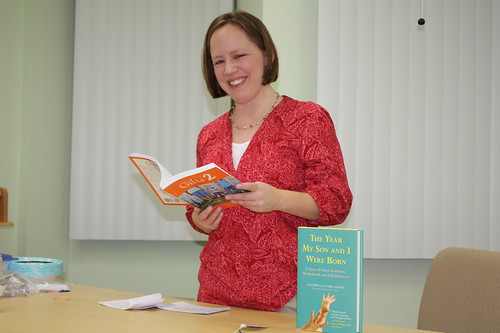
Kristin's cookbook contains recipes and information on Thai, Vietnamese, Chinese, and Japanese food, including sushi. While she was working on her cookbook, I enjoyed every dish she made for me to sample. If she started a catering business offering dishes out of her cookbook, I'd hire her all the time (at the "family rate/discount"). By the way, if anyone would like to buy a signed copy of her cookbook, please contact me for details.
The local newspaper published an article about the event and described Kristin's essay in Gifts 2 as:
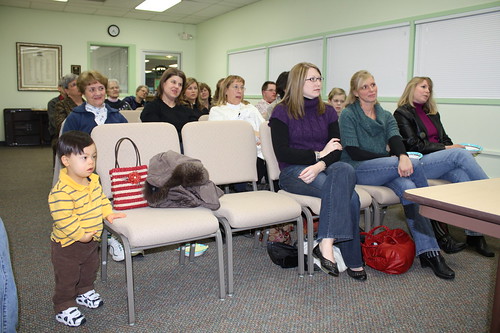
I counted 27 people in attendance, including Bill, Matthew and I. That's a great turn-out since the room seated a maximum of 27 people. Matthew was being a little shy but his presence certainly captured the audience's attention. He was undoubtedly the star (sorry, Auntie Kristin) and I was happy to share him with the audience.
Kristin's cookbook contains recipes and information on Thai, Vietnamese, Chinese, and Japanese food, including sushi. While she was working on her cookbook, I enjoyed every dish she made for me to sample. If she started a catering business offering dishes out of her cookbook, I'd hire her all the time (at the "family rate/discount"). By the way, if anyone would like to buy a signed copy of her cookbook, please contact me for details.
The local newspaper published an article about the event and described Kristin's essay in Gifts 2 as:
"...talks about her gratitude to previous generations of parents of children with Down syndrome who would no longer accept the societal norm of these children being swept away to institutions and disregarded. Thanks to them, her dear nephew, who brings his family so much joy, is part of a much more welcoming world, a world that is ready to love and accept him, and see his abilities instead of only disabilities."
I counted 27 people in attendance, including Bill, Matthew and I. That's a great turn-out since the room seated a maximum of 27 people. Matthew was being a little shy but his presence certainly captured the audience's attention. He was undoubtedly the star (sorry, Auntie Kristin) and I was happy to share him with the audience.
Sunday, December 20, 2009
Occupation: Stay-at-home Advocate Mom (SaHAM)
Sometimes our decisions in life take us to places for different reasons other than which we originally intended or planned. When I went to Australia for a masters degree in International Business, I envisioned pursuing a high-powered career in a large multinational corporation soon after I graduated. I never thought I would find love that would eventually lead to my current life as a Stay-at-home Advocate Mom. Looking back, it wasn't easy for me to let go of my corporate career dream BUT I'm happy with where I'm at now. Going to Australia was one of the best decisions I'd ever made in my life.
As a full-time SaHAM, I am responsible for meeting Matthew's daily needs, scheduling therapy sessions and doctor appointments, and housekeeping. I keep an eye out for social and learning opportunities for Matthew such as Kindermusik, preschool gym, tot time at the library, swim classes, and various playdates/ playgroups with other moms and toddlers.
My advocacy duties are centered on raising awareness about Down syndrome through various outlets such as the internet (my blog, emails, etc), print media (books, Christmas letters, etc), and speaking arrangements at schools when given the opportunity.
I will have more on my plate with baby #2 and as Matthew gets older. One of the additional responsibilities will include refereeing between siblings.
I am on call 24/7. Vacation days are limited and I can only take leave if I have someone else fill in.
The pay? Let's put it this way:
Money I could've made in a high-powered corporate career: $$$$$$$
Being a stay-at-home advocate mom: PRICELESS
Credit: I borrowed the term from another inspiring T21 blog that I recently started following called ever forward, Maya.
As a full-time SaHAM, I am responsible for meeting Matthew's daily needs, scheduling therapy sessions and doctor appointments, and housekeeping. I keep an eye out for social and learning opportunities for Matthew such as Kindermusik, preschool gym, tot time at the library, swim classes, and various playdates/ playgroups with other moms and toddlers.
My advocacy duties are centered on raising awareness about Down syndrome through various outlets such as the internet (my blog, emails, etc), print media (books, Christmas letters, etc), and speaking arrangements at schools when given the opportunity.
I will have more on my plate with baby #2 and as Matthew gets older. One of the additional responsibilities will include refereeing between siblings.
I am on call 24/7. Vacation days are limited and I can only take leave if I have someone else fill in.
The pay? Let's put it this way:
Money I could've made in a high-powered corporate career: $$$$$$$
Being a stay-at-home advocate mom: PRICELESS
Credit: I borrowed the term from another inspiring T21 blog that I recently started following called ever forward, Maya.
Sunday, September 6, 2009
Review of New Parent Information Packet
Almost two years ago, Matthew was born. After he was diagnosed with Down syndrome in the week following his birth, we received a New Parent packet from the Down Syndrome Association of Greater St. Louis (DSAGSL) while we were still in the hospital. I skimmed through a few pages in the packet. Nothing made sense to me. The only sentences that I understood were, "If you feel overwhelmed and don't want to read about Down syndrome today, don't. You can educate yourself when you're ready. There's time." Great advice! I put the packet away. It wasn't re-opened until after we received a similar packet from a new parent volunteer in my area a few weeks after we were home.
This coming Tuesday, I'm participating in a focus group at the DSAGSL to review the New Parent packet. What needs to be changed? Is there new and helpful information we should add?
What's in the New Parent Information Packet?
- A Baby First... Information about Down Syndrome published by the National Association for Down Syndrome (NADS).
- Nursing Your Baby with Down Syndrome - a 15-page booklet
- Healthcare Guidelines for Individuals with Down Syndrome - for pediatrician
- The Oral-Motor Myths of Down Syndrome by Sara Rosenfeld-Johnson, M.S., CCC/SLP
- Growth Charts for Girls and Boys with Down Syndrome (0-3 years and 2-18 years)
- Early Intervention - 1 page answering What is it? Why do we need it? How do we get it?
- A Promising Future Together: A guide for new and expectant parents. A booklet provided by the National Down Syndrome Society (NDSS). The Promising Future Together video is also available on the NDSS website.
- Telling Friends and Family Your Child Has Down Syndrome - 1 page of guidelines on writing the birth announcement.
- How Do I Talk About Down Syndrome? A Language Guide for Family, Friends, and Others.
- Parent Resource Guide. Compiled by the DSAGSL containing Missouri First Steps (Early Intervention) Office Listings, St. Louis Area Outreach/ Preschool Centers, Missouri Department of Mental Health Regional Centers, Internet Resource Guide.
Brochures:
- about the Down Syndrome Center at Children's Hospital, St. Louis.
- for new parents about the DSAGSL.
- about Down Syndrome published by the National Down Syndrome Congress.
Got any suggestions?
Off the top of my head, a few things I've thought to add are:
- a small grandparent's packet
- ideas of how to explain Down syndrome to siblings, particularly older ones.
- a list of inspirational books like Gifts or Roadmap to Holland.
What did you find helpful in the new parent packet that you received? What did you wish it had? If anyone has more ideas or suggestions they would like to share, please feel free to leave a comment. Thanks!
This coming Tuesday, I'm participating in a focus group at the DSAGSL to review the New Parent packet. What needs to be changed? Is there new and helpful information we should add?
What's in the New Parent Information Packet?
- A Baby First... Information about Down Syndrome published by the National Association for Down Syndrome (NADS).
- Nursing Your Baby with Down Syndrome - a 15-page booklet
- Healthcare Guidelines for Individuals with Down Syndrome - for pediatrician
- The Oral-Motor Myths of Down Syndrome by Sara Rosenfeld-Johnson, M.S., CCC/SLP
- Growth Charts for Girls and Boys with Down Syndrome (0-3 years and 2-18 years)
- Early Intervention - 1 page answering What is it? Why do we need it? How do we get it?
- A Promising Future Together: A guide for new and expectant parents. A booklet provided by the National Down Syndrome Society (NDSS). The Promising Future Together video is also available on the NDSS website.
- Telling Friends and Family Your Child Has Down Syndrome - 1 page of guidelines on writing the birth announcement.
- How Do I Talk About Down Syndrome? A Language Guide for Family, Friends, and Others.
- Parent Resource Guide. Compiled by the DSAGSL containing Missouri First Steps (Early Intervention) Office Listings, St. Louis Area Outreach/ Preschool Centers, Missouri Department of Mental Health Regional Centers, Internet Resource Guide.
Brochures:
- about the Down Syndrome Center at Children's Hospital, St. Louis.
- for new parents about the DSAGSL.
- about Down Syndrome published by the National Down Syndrome Congress.
Got any suggestions?
Off the top of my head, a few things I've thought to add are:
- a small grandparent's packet
- ideas of how to explain Down syndrome to siblings, particularly older ones.
- a list of inspirational books like Gifts or Roadmap to Holland.
What did you find helpful in the new parent packet that you received? What did you wish it had? If anyone has more ideas or suggestions they would like to share, please feel free to leave a comment. Thanks!
Saturday, August 29, 2009
What is Normal?
Past studies indicate that an estimated 90% of pregnant women choose to have an abortion when they receive a prenatal diagnosis of Down syndrome. How is it that the life an unborn child with Down syndrome is perceived as worthless?
A first-time mom in Boston, MA is around 12 weeks along in her pregnancy. I came across her on twitter a few days ago. I do not know her personally but I had to say something about her tweet that caught my attention. Here is a series of our unedited tweet exchange over the past few days.
She obviously meant to type "shouldn't have been born." Piercing. Hurtful. Cold. It made me sick to my stomach.
I walked over to Matthew, who was playing happily in his ball pool, picked him up and hugged him. He laid his head on my shoulder, happy about snuggling. I hugged him tight and swayed with him as I grit my teeth and fought back tears and the urge to wreak tweet havoc upon this first-time mom in Boston.
"Normal". Going back to her statement: I'm just not having a baby if its not going to b at least 'normal'. So it seems she views people with Down syndrome as not normal and shouldn't have been born at all. What is "normal"?
Prenatal tests cannot detect all forms of birth defects. If an unborn baby has an intellectual impairment, which is not detected in a prenatal test, is the baby not "normal"? Should this baby not be born?
If a baby is born without Down syndrome but develops problems because of prematurity, is the baby not "normal"? Should this baby not have been born?
If a baby is born without Down syndrome but is in an accident or contracts a debilitating illness, causing the baby to experience cognitive delays and/or physical problems, is the baby not "normal"? Should this baby not have been born?
If a baby is born physically healthy but is later on diagnosed with a pervasive developmental disorder (PDD), is the baby not "normal"? Should this baby not have been born?
Her comments make me angry. Matthew gets angry too when I feed him food that he doesn't like. Is that normal?
I can laugh off her ignorance and not allow her words to pierce my heart just as Matthew belly laughs in anticipation of getting tickled. Is that normal?
I choose to not let her comments prevent me from reasoning with other similar people, speaking out and advocating for Matthew and other individuals who have Down syndrome. I will go on just as Matthew continues to work on his shape sorter, trying to get the right shape into the right slot, and as he perseveres and continues to learn the other skills we are teaching him. Is that normal?
I will celebrate when I am heard just as Matthew claps his hands in delight when he successfully puts the triangle piece of his shape sorter into the triangle slot. Matthew's determination will propel him towards achieving his goals. Is that normal?
A first-time mom in Boston, MA is around 12 weeks along in her pregnancy. I came across her on twitter a few days ago. I do not know her personally but I had to say something about her tweet that caught my attention. Here is a series of our unedited tweet exchange over the past few days.
She said: i should mentioned that AFTER i heard the heartbeat yesterday, she asked if I wanted to test for down's syndrome. Sux if I have to terminate
I said: you don't "have to" terminate just because of the possibility of Down syndrome.
SHetherington said: You'll be missing out on a wonderful child & a wonderful experience.
pazam2u said: please read about how inaccurate the test is. Not reason enough to terminate. People with down syndrome are wonderful.
She said: I'm sure people w/ down syndrome r wonderful & all - I'm just not having a baby if its not going to b at least 'normal'
Shannon at Gabi's World said: you can't predict how your child will turn out wheter they were born with DS or not. Many kids with DS are perfectly 'normal'. please think about if your 'normal' child were to become delayed because of a near drowning at 3 yrs old would you kill it?
She said: there is a difference between environmental factors and biological. I can test for, & therefore prevent, biological issues.
I said: just fyi, there is a long waiting list of parents who would adopt a child with Down syndrome.
She said: too bad there isn't a waiting list of parents who want to adopt 'normal' children that are older & have been abused. THOSE are the ones that need help. Not the ones who shouldn't of been born
She obviously meant to type "shouldn't have been born." Piercing. Hurtful. Cold. It made me sick to my stomach.
I walked over to Matthew, who was playing happily in his ball pool, picked him up and hugged him. He laid his head on my shoulder, happy about snuggling. I hugged him tight and swayed with him as I grit my teeth and fought back tears and the urge to wreak tweet havoc upon this first-time mom in Boston.
"Normal". Going back to her statement: I'm just not having a baby if its not going to b at least 'normal'. So it seems she views people with Down syndrome as not normal and shouldn't have been born at all. What is "normal"?
Prenatal tests cannot detect all forms of birth defects. If an unborn baby has an intellectual impairment, which is not detected in a prenatal test, is the baby not "normal"? Should this baby not be born?
If a baby is born without Down syndrome but develops problems because of prematurity, is the baby not "normal"? Should this baby not have been born?
If a baby is born without Down syndrome but is in an accident or contracts a debilitating illness, causing the baby to experience cognitive delays and/or physical problems, is the baby not "normal"? Should this baby not have been born?
If a baby is born physically healthy but is later on diagnosed with a pervasive developmental disorder (PDD), is the baby not "normal"? Should this baby not have been born?
Her comments make me angry. Matthew gets angry too when I feed him food that he doesn't like. Is that normal?
I can laugh off her ignorance and not allow her words to pierce my heart just as Matthew belly laughs in anticipation of getting tickled. Is that normal?
I choose to not let her comments prevent me from reasoning with other similar people, speaking out and advocating for Matthew and other individuals who have Down syndrome. I will go on just as Matthew continues to work on his shape sorter, trying to get the right shape into the right slot, and as he perseveres and continues to learn the other skills we are teaching him. Is that normal?
I will celebrate when I am heard just as Matthew claps his hands in delight when he successfully puts the triangle piece of his shape sorter into the triangle slot. Matthew's determination will propel him towards achieving his goals. Is that normal?
Subscribe to:
Posts (Atom)